



 0
0

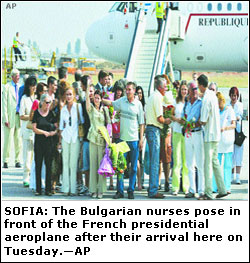 RABAT: Warmer political relations created by Libya’s freeing of six foreign medics will boost efforts by the OPEC member country to widen investment ties and modernise its mostly primitive economic management, experts say.
Still trying to dispel the effects of years of sanctions, the North African energy exporter wants friendlier foreign ties to bolster its quest for outside investment and expertise to help diversify an import-dependent economy built on oil and gas.
Tuesday’s releases should provide a welcoming political climate for that effort by ending what Libya’s critics have called a human rights scandal, diplomats and experts say.
The Bulgarian nurses, jailed in 1999 after hundreds of Libyan children tested positive for HIV, denied charges they infected the children and said they were tortured to confess.
Resolution of the case is seen as a major step in Libyan leader Muammar Gaddafi’s return to the international fold after his country earlier abandoned prohibited weapons programmes and agreed to pay damages for a 1988 airliner bombing over Scotland that killed 270 people.
“Libya has remained for 20 years under embargo and is sitting on a big mattress of money and there are big contracts to be activated,” said Antoine Sfeir, Paris-based expert on the Middle East and editor of Les Cahiers de L’orient.
“We must expect European countries, be they Italian, German, French or even American, to square up for new contracts in Libya and human rights will not weigh very much in the balance.”
“Mr Gaddafi has been for a while now a man who’s well worth knowing and for perfectly mercantile reasons.”
The European Union, whose member states are already among Libya’s main trade partners, said the Bulgarian medics’ release after eight years’ captivity opened the way for what it called a “new and enhanced relationship between the EU and Libya”.
A Libyan close to the negotiations for their medics’ release said the improved ties would include free trade. Bulgaria is a new EU member.
The EU is expected to try to forge a partnership agreement with Libya similar to so-called association agreements it has with other North African countries. These are accords under which economic, trade, and political ties improve as long as the partner countries execute reforms agreed in advance.
Libya “should now proceed to implementing much-needed reforms to the criminal justice system to ensure that nothing like this can ever happen again in Libya,” said Amnesty International’s Middle East and North Africa head Malcolm Smart.
DOLLARS: The nurses’ release is expected to help smooth Libya’s sometimes uneasy relations with the United States, whose companies are eyeing billions of dollars in deals to rebuild Libya’s crumbling infrastructure.
“This was a big obstacle to improved relations as it was one of the major things preventing the Americans from opening full diplomatic relations,” Maghreb expert George Joffe said.
“This gets rid of a very messy and nasty international problem for Gaddafi and that’s important if you are trying to persuade people you are the kind of person you can engage with.”
US-Libya Business Association director David Goldwyn said last year that US firms were interested in supplying information technology, telecoms, water, power and roads.
Arguably the West has already grabbed the top prize from Libya after it agreed to cooperate with Washington’s “war on terror” and re-opened its abundant oilfields to foreign players.
Without waiting for the blessing of human rights groups, leaders of France, Canada, Germany, Italy and Britain have visited Libya in recent years, jostling for position before an expected wave of lucrative deals.
Former British Prime Minister Tony Blair visited twice, most recently in May when UK supermajor BP signed a $900 million gas exploration deal.
COMMAND ECONOMY: But the professionalism of Libya’s oil and gas sector stands in stark contrast to a culture of red tape that blights other parts of the economy, diplomats say.
The country is seeking international participation in plans to modernise, simplify and liberalise a command economy long stifled by heavy-handed bureaucracy.
But western governments hoping Libya will one day serve as an example of how an Arab country can peacefully convert to representative democracy may be disappointed.
Gaddafi says Libya has no choice but to cooperate with the western economic system or risk disaster, but rejects calls to organise national elections, saying they are a fraud that upholds the dictatorship of the majority.—Reuters





























