0
0

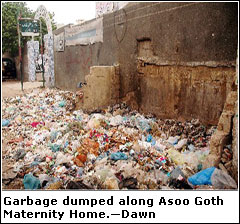 KARACHI, July 22: If an earthquake ever hit Karachi, the building of this maternity home will be the first to collapse. Its crumbling infrastructure makes us suffer the most during rains when the rooms overflow with water that enters from corridors and ceilings that profusely leak. In such difficult times, I and my colleague have to perform deliveries while standing in accumulated rainwater with the help of emergency lights that we buy at our own expense.
This is how Dr Shabana Rizwan describes the state of Asoo Goth Maternity Home, the oldest health service for would-be mothers and childcare in Malir Town. She was the first doctor to come here in 1983. Since then, she has been working here, only to be joined later by Dr Farzana Raees. Together they manage the 12-bed facility that has decayed and falling apart primarily due to the official neglect.
“The building is quite old. I don’t remember the exact year of its construction, but I know that before I was posted here it was opened for outpatients only. No major repair has been carried out yet and now it has become a risk to our lives. Due to leaking ceilings, all the fans got jammed once which had to be replaced,” says Dr Shabana.
Self-help basis
With almost no help from the government in maintenance of the building, the maternity home is being run on self-help basis. Recently, the staff contributed in buying a suction machine and medicines while sometime ago they pooled money to pay the charges for gas supply that remained suspended for a year owing to non-payment. Now they fear the power supply might be disconnected as huge bills had been pending against the maternity home.
Dr Farzana says, “We are fortunate that we have the assistance of some generous staff members who help us in the time of need, otherwise, we wouldn’t have been able to keep the maternity home running. Things were not that bad in the days of Karachi and zonal municipal administrations as we used to get urgent help whenever a complaint is lodged with them. Today, we don’t even get enough stocks of medicines.”
Staff shortage
Notwithstanding the unending list of complaints, a major problem that is directly affecting patients’ wellbeing is the acute shortage of staff. Both doctors leave the maternity home after completing their official five-hour duty. However, a staff nurse lives on the premises and manages the three shifts with the help of another nurse and a lady health visitor.
The doctors say, “We are worried who would stay at night in the absence of the lady health visitor, packing right away to leave on an emergency. This problem is common in all maternity homes and none of them provides a 24-hour comprehensive emergency obstetric care.” With the decades-old ban on appointments, this issue could only be resolved by activating the post of resident medical officer, they suggested.
Patients from other towns
Being the oldest in the town, the maternity home is popular for its service and women frequent the place from as far as Sherpao Colony, Orangi Town, Korangi and Cattle Colony Landhi for delivery and antenatal checkups. “All my children were delivered here and I have brought my sister today for registration. The doctors are experienced and we trust them,” says a woman visiting the health facility.
Nominal charges
Like rest of the maternity homes in the city, this maternity home also works without an operation theatre and diagnostic facilities. For every visit, a patient pays Rs5 as consultation fee and Rs190 in case of a delivery that includes bed charges, delivery and admission fee. Besides, the patient has to bear the expenses of the stuff used during the delivery, for instance, a drip and a bottle of antiseptic.
The doctors say that most of the visiting women come from low-income groups and suffer from anaemia and hypertension. Ninety per cent of them leave the place soon after the delivery against medical advice as they are required at home to attend to other children.
Ambulance taken away
The patients are also told that there is no ambulance facility. “We had an ambulance but that was taken away by some political party workers five years back. Since then, the number of deliveries has reduced from 100 to 60 per month,” they say.
Complicated cases
“We don’t take any risky cases. When pregnant women come for delivery registration, we ask them to get themselves registered at Jinnah hospital, too. During the antenatal checkups, we try to improve a woman’s health and reduce the chances of any complications, but if we foresee anything serious, the relatives are advised to take her to the hospital,” they say.
The doctors say that the relatives of patients are briefed well before the admission about the constraints of the maternity home though the nurses and staff are trained enough to handle normal deliveries independently.
Working at the same maternity home, an ayah reveals that there are occasions when nobody is around and she has to handle the delivery. She says she was a cook, but brought away how to handle the delivery cases after years of working with doctors and nurses. “We have never had a maternal death at the centre,” she proudly asserts.
With no accountability procedure in place, it’s hard to dispute her claim or accuse her of any wrongdoing. In societies where the government fails to deliver, it is people like her who are the only hope for the poor mothers.