0
0

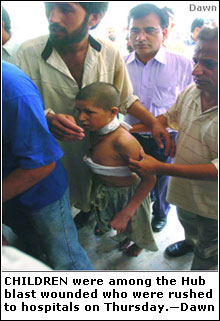 KARACHI, July 19: Up to 41 victims of Thursday’s blast in Hub -- an industrial estate of Balochistan -- were brought to the Civil Hospital Karachi (CHK) and the Jinnah Postgraduate Medical Centre (JPMC).
One victim was pronounced dead on arrival while six others breathed their last in the hospitals.
A senior doctor at the CHK said that 38 people with shrapnel wounds and deep, penetrative injuries were brought to the hospital. Doctors were unable to save the lives of three of these patients. “Our emergency and casualty departments started receiving injured people from 9.30am,” he informed Dawn. “Six of them are in a critical condition.” The victims rushed to the CHK range in age between 13 and 55 years. “Many of them were in shock to the extent that they could not recall the incident while others could only say that the blast had been in a vehicle at a bus stop,” remarked the doctor.
About a dozen of the injured people, all of them male, were discharged after basic medical treatment while 22 have been admitted into different CHK wards including Surgical-4, Neurosurgery and Orthopeadic Unit-I.
Dr Hamid Padhyar told Dawn that an emergency had already been in place at the CHK in view of the recent storms in Sindh and the post-Lal Masjid security situation. However, on-call units and stand-by units were put on high alert on Wednesday and things remained manageable on Thursday.
A person attending the telephone at the JPMC said that two of the three injured persons rushed to the hospital had died, while the third had been admitted in the Orthopaedic ward. The deceased are Naseebullah (20) and Attaullah (25).
Dr Karar Abbasi, the medico-legal officer at the CHK, told Dawn that he had registered the deaths of three persons at the hospital, while a fourth was received dead.
The deceased are Mohammad Hasan (22), Mohammad Akbar (35), Azad Khan (40) and Haji Khan s/o Johar Khan (received dead). “We have handed the remains of nine people to the Hub Police for DNA tests,” Dr Abbasi added.