Fighting terrorism
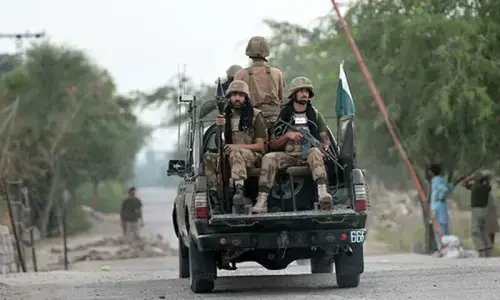
LET us accept it: the government has been unable to contain the backlash vowed by the Taliban as a revenge for the Lal Masjid crackdown. Not that the various deals struck with the recalcitrant elements had worked satisfactorily. There were attacks on the security forces here and there, besides bomb blasts at public places. Nevertheless, the understanding worked out by Governor Ali Jan Mohammad Orakzai in September last and earlier this year had to some extent a positive impact on the security situation. However, after the successful operation against the Lal Masjid militants, the Taliban and their supporters, egged on by Ayman al-Zawahiri, have unleashed a new wave of suicide attacks from Fata and the NWFP to the federal capital, and evidently Pakistan’s military establishment is unable to do anything about it. While the nation had still to recover from Tuesday’s carnage in Islamabad, 34 people, including 17 security personnel, were killed in fierce fighting in the Ghazlamai and Mir Ali areas on Wednesday. The way the militants attacked the security forces showed their meticulous planning. Operating on their home ground, they apparently did good preparatory work, triggered blasts in the mountains to block the security convoys’ movement and then opened fire. More blasts rocked the country on Thursday, the worst case being that in Hub which killed 28 people. Blasts also occurred in Hangu and Bajaur. Obviously, the government is faced with a new and determined attempt by lawless elements to make their power felt.
On Wednesday while talking to newspaper editors, President Pervez Musharraf said that the latest series of attacks had drawn the battle lines between the extremist and moderate forces. The challenge before his government, he said, was to stem the rising tide of Talibanism. The president also talked of a “unified command” and made it clear that he intended to seek re-election by the existing assemblies while retaining his uniform. The truth is that such phrases as “unified command” and “enlightened moderation” have no relationship with reality. The Taliban and their supporters have proved that they are quite capable of taking on modern armies. There is no dearth of the state-of-the-art weaponry with the US-led coalition forces in Afghanistan. They have been bombing the insurgents from ground and air, but the militants have shown extraordinary tenacity. In Pakistan, the sudden rise in the wake of the Lal Masjid operation has shown that the Taliban and their allies are well equipped, their supply lines remain unimpaired, and they have well-indoctrinated cadres willing to lay down their lives for a cause in which they believe, even if this cause achieves no purpose except that of spreading death and destruction.
One must also take note of voices, official and unofficial, from America that it should intervene militarily in the tribal belt. America’s enemy would be most delighted. Here are American troops bogged down in Iraq. They have been there since 2003 to no avail and have suffered, according to the Pentagon figures, over 50,000 casualties, with little gain to show for it. As for Iraqi civilian casualties, the death toll ranges between a minimum 200,00 to a maximum 600,000. In addition, millions are either homeless in their own country or have sought refuge in Syria and Jordan. And in Afghanistan their firepower has killed more civilians than the Taliban. So in their own interest, and in the interest of Pakistan’s battle with the Taliban, let the Americans better keep themselves out of it. Notwithstanding its infinite ability to commit blunder after blunder, Pakistan can succeed, provided the government carries the nation along. It is not a “unified command” that will pacify the area; what can deliver is the unity of approach, a national consensus on the issue, and the cooperation of the right-minded among the tribal leaders. Reliance solely on force is not going to wipe out terrorism.
New trade policy
THE trade policy 2007-08 announced on Wednesday projects the annual export earnings at $19.2 billion and promises to provide a better enabling environment to meet the target.. Though generally seen as a continuation of the existing policy reinforced by fine tuning , it is more focused on addressing the core issues of productivity, competition and export capacity. The added incentives and facilities provided in it are designed to tackle issues responsible for the plummeting of an average double-digit export growth witnessed over seven to eight years to a mere 3.6 per cent in the last fiscal year. Steps have been taken therefore to help improve marketing strategies, social compliance and skill development. The policy has drawn a mixed reaction from the export-oriented industry. Those disappointed by what that they consider to be inadequate incentives say that the annual export target would not be met. Others think that the 11 per cent growth is achievable. Conceding that the policy is export-oriented , the textile and spinning industry representatives lament the lack of incentives to them. The pessimists also see the going ahead tougher for exports because of the rising militancy in the wake of the Lal Masjid episode and the impact it is having on the options of foreign buyers.
Whatever may be the prevailing perception, the export target is not over ambitious, though the trade policy lacks a major thrust for energising the export sector. What is needed is that the government should implement the trade policy in right earnest and the export-oriented industries should make the best of it.
Though appropriate, the decision to employ foreign consultants to identify areas of internationally competitive advantage in agriculture, industry and the services sector and to recommend short-and long- term plans has come pretty late. The potential for export diversification is considerable as indicated by the three billion dollar services export in eleven months of the last fiscal year. The economy is heavily dependent on export on a single sector —cotton textiles — which contributes over 60 per cent of the export of merchandise. A stable high growth in exports — dominated by a single commodity — is not possible because of quick shifts in global exports. The labour cost varies according to the level of economic development and prosperity of a country or a major breakthrough in technological development. The need for increasing export of diversified products cannot, therefore, be over-emphasised. Exporters make very little effort to develop international brands so vital for raising overseas sales. An important initiative taken in trade policy this time is to set up an equity fund — through private and public sector partnership — which would be used to acquire overseas brand or brand-holding companies. It is an important decision the implementation of which should start immediately.
The government has not been paying much attention to the problems of small and medium-sized enterprises (SMEs) in boosting exports. The new scheme for SMEs for import of raw material, including fabrics, to be used as inputs in export goods has not been announced yet and has been left to the Federal Bureau of Revenue to take a decision. It is forgotten that the abundance of cheap labour offers exporters a competitive advantage in the international market. The trade policy has taken several measures to encourage exports, including the opening of business support offices in the US, EU and China and inland freight subsidy for the export of engineering goods. The export-oriented industries have been given the same incentives as are available to the export processing zones. But both the government and the export-oriented industries need to treat subsidies, raging from funding of research and development to cheap credit, as a temporary phenomenon. The objective should be to develop a globally competitive export-oriented industry and not a renter class.
Quality of uprightness
ISLAM is not just a religion in the traditional sense. It is not confined to acts of worship, morality and other aspects of personal piety. Its teachings, even though they do cover religious rituals and morality, also encompass all other aspects of life. Prophet Muhammad's (PBUH) mission encompassed not only spiritual and religious teachings. It also included guidance for such things as social reform, economics, politics, warfare and family life.
In worldly matters, truthfulness, uprightness and honesty in dealings of every kind, are stressed repeatedly in the Quran. Great damage is done to a society when dishonest practices such as cheating or misappropriation are rampant. Dishonesty breeds ill-will, and pollutes the atmosphere of a society. Truthfulness and fair play, on the other hand, promote harmony. Human beings must not be motivated by greed and selfishness and therefore must not distort information and deliberately misguide others. Unfortunately, the accumulation of worldly riches for one’s own benefit is a common practice, often leading the people to succumb to dishonest temptations.
The Quran says: "Know that in your wealth and your children are a temptation and that Allah is He with whom there is a mighty reward."(7:28)
The Prophet (PBUH) embodied honesty and integrity in his daily dealings. His titles were Sadiq and Ameen, necessary qualities whether one is testifying in a court, doing business, or even dealing with people socially. These principles of honesty were strictly adhered to by the Prophet’s successors as well. In their official correspondence, they advocated and insisted on honest conduct in administration and other areas of governmental activity. Anybody with a dishonest record was immediately reprimanded.
Prophet Mohammad (PBUH) has stressed the importance of honesty in most of his sermons, saying: "Remember, there is no faith in him who is not trustworthy; there is no place for him in religion who cares not for his pledged word or promise."
He also said: “The signs of a hypocrite are three: when he speaks, he is false, when he promises, he fails; and when he is trusted, he plays false."
Condemning those who cheat in business the Prophet has said:
"He who cheats is not of us. Deceitfulness and fraud are things that lead one to Hell." Allah describes truthfulness and honesty as qualities that make a human being successful in His sight, as follows. "The steadfast and the truthful, and the obedient, those who spend (and hoard not), those who pray for pardon in the watches of the night."(3: 17).
One must be honest even if one’s own interest is at stake, as is evidenced by the following verse: "And whoso committeth a delinquency or crime, then throweth (the blame) thereof upon the innocent, hath burdened himself with falsehood and a flagrant crime."(4:112). "O ye who believe! Be ye staunch in justice, witnesses for Allah, even though it be against yourselves or (your) parents or (your) kindred, whether (the case be of) a rich man or a poor man, for Allah is nearer unto both ( than ye are). So follow not passion lest ye lapse (from truth) and if ye lapse or fall away, then lo! Allah is ever informed of what ye do"(4:135).
The above mentioned verse also suggests equality for all human beings under the law, in spite of their economic status. The law is to be regarded as the same for rich and poor. Similar ideals are to be practiced in business dealings, as the following verses suggest.
"O my people! Give full measure and full weight in justice, and wrong not people in respect of their goods. And do no evil in the earth, causing corruption."(11:83).
“And weigh with the true balance."
"Wrong not mankind in their goods, and do no evil, making mischief, in the earth."(26: 182-183).
Allah deprecates deceit and falsehood in the following verse: "That (is the command). And whoso magnified the sacred things of Allah, it will be well for him in the sight of his Lord. The cattle are lawful unto you save that which hath been told you. So shun the filth of idols, and shun lying speech."(22: 30).
Allah forbids all unclean and corrupt means of making money, such as, dishonest trading, gambling, and bribery. And the Holy Qur’an has explained and described such practices in many of its verses. In this verse, for instance, Allah warns those traders who cheat in weighing. He says: "Woe to those that deal in fraud, - those who, when they have to receive by measure from men, exact full measure, but when they have to give by measure or weight to men, give less than due. Do they not think that they will be called to account – on a Mighty Day when (all) mankind will stand before the Lord of the Worlds." (133: 1-6)
Once Prophet Mohammad came upon a heap of corn in the market of Medina and thrust his hand onto it. His fingers felt damp. On being asked, the trader replied that rain had fallen upon it. The Prophet observed, "why did you not then keep (the wet portion of) it above the dry corn, so that men may see it? He, who deceives, is not one of us."
Thus traders who deceive by showing to customers a false sample or by concealing from them the defects of the product are not true Muslims in the judgment of Allah’s Prophet and, they are going to end up in hell.
Another example: Prophet Mohammad said: "The seller must explain to the buyer the defects, if any, in the quality of the article offered for sale. Should this not be done, the seller will permanently be caught in the Wrath of Allah (according to another narrator the exact words, ‘he will always be cursed by the angels')."
And finally Allah condemns the actions of dishonest people in the following verses:
"Woe unto the defrauders." "Those who when they take the measure from mankind demand it full." "But if they measure unto them or weigh for them, they cause them loss."(83:1,2,3).
In short, all manner of deceit and dishonesty are prohibited in Islam. It has been proclaimed to be an act worthy of unqualified condemnation. The Holy Prophet has expressed his strong dislike for those who do so. He has said he will have nothing to do with them; they do not belong to him.
Thus honesty and truthfulness demand that a person should act unselfishly. In order for honesty to be effective it has to be genuine, and not a mere act of expediency resulting from fear or injury. Honesty and truthfulness must also be a habit of mind, rather than something practised as a result of a need. The Prophet once said, "No man can attain a firm faith, unless he develops strength of character, and that cannot be achieved unless one acquires the habit of speaking the truth."
Justice at Guantanamo
THE SENSE of deja vu is overwhelming. Once again, lawmakers are promising to introduce legislation allowing prisoners at Guantanamo Bay to challenge their detentions. Once again, congressional Republicans are vowing to defeat it, as they have before. The deja vu should stop here.
By denying hundreds of detainees the most basic of legal rights, that of challenging their detention, the Bush administration has continued to damage the country's image and moral authority abroad. No government should be allowed to hold people indefinitely without affording them a chance to challenge that detention.
Senate Judiciary Committee Chairman Patrick J. Leahy, ranking minority member Arlen Specter and others planned to introduce the Habeas Corpus Restoration Act of 2007 this week to recognise such due-process rights for detainees. The Senate debate over the Iraq war may force a postponement, but it should be a short one.
The measure would modify a law passed by the GOP-controlled Congress on the eve of the 2006 midterm elections curtailing legal challenges to detention and would hold that the long-established principle of habeas corpus applies to detainees at Guantanamo.
This would allow them access to federal courts to appeal their indefinite detention without charge as "enemy combatants." Such suits, filed before the 2006 law went into effect, had forced the administration to make substantial -- if insufficient -- improvements in procedures for holding, interrogating and trying detainees.
Lawmakers should resist the temptation to punt the matter to the Supreme Court for a decision. The court late last month agreed to hear a challenge to the administration's detainee policy; if lawmakers adopt the Leahy-Specter provision, the Supreme Court case is likely to become moot. Neither side in this debate can be certain how the court will rule, and too many detainees have already been held for too long with too little process for Congress to sit idly by.
The reforms should not stop there. The administration should begin the process of shutting down the Guantanamo prison, as Secretary of State Condoleezza Rice and Defense Secretary Robert M. Gates have urged. Sen. Dianne Feinstein last week introduced such legislation, although we believe it would be better for the president to take the initiative.
The president should ask for Congress's authorisation to hold a small number of foreign-born detainees as enemy combatants.
––The Washington Post
| © DAWN Group of Newspapers, 2007 |