0
0

ISLAMABAD, July 18: The government on Wednesday unveiled the trade policy for the current fiscal year, projecting an ambitious 11 per cent growth in exports to $19.2 billion as against last year’s export proceeds of $17.3 billion.
For the first time in the country’s history, no projection was announced for the import bill and, therefore, there will be no target for trade deficit.
When seen in the context of last year’s export target of $18.6 billion, this year’s target is higher by 3.2 per cent.
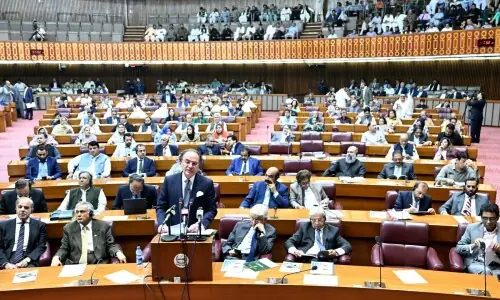
The trade policy announced by Commerce Minister Humayun Akhtar Khan offers incentives for enhancing competitiveness, productivity and export capacity. The major initiative is to focus on financing quality certifications, seeking preferential market access, extension in scope for long-term financing, a new scheme — export-oriented units — establishment of women entrepreneur cities and facilities to increase jewellery exports.
International consultants will be engaged to identify industrial, agricultural and service sectors where Pakistan may have or create some competitive advantage internationally, prepare short-, medium- and long-term plans for these sectors.
Inland freight subsidy will be allowed for the transportation of engineering goods destined for exports. The scope of the long-term, fixed rate, export projects financing scheme has been enlarged to cover export-oriented, core and developmental sectors; purchase of locally-manufactured machinery and compact spinning.
The export-oriented units will offer the same incentives as are available to units in the EPZs. The existing units exporting at least 80 per cent of their production will be eligible for registration (with Federal Board of Revenue) under the scheme and new units, so registered, will be required to export 100 per cent of their production.
An equity fund will be set up through pooling resources of the private and public sector organisations. The fund will be utilised for the acquisition of overseas brands and/or brand holding companies. It can also be used to encourage setting up of sanitary and phyto-sanitary facilities and testing laboratories.
In both cases, the fund will divest within five years from the date of investment by offloading to Pakistani sponsors.
To encourage new investments particularly in hi-tech and core and developmental products, the government has decided to allow first year allowance (FYA) on investment in plant machinery and equipment (PME), to be set off against statutory income in the year of assessment.
The government has decided to restructure the PEFGA to include insurance of the exporters’ credit risk. A social, environmental & security, compliance board will be set up in the Trade Development Authority of Pakistan (TDAP) to educate, coordinate and monitor implementation of local laws relating to these standards with all relevant government agencies in Pakistan and to interact with the buyers abroad.
It has been decided that the level of subsidy will be increased to 100 per cent for ISO 9000, ISO 14000, OHSAS 18001, SA 8000, WRAP, EKOTEX, BSCI and BRC in the following manner: one certification 50 per cent; two certifications 66 per cent; three certifications 82 per cent and four or more certifications 100 per cent.
The government will provide 50 per cent subsidy on rentals and salaries for three employees for three years, with a suitable cap for only socially and environmentally compliant and ISO certified exporters to set up business offices in their principal export markets. It has been decided to provide 50 per cent cost-sharing in their media promotion plan and 50 per cent cost of shelf space for branded products in leading retail outlets.
The government also increased cost-sharing of rentals to four years from three years to the branded exporters for opening their outlets at the rate of 75 per cent, 50 per cent, 25 per cent and 10 per cent per year.
There is a need to set up Overseas Business Support Units to enhance market shares abroad.
It has been decided to set up three overseas business support units in the US, the EU and China in first phase and in Africa, Asean and East Europe in the second phase.
The government will establish online presence (web portal of exporters) and undertake internet marketing for web portal. The TDAP will hire an IT firm to assist the exporters in web development and train in internet marketing.
In order to promote the export of branded rice and food products to the UK, the government will offer 50 per cent cost of the British Retail Consortium (BRC) certification to those exporters who have already established their brand.
In order to facilitate SME exporters, the FBR will announce a new scheme for temporary importation of raw materials, including fabrics, to be used as inputs for export products. It has been decided that zero-rating of sales tax or duty-drawbacks as well as federal excise duty refund against goods exported to Isaf and Defence Logistics Agency will be allowed on production of receipt issued by the Afghan customs authorities, endorsed by representatives of these agencies based in Pakistan confirming that they have received the goods.
The import of those tools and equipment will be allowed which are either not available in Pakistan or are substandard to improve quality of gold, gemstone products. The value-addition requirement for export of gold jewellery manufactured from imported gold has been enhanced.
In order to develop export quality slaughterhouses, it has been decided that financial assistance will be provided to investors initially from the Export Development Fund (EDF).
Women entrepreneur cities will be established in Karachi and Lahore where infrastructure such as industrial plots, common facility centers, business centers, technical workshops childcare centers and training centers will be provided.
In order to further exploit export potential of the pharmaceutical sector, it has been decided to provide 50 per cent cost of audit/accreditations by international health regulatory bodies and 50 percent cost of bio-equivalence and similar testing in WHO-accredited labs.
It has been decided that only those construction companies which are registered with the Pakistan Engineering Council can import secondhand PME. It has been decided that import of up to four-year-old prime movers of 380 horsepower and above EURO-III compliant are allowed to registered transport companies/established fleet operators (owning and operating at least 25 prime movers in their name) for the fiscal year 2007-08.
At present the import of permissible products for display in exhibitions and fairs officially organised by the government or the FPCCI are allowed on the import-cum-export basis. The facility will also be extended to all Pakistan-based associations and individual companies subject to endorsement of the TDAP.
To help physically disabled persons, the government has decided to allow import of motorised wheelchairs whether new or used as donations and gifts to the charitable institutions and hospitals. The government has allowed import of equipment and materials by mountaineering expeditions on import-cum-export basis without having recourse to the ministry of commerce.
In order to further facilitate the overseas Pakistani, it has been decided that the authority to grant exemption from sales tax registration will be delegated to the collector of customs concerned in releasing of goods.