0
0

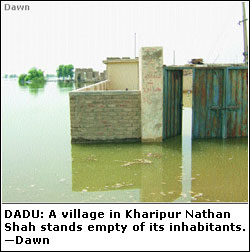 DADU: The government has to make speedy arrangements for distributing foodgrain and other essential commodities among the flood-affected people in Dadu district. Otherwise, the locals fear, more areas would become inaccessible with the passage of time, leading to a greater humanitarian disaster. The little that is being done right now is not going to be of much help to the many who need it.
A tour of several flood-hit districts in Sindh awakened this writer to the misery and uncertainties afflicting the flood-hit.
Food and tents are urgently needed in the flood-hit Khairpur Nathan Shah and Mehar talukas in Dadu district. With floodwater rising sharply and inundating many villages each day, the number of people left homeless and displaced is also going up in hundreds.
After heavy rains on Sunday evening, Ali Murad village near Ghozo union council in Khairpur Nathan Shah became inundated completely, making the villagers flee for their lives in the middle of the night. With little beyond the clothes on their back they are sitting under the open sky on the bund at Abdullah Khan Khoso village.
At a mobile medical camp setup by Thardeep Rural Development Programme, they were able to get treatment and medicines the next day. A number of mobile medical teams of various aid agencies and zila nazims were seen providing free consultation and medicines in the flood-affected area.
Fever, skin disease, ear ache and diarrhoea are rampant in these flood-hit areas of these two talukas, as is the case with all areas of Sindh where floodwater levels are constantly on the rise. Both children and adults spend a lot of time bathing in the dirty water and drinking it due to which health problems seem to have hit every household. But safe drinking water is hard to find, leaving these people with no options but to drink the water that has deprived them of a home.
Momal, who is at the medical camp with her one-year old daughter, tells her sad tale: “Last night the water came so fast that we had to run from our village and now we have nothing with us.” She finds medicines for her daughter, the youngest of three, who has high fever and stomach problem but there seems to be no food for them to eat. “We have not eaten anything all day and have to drink this dirty water. They tell us not to drink it but what can we do?”
From what was seen in these two talukas, rescue seems to be the main focus of both the army and different aid organisations. There were a number of camps of the army, local councils and aid organisations, with an army helicopter hovering over Gozo in K.N. Shah, but the only material and food aid observed being given to these victims were by the workers of a political party (MQM).
With many roads having been swept away and communication cut from many villages, the price of commodities, particularly food items are shooting up.
“The shopkeepers who earlier gave us things on credit have stopped doing so and when some other villager feels pity he shares his food with us. Otherwise we go hungry,” says an old and distressed man on the roadside near Faridabad. “We have not received anything. They say aid has been distributed but I have not seen anyone receive anything. They only give things to their own people,” he adds.
When asked who ‘their own people’ are, he replies, “Well, you know, those who are their voters.”
And aid worker, wishing to remain anonymous, observed, “The other day a politician came in a convoy of 10 to 12 cars and there was lots of fanfare and photographs.
As he was leaving, he called a woman from a group of victims standing nearby and handed her a bag of about two or three kilos of wheat flour. This led to a scramble. It is really so pathetic that the visits are used as publicity stunts and they don't even bother to bring some relief goods on these visits.”