



 0
0

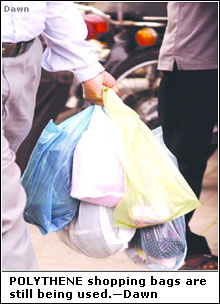 KARACHI, July 16: The government’s much-publicised campaign to phase out polythene bags, which pose a constant threat to the city’s environment and civic infrastructure, appears likely to come to a quiet end because of the authorities’ poor homework.
Market surveys conducted by Dawn showed that the restricted bags – those under 30 microns of thickness – have resurfaced after a brief gap. From milk-sellers to sidewalk vendors, supermarkets and grocery stores to fast-food shops and vendors of ready-to-eat food, all are packing their wares in the very “shoppers” the government is trying to clamp down upon.
In doing so, citizens’ health is compromised since polythene bags are made of thermoplastic resin which may add harmful substances to consumables. Experts say that ready-to-eat food should not be carried in low-quality polythene bags, including the recently-marketed red, pink and green ones that have replaced the black bags.
The scale of the issue can be gauged from the estimate that Karachi uses 30 per cent of the country’s total import of polyethylene (a plastic polymer of ethylene) and plastic, which together account for 10 to 15 per cent of the city’s municipal waste.
They are everywhere
Unfortunately, like thousands of urbanites across the globe, Karachiites find the thin, high-density polythene bags convenient and inexpensive means of transporting both solids and liquids. These non-biodegradable bags ought to end up in landfill sites or incinerators but are most often found littering the sea and the landscape, flying in the wind and defacing vegetation, to say nothing of the piles along various roads. Leaving aside the sheer ugliness of the plastic bags, they also act as carriers of dust, dirt and bacteria, get stuck in overhead wiring and clog sewerage lines, thus damaging the city’s infrastructure.
After years of appeals by citizens and environmentalists, the government of Sindh moved against the offending bags in 2006 by introducing an ordinance which later became the Sindh Prohibition of Manufacturing, Sale and Use of Polythene Bags Act-2006. This prohibited the manufacture, sale and use of black polythene bags, including any bags under 30 microns’ thickness, and set the punishment at a three-month prison term, a fine of Rs50,000, or both.
On March 15, 2007, the Sindh environmental department and the City District Government Karachi (CDGK) started cracking down on the manufacturers and vendors of polythene bags in the banned category. Given that the provincial environmental department was unable to frame rules in line with the Act and also lacked the magisterial power required for the purpose, the ban was enforced through Section 144 of the Criminal Procedure Code (CrPC) and on two different occasions, City Nazim Syed Mustafa Kamal ordered a ban on the manufacture of such bags for 30 days.
However, under the provisions of the law, the city government may not invoke Section 144 of the CrPc for the third consecutive time on the same subject, claimed a source.
No ban in force
An additional executive district officer (EDO) of the CDGK, Matanat Ali Khan, told Dawn on Monday that there is currently no imposition of Section 144 of the CrPc against polythene bags thinner than 30 microns.
Earlier, as many as 36 mukhtiarkar and deputy district officers (revenue), supported by officials of the Sindh Environment Protection Agency (Sepa) and backed up by the police, took action against the banned bags until mid-May.
“We seized about 1,115 kilogrammes of the prohibited polythene bags from various places in the city,” said a source, adding that “106 persons, including those from large shoe stores, food and nihari vendors, medical stores, dry cleaners’ shops, bookstores and milk and meat sellers, were booked for violating the Act.”
According to a source in Sepa, the mechanism of dealing with offenders, including users, was not aimed at causing panic. Therefore, as an initial measure, the action was restricted to confiscating the banned products from vendors and small shopkeepers and lodging cases against the big parties.
What alternatives are being offered?
The Sindh Minister for Environment, Dr Sagheer Ahmed, told Dawn that the anti-polythene bag drive stretched over two months with the objective of checking environmental degradation caused.
“In order to make the campaign more purposeful, Sepa also framed some rules in line with the Act but these could not be enforced because at a high-level meeting during the last campaign, it was felt that the thickness of the banned bags should be increased to 100 microns,” said Dr Ahmed.
“The government is being urged to consider this and if the plea is approved, some amendments will have to be made to the Sindh Prohibition of Manufacturing, Sale and Use of Polythene Bags Act-2006.”
The minister pointed out that a well thought-out plan accommodating the bags’ producers and educating citizens would also be required, and added that a decrease in the use of polythene bags under 30 microns’ thickness has already been observed and the environment staff has been asked to continue surprise raids.
Stakeholders in the polythene business argue that reductions in the manufacture and sale of the prohibited bags should be ensured by identifying suitable substitutes. However, environmentalists and conservationists believe that the government must first recognise the bags as a hazard and then immediately implement relevant laws to bring the public and the manufacturers in line with official policy.
However, they emphasise the need for the government to have the courage to completely curtail the manufacture and use of these bags in Karachi and other parts of the province. This, they argue, will pave the way for environmentally friendly bags. Experts add that unlike other municipal waste, polythene bags must not be burned since this creates harmful gases, and such bags should not be made of recycled materials.
“Only when these polythene bags are completely gone can the production of alternative materials be encouraged and ensured,” commented one such activist.
“Environmental concerns caused by these non-biodegradable bags, such as the blockage of drains, safety hazards, soil degradation and litter cannot be overlooked.”
According to a senior scientist, the issue is simply a matter of bringing to rational levels the amount of polythene in our lives, and handling polythene products safely.




























