Widening trade deficit
THE trade deficit has hit a new record, peaking at $13.54 billion in 2006-07, much in excess of the government’s estimate of $9.4 billion. The annual target for both exports and imports have been missed by a wide margin. This calls for a review of the foreign trade policy which, evidently, has not served as a catalyst for export-oriented industrialisation, nor has it encouraged substitution of imports by indigenous production. Exports increased by a mere 3.5 per cent to reach $17.3 billion and imports have surged by 8.1 per cent to an all-time high of $30.86 billion. If the trend continues, imports will soon be twice as high as exports.
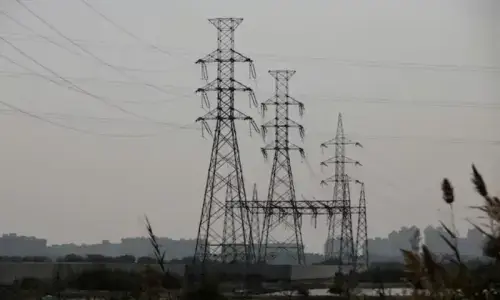
The blame game between manufacturers and the government on such issues as cost of production and industrial efficiency indicates a failure on both sides to meet global challenges — issues of quality, price and value-addition as well as diversification of markets and the production base — in any meaningful way. Traditional industries like textiles, exposed to international markets for decades, are unable to compete successfully with India when that country’s rupee has appreciated to 40.5 from 46.1 per dollar over a year ending July 4 and the Pakistani rupee has remained almost stable at 60.4 against 60.3. Similarly, the Chinese currency is stronger at 7.59, up from eight yuan to a dollar. In this period, textile exports have increased by a paltry six per cent. While the textile industry has been generally modernised, it suffers from a shortage of trade skills required for quality production and value-addition and needs to launch its own crash programme to upgrade the skills of its managers and workers. Nothing counts more than the quality of manpower. The absence of a corporate culture and modern management and marketing practices is a handicap when it comes to competing in the international market. It may, however, be conceded that the rising cost of utilities like water and power, also in short supply, forces many units to make their own arrangements which add to the cost of production. The government needs to tackle the power crisis on a priority basis. As export growth has declined, imports have surged on the back of domestic demand for oil, cars, electronic goods, foodstuff, mobile phones, etc. Consumer credit, though declining now, has helped fuel this demand. At the same time, little attention has been paid to import substitution in areas where the country enjoys domestic advantages. Even the unspecified imports are said to have crossed the two-billion-dollar mark in the last fiscal year.
The worsening trade deficit is being met through financial and capital inflows, most of it unsustainable in the long term. Last year, much of the foreign investment went into takeovers of local banks, telecom and cigarette companies or into the speculative shares business rather than creating new export-oriented production capacity. Direct foreign investment is pushing up remittances of profits and dividends, up from $504 million for fiscal year 2006 to $760 million in 11 months of the last fiscal year. Privatisation proceeds, meanwhile, are drying up. Current external capital inflows, more or less equal to export earnings, are helping create a small external-sector surplus. But the financial sector is being put under the discipline of a volatile global financial market and carries great risk. There is no alternative to developing export-oriented commodity-producing sectors, and this is where the government and industry need to focus on an urgent basis.
The view from the West
CONSIDERED advice from foreign quarters need not be dismissed as interference in the country’s internal affairs. There are solid reasons why the world is interested in Pakistan and its role at any given time in the comity of nations. First there is the country’s geopolitical worth, determined not by physical size but location. This was important in the Cold War era from a strategic perspective but is of equal significance in an age dominated by the exigencies of free trade. Much of the oil heading east from the Gulf, for instance, must pass through or near Pakistani waters. Then there is the question of the country’s nuclear assets and who may come to control them in the worst-case scenario. It needs to be examined why Pakistan is seen as a hotbed of Islamist militancy — an ally in the war on terror as well as a breeding ground for terrorists. The country’s image, which is something of an obsession with the current administration, is not entirely divorced from reality. What was sown in the late seventies and the eighties with the all-out support of the West is being reaped today, leading to instability within the country and, possibly, the region as a whole. Little wonder then that all major countries, friendly or wary, take an active interest in where Pakistan is headed.
Opinion in the US has shown a marked shift in recent weeks. Editorials in American newspapers and reports by leading think tanks are advocating a total reassessment of Washington’s relationship with the Musharraf government, as is the US Congress. Calls for free and fair elections are getting louder by the day along with demands that the president should relinquish his uniform and seek re-election by new assemblies. Doubts are also being expressed about the validity of the impression that extremists would govern Pakistan if it weren’t for President Musharraf. On the contrary, it is being argued that the absence of genuine democracy has created a political vacuum that is encouraging extremism. In an unusual move, the European Parliament is now echoing most of these views. They may be uninvited but are certainly not without merit.
Another zoo tiger dies
IT is tragic that a Bengal tiger that was brought to the Lahore zoo from the Safari Park for breeding purposes died on Friday, presumably from a fatal parasitic disease. The tiger is the fifth to have died in the last year and a half, which makes it imperative for the authorities to take urgent remedial measures. If the post-mortem reveals that the latest death was also caused by the parasitic disease responsible for the other deaths, steps must immediately be taken to safeguard the remaining tigers. The zoo management must also ensure that its entire premises are well maintained and all animals properly looked after — something that seems to be lacking in all zoos in Pakistan. In April this year, two stray dogs managed to get into the Lahore zoo and killed 28 peacocks in a cage. This shows just how neglected the animals are and how apathetic the zoo authorities have become. In July last year we wrote that there was just one vet at the Lahore zoo to deal with the 1,200 animals there — which perhaps explained why 16 animals had died a few months earlier. Sadly, not much has changed since. Despite efforts, the assistant vet at the zoo was unable to save the Bengal tiger. Could it be because detection came too late?
While the authorities may be finding it difficult to find a qualified vet for the Lahore zoo, as government pay scales are poor, an interim solution must be found. If it requires paying a vet a higher fee until a permanent solution is found, so be it. Vets in Lahore too would do well to step in on humanitarian grounds and come to the aid of the zoo and offer their services. Earlier this year, it was announced that a laboratory would be set up soon. This must be expedited before more animals die.
Growth at the expense of agriculture
THE GDP of a nation consists of the agriculture, industry and services sectors. Each sector has unique characteristics with differential impact on employment, regional distribution of income and poverty reduction.
Growth in the services sector primarily benefits the urban population, whereas growth in agriculture has a direct impact on rural poverty and the welfare of 60 per cent of the population living in the rural areas. Growth in industry also benefits the population in urban areas as almost all industrial units are located therein.
GDP distribution among the three sectors varies from country to country but in developed economies like those of Germany, the US and Britain, agriculture accounts for only one per cent of the GDP, services about three-fourths and industry approximately a quarter. China is unique in having an industrial sector that contributes 46 per cent to GDP and a services sector contributing only 41 per cent.
In India and Pakistan, the services sector is 54 per cent and the industrial sector around 27 per cent. The high weight of the services sector enables national income accountants in both countries to inflate the GDP growth figure as services can easily be overestimated. The Economist, while comparing the GDP growth of India and China, found that India has overestimated the contribution of its services.
In India and Pakistan, agricultural growth has been on the lower side. During the last three years, agriculture in India has grown by 2.3 per cent whereas industry has grown by 10.7 per cent and services have grown by 11.6 per cent. In Pakistan, the agricultural growth rate averaged 2.5 per cent per annum during the last seven years.
A World Bank study states that “in India, agricultural growth is decelerating from 3.2 per cent in 1980-92 to 2.4 per cent in 1992-2003 and to 1.3 per cent in recent years. Agricultural productivity remains very low in Pakistan, with serious limitations on access to land, irrigation fertile soil, and credit.” Another World Bank study on Pakistan’s rural growth states “the longer term agricultural GDP per capita growth rate (1999-2000 to 2004-05) was only 0.3 per cent annually.”
On India, a World Bank study states “farmer distress in parts of India is leading to farmer suicides, which in Maharashtra have risen from 15 persons per 100,000 farmers in 1995 to 57 persons in 2004.” Farmers’ suicides stemming from poverty have not yet been reported in Pakistan. However, even according to official figures, the rural poverty rate of 28 per cent is almost double that of the 15 per cent urban poverty headcount.
The low growth rate in agriculture, which provides 45 per cent of overall employment, stems from a raft of bad policy measures like GST on fertiliser and pesticides, increasing the support price of wheat by one-third in two years, ineffective agricultural education and research, and inadequate agricultural credit. It is shocking that the per capita growth in agricultural output has only been 0.3 per cent per annum. It needs to be lifted to about two per cent if agricultural growth is to be meaningful for the rural population.
The government has this year announced subsidy for electricity used in tube wells as well as subsidy for phosphatic fertiliser. These steps should have been taken much earlier.
The government has estimated that agricultural growth in 2007 would be five per cent based on a 10 per cent increase in wheat crop and a cotton crop of 13 million bales. These are overestimates. The price of wheat started climbing up after the harvest and has increased by more than 10 per cent. The prices of atta and naan have increased correspondingly.
Consumers are bewildered as to why the price of wheat, atta and naan have increased when there has been a bumper crop with a 10 per cent increase in output and a ban on exports. The price behaviour does not tally with estimates of a bumper wheat crop.
Similarly, as regards cotton, the ginning mills have processed only 12.5 million bales whereas the government estimates 13 million bales. India has achieved a breakthrough in cotton on the lines of the “green revolution” in wheat in the 1960s by using GM seeds which has led to 20 per cent increase in output.
Pakistan’s cotton output has hovered around 10-13 million bales for the last eight years. Our agricultural experts and researchers have failed to introduce GM cotton which could have led to a cotton crop of about 20 million bales. It is ironical that we are importing three million bales mostly from India because of technological failure. In fiscal year 2005, when we had 14.2 million bales, the GDP touched nine per cent growth. If we have 20 million bales of cotton, our GDP could exceed nine per cent to be at par with India’s GDP growth rate of 9.3 per cent.
In short, our agricultural growth has been very tardy exacerbating rural poverty, depressing GDP growth and leading to spiralling food inflation. In fiscal year 2007, the agricultural growth rate of five per cent does not tally with food inflation of more than 10 per cent. Normally, increase in agricultural output should have resulted in a lower rate of food inflation.
The industrial sector consists of mining, manufacturing, construction and electricity and gas distribution. The most buoyant component of this sector is construction which has been correctly estimated to increase by 17.2 per cent as the domestic consumption of cement has spurted by 20 per cent.
Construction has strong forward and backward linkages and the buoyancy of this sector is evident across the country in the shape of new housing, roads and mega public sector projects. Otherwise, manufacturing growth was only 8.4 per cent against the target of 12 per cent.
It is surprising rather alarming that the contribution of the electricity and gas sector has decreased by more than 15 per cent. There was no increase in gas consumption in fiscal year 2007 while electricity consumption grew by only five per cent. The higher negative value added of more than 15 per cent in these two sectors stems from gross inefficiency and mismanagement.
The services sector consists of transport and communication, wholesale and retail trade, finance and insurance, public administration and social services. The most buoyant component of this sector is finance and insurance which grew by 18.2 per cent. The rate of increase in other sectors varied from six to seven per cent.
The most buoyant sectors of Pakistan’s economy are construction, finance and automobiles (cars, motorcycles and tractors). The seven per cent GDP growth rate depicts a growing but lopsided economy in which the majority of the population living in the rural areas has hardly benefited. In urban areas, too, inequality in income has increased. The GDP growth of seven per cent would have been far more meaningful if CPI growth was in the region of five per cent rather than around eight per cent and food inflation was also not in double digits.
China, despite having a very heavy industrial weight (46 per cent as compared to about 27 per cent in India and Pakistan), has been enjoying a growth rate of more than 10 per cent for more than two decades because all sectors — agriculture, industry and services — are growing at almost the same rate. In India and Pakistan, low growth in agriculture is dragging down the overall GDP growth and preventing the alleviation of grinding rural poverty prevalent in both countries.
The writer is former federal secretary of planning.
Rough justice
THIS week, China executed its former top food and drug regulator, Zheng Xiaoyu, who had been convicted of accepting more than $800,000 in bribes in exchange for helping pharmaceutical companies sidestep regulatory hurdles. The country also sentenced to death another former food and drug regulator accused of being on the take.
Outrage at the officials' misconduct is understandable, as is the desire to send a strong message to Chinese citizens and trading partners alike that corruption and lax oversight will no longer be tolerated. At least 10 people died and dozens more became seriously ill in China after consuming a tainted antibiotic produced by a company that reportedly had bribed Mr. Zheng. Hundreds died in Panama after taking cough syrup that contained an ingredient Chinese manufacturers labeled as innocuous but that turned out to be deadly. Shoddy Chinese regulation has been felt in the United States, where Chinese-produced seafood, toothpaste and pet food have been recalled because of safety concerns.
What would allay the fears of consumers of Chinese products more than the hurried execution of allegedly crooked officials -- Mr. Zheng was sentenced only on May 29 -- would be improved oversight of food and drug production. The Chinese government claims to be moving in that direction, promising to stop production of fake pharmaceuticals in the next five years, pledging to install a food recall system to enable regulators to more quickly pull tainted food off the market, and deploying tens of thousands of additional inspectors to conduct on-site reviews of food and drug manufacturing plants. These are all good steps and should be seen through to fruition. But they won't inspire full confidence until they are ensconced in a larger system of rule of law, in which judges can function independently of the Communist Party, prosecutors are removed from politics, and reporters who expose corruption are not hounded and jailed.
— The Washington Post
| © DAWN Group of Newspapers, 2007 |