



 0
0

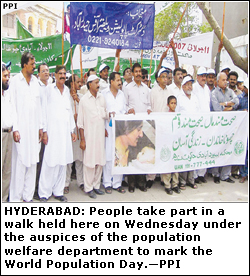 MANSEHRA, July 11: Neonatal mortality rate is much higher in Pakistan than in other Muslim countries as men here have not been playing their due role to provide proper nutrition and facilities of safe delivery to women, experts said at a seminar held on Wednesday to mark the World Population Day.
The seminar on ‘Involvement of male in safe motherhood’ was held by the United Nations Population Fund (UNFPA) and the Mansehra district population and welfare department.
The speakers said that in a male-dominated society like the one in Pakistan, women were ignored and treated as a second-grade citizens.
They said men did not take proper care of their wives during pregnancy and added that consumption of routine food by expecting mothers led to complications in deliveries.
They said 35 children died in the country per 1,000 births and about 30,000 mothers – one in every 20 minutes – died of causes related to pregnancy every year.
The infant mortality rate was 77 per 1,000 births.
The experts said that maternal death rate was high because 76 per cent of the deliveries were conducted at home.
They said that although the population growth rate had declined in Pakistan, it was still higher than that in other developing countries.
During 1951-61, the growth rate in the country was 2.45 per cent, in 1961-72 it climbed to 3.66 per cent, in 1972-81 3.05 per cent, in 1981-98 2.61 per cent, in 1998-2002 2.1 per cent and in 2006 it had declined to 1.8 per cent, they said.
They said that ever year 4.20375 million births took place in Pakistan – eight children per minute – which was alarming for a developing country. About 1.197 million people died every year, most of them women and children – three deaths per minute. Thus the country’s population increased by 3.00675 million every year, they said.
The speakers said Pakistan covered 0.6 per cent of the world’s area but its population of 156.26 million was 1.8 per cent, which affected the environment of the country.
They said 29 per cent of the country’s population lived below the poverty line, 37 per cent had no access to safe drinking water, 38 per cent lived in single-room houses, 12 per cent lived in slum areas and 51 per cent were deprived of sanitation facilities.
The district population and welfare department in Battagram could not hold a seminar scheduled for the occasion because of the tense situation in the area.
The district population and welfare officer said the department had also postponed hoisting banners at public places.


























