0
0

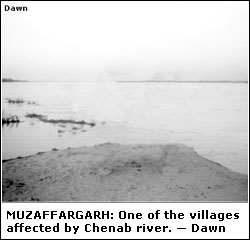 MUZAFFARGARH, July 8: As many as 36 mauzas of Rangpur spreading over 3,000 acres had been hit by land erosion since January 2007 while the government did not take any steps for rehabilitation.
This correspondent visited the area to see the plight of the affected people. Malik Khurshid Ali Kalro was leading a prosperous life by virtue of his 200 acres of mango orchards which he used to sell for Rs5 million every year. In 2005, he was a candidate for Kot Addu tehsil nazim slot. But this year, most of his land was eroded by the Chenab. Now he is left with only 25 acres as this land is far away from the river.
“Whenever land is hit by erosion, the government does not do anything for the affected people. Even we have no right to catch fish from the river because the government awards contract for the purpose,” he said.
“My 100 acres were eroded by the river this year,” said Malik Shafqat Khairha.
He said it was his inherited land and he did not want to sell it.
“We cannot fight against erosion but at least the government should compensate our loss,” Mr Khairha said.
Thousands of acres had been allotted to ex-army officers in the district but the people affected by erosion were completely ignored, he said.
Some of the affected mauzas are Jhalareen, Lashkarpur, Ganjee, Tibbi, Mauza Kheree, Khajiwala, Santi, Pippli, Kotla Sadaat, Hajipur, Faridabad and Khudai Basti.
This year in February, the erosion had also posed threat to Head Muhammadwala, hardly a kilometer away from the river. A spur was built immediately to save it.
The affected people also complained that they had to pay for crossing the river to go to Multan. Boating rights were also sold by the district government. They had to pay Rs20 to 50 per trip to cross the river. Sometimes boatmen refuse to carry their patients to the other side.
Ghulam Farid, a contractor of boats, said he had paid Rs450,000 to the Muzaffargarh district council. He said he charged five maund wheat from every family which was not too much. He said if some families refused to give grains, he charged money from them.
Dawn learnt that an NGO — Doaba Foundation — had set up three cluster centres here for the erosion-hit people with the help of Oxfam.
The NGO coordinator said three shelters — children and women shelter, livestock shelter and information centre - had been established here last year.
He said the foundation was training women and children of the area and educating the people about livestock. The NGO distributes goats and sheep among the erosion-affected people and they rear the cattle.
At the information centre, people are informed about the flood situation.
In the beginning, he said people were not ready to send their women and children to the shelter. But now women come willingly for getting education and skill-based training.