0
0

Red alert
We have been hijacked. An audience of 169 million has become enslaved to the news and views from Islamabad. As ‘the showdown at Lal Masjid’ enters its sixth day, all happenings in the country take a back seat with the media lights maintaining its glare on the doings and sayings of the Maulanas Aziz and Rasheed Ghazi (and Mudira Umme Hassan).
What happened to the spotlight that should have been on Balochistan where millions are still struggling for survival after the storm? What about the bleak power situation in Karachi? And, most importantly, what is happening at the Multi-Party Conference convened by the PML-N in London?
With theatrics becoming every man’s occupation in the country, TV channel anchors are outdoing each other to get a piece of the glory (or shame?) and have taken to becoming ‘The Negotiator’. Last I checked an anchor’s job was to take an interview, not mediate between two warring parties.
And as the plot thickens, so does the play of buffoonery. Media ethics has been consigned to the devil and the bill of rights lies missing. While we grew up listening to the rights of convicts being read out to them on mystery shows on TV — ‘you have the right to remain silent; anything you say or do will be held against you in a court of law’…so on and so forth — our state-owned TV channel in a bid to cash in on the scoop, violated every law in the book. The interviewer became an adjudicator. And whatever the maulana said or did (including the never-to-be-forgotten grand sweep to remove the veil) after ‘re-dressing’ himself in the burqa, is now part of our ‘glorious’ history.
One repeatedly goes around in circles. Where has logic gone a begging?
How can one digest the contorting facts that emerge? In the country’s seat of power a standoff continues for nearly a week, whereas in Karachi in a matter of hours over 50 civilians are slain without much ado. And what fools us that we actually form the numbers of the audience glibly lapping up all that is dished out.
Well, if the success of a government is measured by the attention it grabs then the present regime has surely won hands down. It has diverted our attention from all major events that may shape the country/regime’s future and it has taken the edge off all calamities natural or man-made.
At present, Balochistan is crying out for help but all that the nation gets to see on its national TV are revolting pictures of men with their shirt up and burqa down!
In the aftermath of Balochistan, hundreds of people are still untraceable and taluka governments have no way of ascertaining the number of deaths. It is being said that if there were trained rescue teams available to deal with the aftermath, the death toll would have been less.
So for the government, the Lal Masjid stand-off has been multi-purpose. It covered their ground in the case of their inefficiency (or was it disinterest?) in providing an immediate respite to the flood victims; it has totally diverted focus from PML-N’s political high point where most definitely sparks will fly and an agenda of sorts to rock Musharraf’s boat will formulate; it has of course veered attention from the CJ issue and the imbroglio that the state machinery found itself in after the May 12 bloodshed in Karachi; it definitely got power rioters off the streets and into TV watching, giving Prime Minister Shaukat Aziz enough space to say that there is no discrepancy in the KESC’s privatisation and, finally, it took the edge off the wrath directed towards Rushdie’s knighthood. And, most unwittingly, it also got a former MQM minister off the hook for his offer of being a willing assassin for Mr Rushdie. Though I wonder if Mr Aamir Liaquat is happy about being sidelined from the media glare as being the centre of a controversy is after all his only forte!
Making money in the rain
THE thunderstorm that hit Karachi on June 23 brought death and destruction in its wake. Dozens of people were electrocuted. Trees and hoardings were uprooted all over the city. And the people who had taken shelter under these trees or happened to be passing below these hoardings were either crushed to death or badly injured under their weight.
Vehicles which were parked next to trees and underneath these hoardings were absolutely squashed.
However, the monsoons had started on June 21 and brought much respite to the citizens who had been suffering from the scorching heat of the summer and the apathy of the KESC under their prolonged loadshedding.
Another thing that the rain does to Karachi whenever it pours is make the plants and tree leaves turn lush green and the grass verdant.
All the soot from vehicles and the dust from dirty tyres make the city highly polluted. Most of the soot and the dust settle on plants and the leaves of trees. All this only gets washed whenever it rains as there is no proper mechanism to water the plants on a regular basis.
In many localities poor children, some of them naked or with tattered clothes, could be seen playing in the rain and splashing on the puddles. The smiles on their faces were a clear sign of how happy they were.
Sometimes pleasant weather can make you do just that. It definitely is an enhancer of your moods.
Then there are those who are out to make a quick buck. Yes, weather can add a few chips to your pocket too if you happen to be business-minded.
A couple of hawkers were spotted in Bahadurabad Chowrangi (or should I say Char Minaar Chowrangi as a miniscule replica of the Hyderabad Deccan landmark has been built there) on the evening of a rainy day selling umbrellas of all hues and shades, including a pastel blue one with a pair of pointed ears protruding from two edges, to needy clients.
It immediately reminded me of the summer of 2001 in Paris where while visiting the Eiffel Tower it suddenly started raining cats and dogs.
Within a few minutes appeared six or seven Indians, all Sikhs and Mona Sikhs (the clean-shaved ones without the turbans), who started selling umbrellas to tourists.
About 15 minutes earlier they had been playing cards on a patch of grass adjacent to the premises of the Eiffel Tower.
On seeing the rain, they quickly got out the umbrellas from some secret location and started doing lucrative business.
However, all of a sudden French immigrant officials appeared out of nowhere and arrested a couple of them. The remaining youths disappeared by mingling into the crowd of tourists who were all around the place. All this was an added bonus to the tourists.
Where minting money during the monsoons is concerned, nobody can beat the Karachi taxi drivers and rickshawalas who take advantage of the plight of passengers by charging them exorbitant rates. They make at least three to four times the money they make on a normal day. And they prefer turning down a passenger rather than bringing down their rates. Yes, they are that adamant.
The rain also helps some poor children in making money; the ones who can be seen at various crossroads with wipers.
Whether your windscreens need cleaning does not matter as they start cleaning them all the same. And since the rains with all that splashing muddy water made the windscreens all the more dirty, people did not mind them being cleaned.
In the process, the poor children add some much-needed income to their pockets.—Mohsin Maqbool Elahi
ABC of the city
In the context of Karachi, the first alphabet ‘A’ qualifies for accidents that occur every day, B for blasts, C for corruption, D for declining standards of education, E for encroachments spreading in every direction, F&G for filth and garbage littered in commercial and residential areas, H for hoodlums, I for instability in prices, J for (overcrowded) jails, K for killings, L for lack of public lavatories, M for monstrous structures, N for noise pollution, O for overflowing gutters, P for power crisis, Q for quacks, R for rallies, S for street crimes, T for traffic jungle, U for underpasses that get flooded when rains come, V for vanishing footpaths, W for water crisis, X for xenophobia, Y for youth without jobs and Z for zero tolerance.
However, Karachians should not get depressed with the ‘alphabetical negatives’ as there are a number of good points, too.
For example, A also stands for ancient buildings such as KMC building, Empress Market, Mohatta Palace, Wazir Mansion; B for beaches, C for commercial activities and cafes in every town; D for doctors of international repute serving ailing humanity selflessly like Dr Adibul Hassan Rizvi, Dr Ghafar Billoo, Dr Abdus Samad, Dr Tipu Sultan; E for (pleasant) evenings of the city; F for flyovers, G for great people who belong to Karachi such as Quaid-i-Azam Mohammad Ali Jinnah, nuclear scientist Dr Abdul Qadeer Khan and renowned social worker Abdus Sattar Edhi; H for hub of industries; I for islands; J for Jinnah International Airport; K for kutchi abadis providing shelter to many; L for (no) language barriers; M for media offices; N for nurseries along roads; O for owning the city; P for pedestrian bridges; Q for Quiad-i-Azam’s mausoleum; R: recreational parks like Bagh Ibne Qasim and Safari; S for sea and shopping malls; T for trade and industries; U for universities; V for vibrant life; W for women’s liberty; X for xylophonists like other instrumentalists; Y for youth yearning to make the city even better and Z for zoological gardens.—Azizullah Sharif
Compiled by Syed Hassan Ali
Email: karachian@dawn.com
A death lost in mystery
The death of a schoolteacher on June 28 in Gujranwala has left many questions. Police have yet to ascertain if her death is a tit-for-tat murder or a suicide or murder by her own family to implicate their rivals in a case.
It was on June 27 when 23-year-old schoolteacher Rashida of Qabristan Garjakh locality was brought to the District Headquarters (DHQ) Hospital in a critical condition. Doctors referred her to Mayo Hospital where she died at 1:30am on June 28.
The same day, Rashida’s mother Shamshad lodged a complaint with the Garjakh police, saying her daughter was going to school at 7am when Mukhtaran, her son Shahid and two unidentified men stopped her and poured acid into her mouth.
She said she was witness to this incident because she was habitual of watching her daughter until she reached her school.
She said when she saw all this, she along with her other daughter, Sajida, reached the scene and saw the accused fleeing.
She said she took Rashida to the DHQ hospital and later informed the police. She said the police registered a first information report (FIR) against Mukhtaran, Shahid and two unidentified men.
Garjakh SHO Faisal Chadhar told Dawn the FIR was the result of an old enmity between the two families (of Zubair and Munir Ijaz) who were relatives and had been living in Hameedpura peacefully for the last many years before a petty dispute tore them apart.
According to the police record, Mukhtaran’s husband Zubair lodged an FIR with the Garjakh police on Sept 24, 2006, saying Rashida’s brother Muhammad Abid quarrelled with Shahid after he allegedly spit on him. A few hours later, her father Munir Ijaz, brother Khalid, cousin Ahsanullah and three unidentified people barged into his house and abused his family, Zubair said, adding an argument ensued and ‘attackers’ beat his son, Tahir, with rods. He was taken to Mayo Hospital where he died.
Ijaz and Khalid are now in the central jail, while Ahsanullah has been declared a proclaimed offender.
The SHO said the Tahir murder case was pending with the court, and the defendant party had accused the plaintiff party of killing their girl, Rashida.
The SHO said according to Shamshad, the acid was poured into Rashida’s mouth at 7am. He said if she was true, there should be some witnesses to the incident. He said Shamshad did not mention the cause of a clash between the two families in the FIR despite police request because it could have ‘exposed’ her intentions.
He said the police were investigating if Rashida was killed by the accused or she committed suicide after a domestic row.
He said the police had to wait for a medico-legal report for a final observation on the case, which was expected within 15 days. He claimed that Rashida did not record any statement to the police after the incident.
Garjakh police station ASI Malik Hanif, who was duty officer on the day of incident and visited Rashida at the hospital, said there were bruises on her right cheek, throat and arms and her stomach was badly damaged. He said the inner side of her lips was burnt, but there were no acid burns on her face, which made her mother’s claim doubtful.
He said when she was referred to Mayo Hospital she told him that Mukhtaran and Shahid had poured acid into her mouth.
Shamshad told Dawn that Shahid had been calling her on cell phone and using abusive language about her daughters, which forced her to leave Hameedpura and take shelter at her daughter Sajida’s house in Qabristan locality.
She said Rashida recorded her statement to the police against the accused, and added that her (Shamshad’s) sister, Riaz Begum, was a witness to this.
Sajida said Rashida was not able to speak during her stay at the hospital because her mouth was completely burnt. She said she was not present when Rashida recorded her statement to the police against the accused.
According to the medical certificate register of the DHQ hospital’s trauma centre, only a final autopsy report from a Lahore laboratory would determine the cause of Rashida’s death.
Accused Mukhtaran’s brother Mukhtar Ansari said a business jealousy was the cause of a clash between the two families. He said both families were associated with the embroidery business and Zubair’s family was earning more than the Ijaz’s. He said a “petty” dispute provoked a fight between the two families and Tahir was killed accidentally, otherwise Ijaz’s family did not want to kill him.
Ansari said Rashida was a “sentimental” girl and had tried twice in the past to commit suicide by jumping from her roof to lodge a case against Zubair’s family and help her father and brother get out of jail. He said Shamshad had been trying for long to stop Rashida from taking such a step, but she succeeded in her ‘mission’ in the third attempt.
Zubair rejected Shamshad’s allegations, saying it was an attempt by her to counter the Tahir murder case and get her son and husband out of the jail.
Improper dumping of solid waste
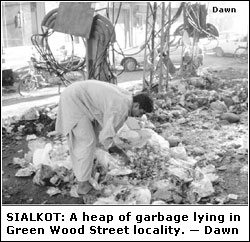 AROUND 647 tons of solid waste and garbage are being generated in the Sialkot district every day while tehsil municipal administrations have the capacity to dump only 392 tons. The rest of the solid waste, which is thrown away on streets and along the roads, is causing a real health hazards.
According to the fresh statistics provided by the Sialkot district administration, the improper dumping of the solid waste is also creating environmental pollution in the entire district, posing a serious threat to human beings and aquatic life.
Official sources say that the unscientific way of the solid waste dumping has been continuing since long owing to the negligence of TMAs. Virtually, all the four tehsils - Sialkot, Daska, Sambrial and Pasrur - have no proper dumping grounds.
In Sialkot tehsil, the TMA lifts only 300 tons of waste daily with the help of tractor-trolleys while 200 tons are left in the open places due to shortage of resources.
The people in Daska tehsil generate some 80 tons of solid waste every day, but the TMA has the resources to dump only 60 tons of garbage.
The situation in Sambrial tehsil is more pitiable as the TMA there can lift only 20 tons of garbage out of 50 tons produced by the residents.
The condition prevailing in Pasrur tehsil is no different from other tehsils, as the TMA is able to lift only 12 tons of garbage out of 17 tons.
Despite giving words of warning by the health department about the alarming use of drugs among the people particularly labourers, the federal, provincial and district governments have taken no measures to check the menace.
Addicts can be seen injecting drugs to each other in every nook and corner of the city, negating tall claims of local NGOs to purge the society from drugs and make addicts the useful citizens.
Official sources say that Kashmir Road, Defence Road, Shahabpura Road, Rangpura, Naikapura Chowk, Pakka Garah, Hajipura, New Muslim Town, Lorry Adda, Christian Town, Puran Nagar, Muslim Colony, Green Wood Street and their adjoining areas, and compounds and toilets of almost all cinemas have become a safe haven for drug addicts.
| © DAWN Group of Newspapers, 2007 |