0
0

 KARACHI, July 5: The Lal Masjid stand-off has thrown up some surprises — not only did it fail to ignite a backlash in the mega-city of Karachi, it also failed to fuel the notion that Pakistan constitutes a sanctuary to militant groups.
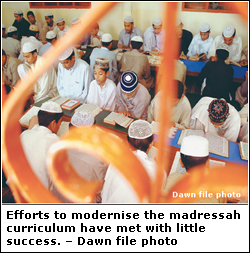
In a country of approximately 7,000 madrassahs enrolling a staggering 18 million estimated students, the reaction to the state’s offensive against the clerics has been restricted to a few murmurs in far-flung areas of the NWFP.
For Karachi, it was business as usual. Home to some 1,400 seminaries enrolling five million students, the city could have proved a time-bomb. But the rabid calls of the Lal Masjid brothers failed to resonate, and while several Karachi madrassah students subscribed to the ideology that has caused fireworks in Islamabad, they expressed reservations over the cleric brothers’ methods.
‘They should have acted more wisely’
On the issue of the manner in which Maulana Abdul Aziz attempted to escape, a group of Jamia Binoria students approached by Dawn said only that they had not expected this of him. Similarly, Maulvi Mohammed Yousaf, a young teacher at Pathan Colony’s Jamia Arabia, said that there could be “no two opinions about the Lal Masjid clerics’ demand for Shariah” but stopped short of endorsing their methods. Students of the Rahmaina madrassah in Gulshan-e-Iqbal commented that the Lal Masjid brothers ought to have “acted more wisely.”
Similarly, most of the country’s religious parties have also kept their distance from the controversies, and stayed on the sidelines while the rebel clerics and the authorities fought it out. “The religious parties have mainly been very positive,” said minister for religious affairs Ejazul Haq. “Maulana Fazlur Rahman tried to negotiate and Qazi Hussain Ahmed spent half a day there in etiqaaf but came away.” Mr Haq conceded that a strike call had been given by Qazi Ahmad but said that “that is not for Lal Masjid, it’s just taking political advantage of the situation.”
While many Karachiites believed that the confrontation would put the Madaaris Reform Bill in the dock, Mr Haq insists that this is not the case. “The bill is intact and does not require changes,” he told Dawn, explaining that the first phase concerned the regularisation of madrassahs and the second phase involved the introduction of modern education to bring the seminaries into the mainstream. “This has been accomplished and the only thing left is the appointment of the chairman. There is complete cooperation from all the parties, none of which are siding with Lal Masjid,” said Mr Haq, adding that representatives of the Wafaqul Madaaris tried reasoning with the brothers in February but were not heeded.
Madrassah modernisation?
Saifullah Rabbani of the Akhbarul Madaaris says that “their [governmental] efforts to make model madrassahs failed and they wasted crores. We have included the syllabus changes, accepted registrations and audit reports but why should we suffer the presence of a government representative when non-governmental or charity organisations do not?” he questioned. He added that matriculation is now a prerequisite, and that for the 16-year course, “we have included computer studies, English, mathematics, history and geography to the curriculum, which is accepted by the five boards.”