



 0
0

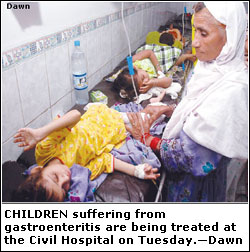 KARACHI, July 3: Gastroenteritis is becoming an increasingly serious concern in the wake of the recent rains, particularly in areas with little access to sources of safe drinking water and sanitation systems.
Official estimates show a sharp rise in the number of gastroenteritis and diarrhoea patients brought to provincial and city government hospitals on Tuesday, 810 as compared to 730 on Monday. 54 patients were retained for comprehensive treatment on Tuesday.
During the 24 hours ending at noon on Tuesday, the Civil Hospital Karachi (CHK) received 104 patients while the Qatar Hospital in Orangi town received 115. The Lyari General Hospital treated 25 patients while 83 sufferers were taken to the Children’s Hospital in North Nazimabad. Various hospitals in Gadap town received 120 patients, said an official of the Sindh health department.
Children fall prey to the disease
In addition, Dawn’s research has shown that 95 children were rushed to the CHK Diarrhoea Treatment Unit between 9am and 7pm on Tuesday, while the National Institute of Child Health (NICH) received about 50 such patients till 2pm.
These patients came from most Karachi localities including Korangi, Malir, Landhi, Gulshan-e-Iqbal, Sohrab Goth, Gadap, Kausar Niazi Colony, Khuda ki Basti (Surjani town), Kharadar, Lyari, North Karachi and Baldia town.
The rising incidence of gastroenteritis indicates the lack of safe drinking water, poor sanitation and inadequate health and hygiene practices. Urban slums are the worst-hit.
Awareness drive needed
Dr Yasmeen Kazi at NICH, which receives 150 to 200 diarrhoea cases every day, put the blame on general hygiene conditions, the lack of education and new mothers’ reluctance to breast-feed infants. She said that people need to be made aware of the need to avoid spoiled or overripe food stuffs and food sold at road-side stalls, adding that it was time to launch a mass public health education campaign, particularly in city slums.
Dr Ghayasuddin Abro of the CHK diarrhoea unit, which has received about 250 children aged between one and five years since July 1, said that contaminated water, bottle-feeding and poor socio-economic conditions could be seen as the main reasons behind the increase in gastroenteritis cases. He warned that the absence of precautionary measures, particularly if it rains again, could turn the situation critical.
WHO guidelines
According to WHO guidelines, the only sure means of protection against a severe gastroenteritis epidemic is the adequate supply of clean drinking water and sanitation.
Piped water must be chlorinated, leaking joints should be repaired and a constant pressure must be maintained in the system to prevent the entry of ground water.
Water should be chlorinated or boiled before use to kill bacterial pathogens, while washing one’s hands with soap is one of the most effective measures of preventing the ailment. The guidelines state that environment and health workers should monitor food-handling practices and be given the authority to stop street sales or close restaurants when their inspections reveal unsanitary practices.
According to a survey conducted about three years ago, 79 per cent of Karachi’s population has adequate access to drinkable water, including piped water. Ninety-three per cent have access to sanitary facilities, including those connected to a public sewer or a septic system.
The survey added that 90 per cent of the city’s wastewater was disposed, but only 53 per cent of solid waste was taken care of. 79 per cent of the population wash their hands before meals and 82 per cent wash hands after using the toilet.



























