



 0
0

Book on Hasan Nizami’s writings
 SKETCH-WRITING in Urdu has come of age now. But this genre developed quite late in Urdu and owes much of its current prominence to those who wrote sketches in the early twentieth century. Farhat-ullah Baig, along with Rasheed Ahmed Siddiqi and Moulvi Abdul Haq, is considered one of the most prominent practitioners of the craft. Khwaja Hasan Nizami (1878-1955) is also remembered for, among other things, his sketch-writing. In fact Hasan Nizami is considered among those who popularised the genre of sketch-writing with their lively and light-hearted sketches.
Born in the family of the custodians of Hazrat Nizamuddin Aulia’s mausoleum, Delhi, Hasan Nizami had a multi-faceted personality. He was a mystic, a historical-fiction writer, a travelogue writer, a journalist and a humorist. Once, in his youth, he became a sadhu, or a mendicant. Though he began his practical life, with a little formal schooling, as a salesman selling books from door to door, when he died he was the author of over 100 books and pamphlets. He brought out many newspapers, ‘Munadi’ being more famous among them, written mostly by himself. He even sold eastern medicines and curative oils. He was a bookseller-turned-writer-turned-businessman. It is a pity that no proper and in-depth research or critical work has been carried out on him though his enigmatic personality and prolific career as a writer arouses a lot of interest.
Khwaja Hasan Nizami’s prose is simple and colloquial yet chaste and idiomatic. He wrote many interesting sketches but nobody cared to collect these sketches and they remained scattered, rather buried, in the pale and dusty issues of old journals and newspapers.
It is much to the relief of lovers of chaste Urdu prose that Dr Abu Salman Shahjahanpuri has come up with a collection of Hasan Nizami’s sketches, titled ‘Khwaja Hasan Nizami: Khake Aur Khaka Nigari.’ Dr Abu Salman, a reticent scholar as well known for his historical research work as meticulousness, has published the sketches with a scholarly foreword giving the details of Hasan Nizami’s life, his publications and his many literary skirmishes with luminaries such as Iqbal, Zafar Ali Khan, Mohammad Ali Jauhar and Ab-ul-Kalam Azad (p.70-93).
Dr Abu Salman has described that Hasan Nizami worked for the British and how it caused resentment against him (p.80). He has also given an account of Hasan Nizami’s offer he made, during his visit to Pakistan, to the American ambassador to work for the American propaganda machinery (p.88). His 80-page scholarly foreword has raised many questions about Hasan Nizami and his personality. While it is bound to raise hackles, it has been written in true scholarly spirit and honesty.
“Hasan Nizami did not have any inhibitions about the topics of his work or his sketches. He did not hesitate to write a sketch of whomsoever he deemed fit, be it spread over many pages or a few lines. He wrote sketches of Allah, angels, Satan… saints and even actresses and prostitutes,” writes Dr Moinuddin Aqeel in his foreword to the book.
Published by Poorab Academy, Islamabad, the book is at once educative and entertaining.
Bracing ourselves for the monsoon
 IF the pre-monsoon downpour over the previous weekend was any indication of the efficacy of the drainage systems and other flood control measures that have been put in place in our cities, we had better be prepared for the worse.
After the downpour, most newspapers on Monday carried pictures of the aftermath, the most popular one of which was a street scene in Lahore which showed a black car half submerged in flood water and people wading in the thigh-high flood water.
If this is what a pre-monsoon rain can do to a street in a provincial capital, one dreads to think of what can happen when the actual monsoon strikes. The chief meteorologist’s prediction that the monsoon this summer would bring above normal rains in the eastern districts of the country, is further cause for pessimism.
In Rawalpindi, several places were submerged in ankle-deep water after the pre-monsoon downpour, including the Pindora area. And this too, after the city government had claimed the week before that it had been working hard at dredging and clearing up the choked drains and canals to facilitate storm-water drainage in anticipation of the monsoon.
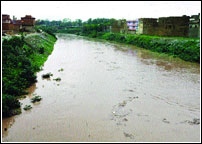
Little wonder, despite announcement by the local government of a newly installed computerised flood warning system donated by Japan which is supposed to enable timely warning of impending flood, people are generally skeptical about the efficacy of the city’s existing drainage system in preventing flooding during the coming monsoon, especially in localities along the Rawalpindi stretch of the 30 kilometres Leh Nullah which meanders through the twin cities beginning from the northwestern edge of Islamabad.
The once famed but now notorious Leh, particularly the section in Rawalpindi, is what it is today — a polluted and choked-up eyesore rather than a beautiful flowing stream with landscaped banks — because of lack of civic mindedness on the part of the public and because of the lack of effective measures by the relevant authorities in cleaning up the stream once and for all, curbing further litter, industrial and silt discharge into it, and ensuring that clean water flows continuously through it.
Congested cities like Rawalpindi are particularly vulnerable to flooding unless they have a well-designed and well-maintained storm-water management system in place to ensure that storm-water runoff drains away quickly to minimise flooding, thus preventing public health problems like dengue fever, malaria, gastrointeritis, etc.
A comprehensive storm-water management system or flood control programme for any densely populated built-up area is necessary for saving both lives and property, and would need to include the construction, improvement and cleansing of drains, canals, streams and other waterways from litter, garbage and sediments; the raising of platform levels in low-lying areas in the course of land development; and the implementation of a pumped drainage system where it is not possible to raise the platform level.
As for Islamabad, which has been undergoing intensive roads and new sectors’ development during the past year, the coming monsoon will be a test of the sustainability of these new land developments. Unless all these developments are being accompanied by adequate drainage and the infrastructures such as road underpasses are provided with adequate flood protective measures, the gobbling up of green areas by such development and thus the loss of more and more surface area for storm-water penetration into the ground will inevitably result in greater vulnerability to flooding, both in Islamabad and especially in neighbouring lower-lying Rawalpindi.
The massive construction activity could also contribute to flooding in another way. Neither the construction industry nor CDA seems to have been vigilant in preventing dust, silt and other debris from the construction sites from being spilt all over the place, especially on existing roads. During previous downpours such silt, sediments and debris must have been washed into drains, canals and into Leh and its rivulets, thus reducing the capacity of these to carry away runoff storm-water during the monsoon.
Not only is it important that the construction sites keep exposed earth surfaces to a minimum, there must also be measures in place to trap silt and debris and prevent them from being washed into drains, canals and streams after a downpour. In the developed countries, new technology and products are employed to achieve this, e.g., erosion control blankets, turbidity curtains, silt fences, polymer blocks, etc.
If there is a need for CDA and Wasa to monitor all the construction sites in the twin cities by conducting regular checks to ensure that there is no pollution of the waterways or sedimentation of drains and canals by silt and debris from the construction sites, there is also a need for a similar monitoring of all industrial units in the twin cities to ensure that they do not dump effluents into drainage systems which will not only pollute the waterways but block the flow of storm-water. Such monitoring will be all the more important once the proposed new industrial area in the twin cities is established.
No matter how important industrialisation is to Pakistan’s future, we need to ensure that it is prevented from overwhelming the quality of life of its citizens, as it has already happened in many cities in the country.
Just as our industries and construction sites need educating on proper housekeeping measures, the general public also needs to be educated and informed through the media as well as directly, not to throw litter and garbage into drains, canals and streams.
Global climate change resulting in more instances of extreme weather, and thus flooding, may be very much beyond the control of Pakistan. However, what we can do is to adopt a pragmatic approach of taking precautionary measures and establishing efficient systems in our cities to actively monitor and manage these vulnerabilities.
| © DAWN Group of Newspapers, 2007 |



























