0
0

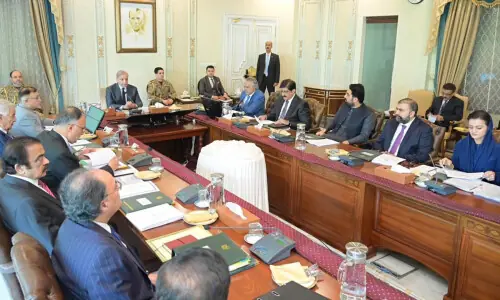
ISLAMABAD, June 23: A top judicial body headed by Acting Chief Justice Rana Bhagwandas on Saturday took serious notice of a report by the Transparency International regarding complaints of corruption in the subordinate judiciary and asked the high courts to take necessary action to purge the menace.
A meeting of the National Judicial (Policy Making) Committee (NJPMC) asked the four high courts to take disciplinary action without showing any leniency against officers involved in corrupt practices.
Under the Law and Justice Commission of Pakistan, the NJPMC coordinates judicial policy within the court system and ensure its implementation.
The Transparency International in a report on National Corruption Perception Survey 2006 mentioned complaints of corruption among judicial officers and court staff at the level of subordinate courts and 10 government institutions and departments, including the investigation department and the prosecution agency.
“Corruption in any form or manifestation is unacceptable and, therefore, should be eradicated,” the NJPMC resolved, according to an official handout.
The committee expressed satisfaction over the implementation of its recommendations by the provincial governments which sanctioned 79 additional posts for the appointment of female judges in the subordinate judiciary. The NJPMC recommended appropriate amendments for the establishment of family courts in tribal areas of Balochistan.
The provincial governments, the meeting was told, had sanctioned additional posts of female judges for appointment under the Family Court Act, 1964. A total of 79 posts, including 35 posts for female judges, have been sanctioned by the Punjab government, 24 by Sindh, 13 by the NWFP and seven by the Balochistan government.
The Balochistan High Court has already appointed female judges while other high courts are in the process of advertising the posts.
The NJPMC also considered the complaint of non-acceptance of women as surety in bail matters in criminal cases and observed that there was no bar in the law for a woman to stand as surety for an accused person to be released on bail.
The committee decided that the respective high courts would issue directives to the subordinate courts to accept women as sureties when they executed bonds to the satisfaction of the court.
The NJPMC considered suggestions to eliminate the evil of perjury in courts and asked the high courts to direct the subordinate judiciary for strict action against perjurers who give fabricate statements or present forged documents or affidavits in courts.
The committee expressed dissatisfaction over the falling standards of legal education in law colleges and stressed the need for reviewing the curriculum of the colleges to make it more relevant to the present-day requirements, improvement in the quality of teaching faculty and limiting the strength of students in each class.
The NJPMC also took notice of the publication of court summons/notices in periodicals or magazines with limited circulation and directed that such notices should be published in newspapers having wide circulation.