0
0

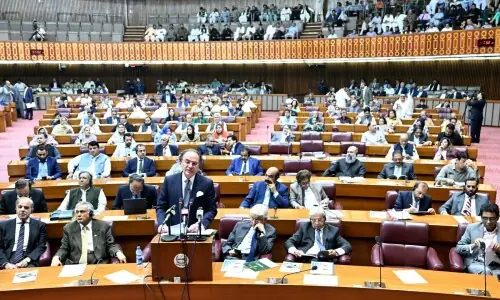
ISLAMABAD, June 23: The government wavered in the National Assembly on Saturday on how to deal with a prolonged revolt by madressah militants in Islamabad and betrayed disarray over some key political matters before the house ended its last budget session in an air of uncertainty about its future.
The house approved a nearly Rs641 billion worth supplementary budget — including more than Rs415 billion of non-votable charged expenditure — for the outgoing fiscal year as well as doing the same with similar demands for as far back as fiscal years 1985-86, 1986-87 and 1987-88 to fulfil a formality before its was prorogued by a presidential order a day after passing the present government's last budget of more than Rs1.8 billion.
But an overnight kidnapping of nine Chinese operators of an Islamabad massage parlour, in the latest of a five-month defiance of state authority by the militants seeking to enforce their own brand of Islamic code of life, overshadowed the last day of an 18-day budget session.
While Minister of State for Interior Zafar Iqbal Warraich seemed looking for excuses for the absence of a strong action against the militants, some members of the treasury benches made it clear they did not think alike about issues such as having a congenial climate for the next elections, suggestions about withdrawing tit-for-tat disqualification references filed by ruling coalition and opposition members and in responding to opposition leader Maulana Fazlur Rehman's support for letting the present assemblies complete their five-year terms.
Mr Warraich, speaking hours before the kidnappers freed the six Chinese women and three men, said the government had “shown patience for very long” but suggested the house pass a unanimous resolution to facilitate an “operation” against the militants after a ruling party member, Ms Mehnaz Rafi, raised the issue of what she called the “most shameful” act by the so-called “Lal Masjid Brigade”.
“Who has given them the authority to look into what is happening in a massage parlour?” she asked before the government came under flak from opposition members who accused it of tolerating the militants for political reasons and also saw a hand of its intelligence agencies in the affair.
Before several opposition members, including opposition leader Maulana Fazlur Rehman, denounced the militants for what they called a wrong interpretation of Islamic beliefs, Mr Warraich said the kidnappers had been warned to unconditionally release the Chinese or “the administration would take its course”.
“I know that taking action is the solution,” Mr Warraich said about the challenge from the militants whose previous acts of defiance included kidnappings and subsequent release of two women with a child and police officials, raids on music shops, burning of music cassettes and CDs and the constitution of a Sharia court to issue and enforce edicts.
But, he said, a government action could result in fatalities and, in a reference to the opposition, added: “These people would then demonstrate and play politics with corpses.”
He said the government would carry out an “operation” against the militants if the whole house asked it to do it. “A unanimous resolution passed by the house will make it easy for us.”
Maulana Fazlur Rehman said no Muslim could tolerate immorality but the responsibility for the elimination of an evil by force rested with those who wielded political power while the Muslims, without such authority, could resort to only preaching and political process.
He said while the present government had soured relations with all other neighbours of Pakistan, the country could not afford such a situation with a close friend like China “whom we can trust”.
Nayyar Hussain Bokhari of the People's Party Parliamentarians (PPP) said no part of Pakistan was left with the government’s writ which, he added, could be established by enforcing the existing laws.
Maulana Abdul Akbar Chitrali of the Muttahida Majlis-i-Amal (MMA) alliance said the situation in Islamabad’s Jamia Hafza madressah was the work of intelligence agencies aimed to harm the MMA.
Khwaja Mohammad Asif of the Pakistan Muslim League-N said the government’s inaction would mean its own involvement in promoting the affair to give a message to the outside world that extremism would prevail “if we are out (of power)”.
PPP’s Ms Naheed Khan blamed what she called the rise of terrorism from the Waziristan tribal area to Islamabad on government’s connivance or failures and said Pakistan’s existence would be in danger if the process were not halted.
Parliamentary Affairs Minister Sher Afgan Niazi dismissed Maulana Fazlur Rehman’s fears about an early dissolution of the National Assembly based on the reports of some contradicted remarks of Pakistan Muslim League president Chaudhry Shujaat Hussain and questioned the justification of religious parties backing Pakistan Tehrik-i-Insaaf chief Imran Khan and joining in filing a retaliatory disqualification reference against Prime Minister Shaukat Aziz.
But Railways Minister Sheikh Rashid Ahmed praised what he called an “important speech” by the opposition leader, who called for avoiding the “dictatorial practice” of dissolving the assemblies prematurely and said the MMA would provide no excuse for such an action by dissolving the provincial assembly in the North West Frontier Province which it rules.
The minister said alternatives of emergency, “a mini-martial law” and dissolution of assemblies were considered in the past but the situation was changed now and time had come to adopt “a new path” in deciding whether the president should be elected by the present or the next assemblies. He also urged the Maulana to accept offers by the prime minister and the PML chief for a dialogue for evolving a code of conduct for the next elections.
While Muttahida Qaumi Movement (MQM) parliamentary leader Farooq Sattar rejected allegations of MQM being responsible for the May 12 bloodshed in Karachi by organising a rally while suspended Chief Justice Iftikhar Mohammad Chaudhry was also to visit there, he said the decision for the rally was taken collectively by all coalition parties and called for an inquiry to find out who “imposed violence on Karachi”.
Mr Niazi received a snub from a vocal PML back-bencher, Farooq Amjad Mir, who said the minister’s decision to file a disqualification reference against Imran Khan on the basis of the former cricket captain’s alleged affair with British heiress Sita White -- as also done by the MQM -- was his personal and not the party decision.
But despite differences on other issues, the ruling party members appeared united in condemning a Punjab Bar Council move to bar Speaker Amir Hussain from bar associations in the province in what they saw as a challenge to the National Assembly in retaliation against his action in sending the two disqualification references against Imran Khan to the Chief Election Commissioner for action.