0
0

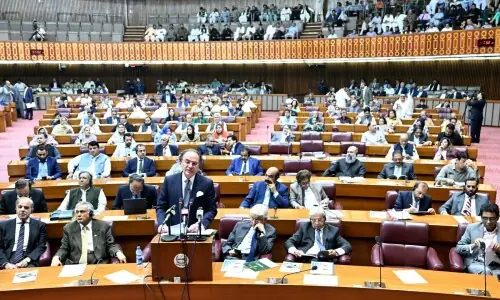
QUETTA, June 21: Balochistan Finance Minister Syed Ehsan Shah presented in the provincial assembly on Thursday a Rs63.08 billion budget with a deficit of Rs10.27 billion.
The minister said the deficit would be met by augmenting local resources and savings in expenditure and with grants from the federal government.
The budget shows Rs257 million deficit on the revenue side and more than Rs10.02 billion on the development side. There is no new tax, no new development scheme and the development outlay is unfunded.
Opposition members made a noise when the minister started reading out his speech spread over 68 pages. While there were a few complaints of non-availability of budget documents, some members raised the issue of continuing National Finance Commission stalemate.
According to the minister, total income from revenue and capital side is over Rs53 billion against which the expenditure is Rs63 billion, a deficit of more than Rs10 billion.
Keeping in view the limited cash flow capacity in the coming fiscal year, the finance department is proposing to release only Rs800 million every month and that too only on authorisation.
On the current revenue side, the government expects an inflow of Rs40.86 billion from Islamabad on account of its share in federal taxes and also on account of direct transfer. Like three other provinces, Balochistan will get a special subvention grant of Rs11.22 billion. In addition, the provincial revenue generation is pitched at Rs2.96 billion. Overall, the total current revenue is being put at Rs43.28 billion.
The current revenue expenditure is estimated at around Rs41.49 billion indicating a revenue surplus of Rs2.33 billion. The surplus will be offset and turned into a loss of Rs257 million on account of Rs2.59 billion deficit on the capital side where expenditure amounts to Rs8.11 billion and receipts Rs5.52 billion.
The public sector development programme of Rs13.47 billion is by and large unfunded because only Rs3.3 billion is expected as foreign assistance, Rs11.50 million is Japanese cash grant and Rs107.62 million ASPL-11.
The government announcement of 15 per cent increase in salary and 20 per cent in pension would add about Rs4 billion to the current expenditure.
The minister devoted a greater part of his speech to various mega projects being taken up and informed the house that the federal government was investing about Rs150 billion in the province.
“The first phase of Gwadar port project has been completed at a cost of $300 million,” the minister said adding that a Rs40 billion project is being taken up to set up an oil city at Gwadar. The Gwadar Development Authority is investing Rs3.61 billion on 37 development schemes and there is a proposal for construction of an international airport at a cost of Rs1.66 billion.
Gwadar port, he said, was being linked with all national highways through a road network and the Coastal Highway has been laid down at a cost of Rs15 billion. In appreciation of international importance of the port, the government is extending the broadcasting network of Radio Pakistan to Gulf countries. The Mirani dam, he announced, had been completed at a cost of Rs5.11 billion. For the development of agriculture in the province, he said, the federal government had contributed in construction of Kacchi Canal, Subukzai dam and Mirani dam.
Syed Ehsan Shah said work on a massive road network was underway to link Balochistan with all parts of the country. At present the province is being linked from three sides. It is being connected to Sindh via Sukkur, with Punjab via Multan and with the NWFP via Dera Ismail Khan. The construction work is going on at a fast pace on a 650-mile stretch of the road after having already completed 850 miles.
He spoke about construction of more than 72 small dams and water schemes in Balochistan. In the last few years, 236 small dams had been built in the province, he said.
The minister said a massive exploration programme had indicated presence of 50 metals and minerals attracting investors from world over. Copper production in the province is now 17,000 tons a year while there was nothing six years ago.
While the minister spoke of the gigantic projects being taken up to change the economic profile of Balochistan, the budget documents show that social indicators are poorest in the country. The literacy rate in Balochistan is only 29.81 per cent as against the national average of 39.69 per cent. Urbanisation is lowest and dependency ratio is highest because Balochistan boasts of highest ratio of population below 15 years.