0
0

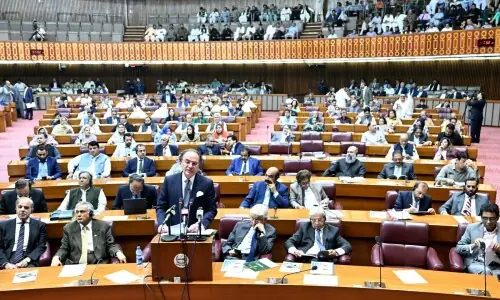
ISLAMABAD, June 19: Serious questions were raised in the National Assembly on Tuesday about the Election Commission’s credibility to hold free and fair elections when an estimated 37 million voters could be missing from the new electoral rolls with only two weeks left to seek corrections.
The opposition used a debate on the federal government’s non-votable charged expenditure for the fiscal year 2007-08 to point to the draft computerised electoral rolls listing nearly 20 million less voters than those of 2002, with some members seeing in the process an attempt to rig the next elections and some complaining it would be too difficult to seek additions by July 3 set by the Election Commission.
But the opposition members who spoke on the issue during two sittings of the house on Tuesday seemed to be unaware of the data compiled by a coalition of non-governmental organisations monitoring the process that put the total of the missing voters at 37 million by taking into account projections made last year of more people who would have attained the voting age of 18 years.
The National Assembly debate on more than Rs2.583 trillion of the expenditure charged upon the Federal Consolidated Fund was only a formality as the Constitution allows only a discussion but no vote on the demands for grants and appropriations under his head, whose main component was more than Rs2 trillion of domestic debt.
But main focus of the opposition parties was on more than Rs1.279 billion allocated for the next elections, which they say can be rigged again by the government that in turn promises the process will be free and fair.
Minister of State for Finance Omar Ayub Khan dismissed as groundless opposition complaints on other issues such as the absence of a National Finance Commission award of provincial shares in the federal divisible pool that was replaced by a presidential award last year and the payment of provincial royalty on power generation, but he did not respond to concerns about the elections.
The Election Commission’s draft electoral rolls displayed across the country on June 12 put the number of registered voters at 52,102,428 -- 19,478,852 less than the 2002-05 total of 71,591,280.
But the Free and Fair Election Network of 30 NGOs put the total of missing eligible voters at 37 million on the basis of 2006 projections of the government-funded National Institute of Population Studies, which it said had put the voter population of 18 years and above at 88.87 million.
Muttahida Majlis-i-Amal deputy secretary-general Liaquat Baloch, who opened the debate on the charged expenditure, said the new voters’ list had made the present Election Commission’s position questionable and repeated the opposition’s demand that the next elections be conducted by an independent Election Commission.
Mr Naved Qamar of the People’s Party Parliamentarians saw the absence of 20 million voters compared to the previous list as a basis laid for poll rigging and manipulation as he also complained of too little time given for corrections in the lists and called for the elimination of the role of intelligence agencies in the process.
Mr Pervez Malik of the Pakistan Muslim League (Nawaz) said the voters’ list should have been generated from the data of the National Database Registration Authority, which according to an Election Commission official, had prepared the previous lists on the basis of the 1998 population census.
Several other opposition members also voiced similar concerns about the new voters’ list which show more than 13 million women and nearly six million men being omitted from the old lists apparently for non-possession of the new computerised national identity cards.
Some opposition members complained about lack of facilities for travellers in the Pakistan Railways for which an allocation of more than Rs9 billion had been made while some others used allocations of more than Rs316 million for the staff, household and allowances of the president and more than Rs315 million for the Supreme Court to criticise the President Pervez Musharraf and a reference he has sent to the Supreme Judicial Council against Chief Justice Iftikhar Mohammad Chaudhry.
The assembly will meet on Wednesday at 10.30am to begin voting on demands for grants for various ministries and divisions of the federal government as well as cut motion to be moved by opposition members.