0
0

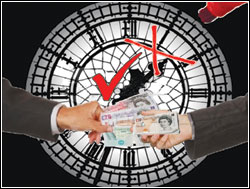 Corruption in high places and that too in rich countries like the UK were never considered anything bad.
Any financial ‘excesses’ of great or lesser magnitude were dismissed as necessary evils of market economy which is presumed to have been proved beyond all doubts to ensure the greatest economic good of the greatest number of souls.
However, in recent years the repeated and strident harangues of the rich that the economies of the developing countries would continue to be consigned to doldrums forever unless the governments in these countries controlled the so-called rampant corruption diverted undue attention of the world on the causes of corruption. And to the consternation of the rich world it was revealed that corruption was a two-way street and that the developed countries were as much guilty of the crime as the developing countries.
The rich countries got together and signed an anti -corruption convention and most including the UK later ratified the convention enacting suitable laws in their respective countries. But that none had any intention to enforce the law became very clear when late last year despite the existence of the OECD convention, it was seen by the whole world the way the government of Prime Minister Tony Blair tried to stop the Serious Fraud Office (SFO) to stop investigating the alleged greasing of palms of the Saudi Royal family by the UK’s biggest arms maker, the BAE.
Embarrassed, the OECD sent reprimands to the UK government at least on two occasions in the last six months and now the Transparency International also seems to have joined in with the OECD in this exercise.
Last Wednesday the Transparency International (TI) issued a demarche to the UK government saying that public admission by its government that key information was withheld from the Organisation for Economic Cooperation and Development (OECD) working group on bribery is a blow to the success of the OECD’s anti-corruption convention.
The UK government must ensure full disclosure of information on the UK-Saudi Arabia Al Yamamah defence contract that is relevant to the OECD’s special review of UK compliance with the convention, the anti-corruption group said. TI also called for the investigation to be immediately reinstated. As a signatory of the OECD anti-bribery convention, the UK is bound by its requirement to prosecute bribery of foreign public officials.
“The credibility and future enforcement of the OECD anti-corruption convention is under threat by the actions of the UK government,” said Huguette Labelle, Chair of Transparency International. “The convention’s success depends on effective implementation, strict enforcement and the courage of governments to stand up to political pressures and do the right thing.
“The UK’s termination of the investigation is a serious threat to the OECD convention. The government’s assertion that national security concerns overrode its commitment to prosecute foreign bribery opens a loophole that other governments might readily use to sidestep the convention’s provisions. Article Five of the convention forbids termination of a corruption investigation for any reason other than the merits of the case. The convention contains no provision for a national security exception.
For over a decade, TI has campaigned around the world for new laws to curb the bribery of foreign government officials by multinational corporations. We have seen mounting support for such laws. The first milestone in TI’s global efforts to secure international laws against bribe-paying was the ratification by 36 governments, including all leading industrial nations, of the OECD anti-bribery convention in 1999. Now, this achievement has been placed at risk by the UK's actions, casting a major cloud across the anti-corruption landscape. “
Despite significant progress in establishing global and regional anti-corruption agreements, including the landmark United Nations Convention against Corruption, multinational corporations continue to use bribes to secure contracts abroad.
“It is crucial for the future of the OECD’s anti-corruption convention that the facts concerning UK government contracts with the government of Saudi Arabia, and BAE Systems’ involvement, be publicly revealed,” stated Cobus de Swardt, Managing Director of TI. “BAE Systems also faces corruption enquiries in Czech Republic, Qatar, Romania, South Africa and Tanzania, and the UK government must actively investigate these allegations. The investigations must be completed quickly, transparently and consistently. No country’s strategic interests should outweigh their obligation to behave ethically and respect their international commitments.”
"The seriousness of the UK's actions cannot be underestimated," said de Swardt. "Multinational corporations use bribes on a grand scale to secure contracts from foreign officials and politicians.”
The TI reprimand referred to the June11, 2007 edition of the BBC programme Panorama and said the programme included allegations that BAE had paid £1 billion [US $2 billion] over more than a decade to Prince Bandar bin Sultan of Saudi Arabia, in exchange for facilitating the Al Yamamah defence programme; that these payments were made with the full knowledge of the UK ministry of defence; and that the payments were concealed from Parliament and the public. BAE Systems has denied any wrongdoing.
The OECD anti-bribery convention was signed on December 17, 1997 and entered into force on February 15, 1999. The United Kingdom ratified it in 1998.
The BAE fraud case allegedly involving Saudi royal family seems to be refusing to go away despite attempts by the government of Prime Minister Tony Blair to hush up the matter as according to The Sunday Times (June 11) Prince Bandar bin Sultan, had personally lobbied Downing Street to get it to drop a criminal inquiry into the contract.
Quoting a senior Whitehall official the ST said the Prince is said to have met Tony Blair last July at the height of the Serious Fraud Office (SFO) inquiry into claims that BAE had illegally paid huge sums to members of the Saudi royal family.
The ST said the Prince had told Jonathan Powell, Blair’s chief of staff, that the Saudis would pull out of the arms deal, which involved the sale of 72 Typhoon jets, unless the investigation was stopped. He also said intelligence ties in the war on terror would be cut.
At the time, the SFO was preparing to examine payments to accounts in Switzerland. Another official said Bandar’s approach followed the SFO’s discovery of secret Swiss bank accounts that investigators believed were linked to the £43 billion deal.
Last December Lord Goldsmith, the attorney-general, announced the investigation was being halted on national security grounds. The ST said Bandar, who is said to be in hospital in California, was unavailable. His lawyer said he denied any impropriety over the alleged £1 billion payments.
However, a friend of Bandar said: “He may well have spoken to Blair or Jonathan Powell about the SFO inquiry. But you should consider it was likely that in doing so he was representing his government and not himself.” Downing Street said it was “no surprise” Bandar, a valued ally of Britain, regularly met officials and ministers but an official denied any ultimatum over the contract.