0
0

An election-focused budget
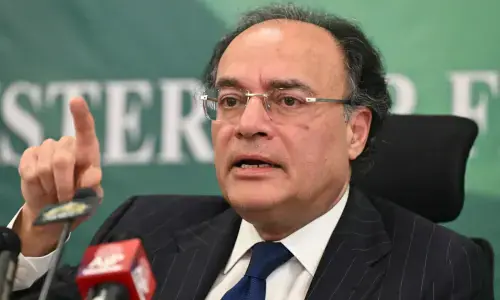
THAT it would be an election-centric budget was never in doubt. The proposals for income and expenditure for 2007-08 announced by the minister of state for finance Omar Ayub Khan in the National Assembly on Saturday more than confirmed the expectations. Still, compared to the official buildup and Mr Khan’s hyperbole in his budget speech, relief offered to the common citizen does not appear all broad-based and lasting. Some of the proposals do try to address the concerns found among vulnerable pockets, but that is all. At Rs1.874 trillion the total outlay of the budget is awe-inspiring when compared with previous budgets. If as much as Rs1.025 trillion is being projected by way of resources to cater to the financial needs of the nation over the next 12 months, with a deficit financing of just 4 per cent of the GDP, at Rs398 billion, one must praise the effort of the official economic managers at resource mobilisation. This is amazing, because there are no more than about 1.2 million tax payers in a country of 160 million. The agriculture sector, a major contributor to the GDP, as well as real estate and capital gains continue to stay out of the tax net. With so much available for spending it was only expected that there would be massive increases in the allocations for important economic and social sectors, and enough left for providing financial relief to low-income groups. This is to be done through increase in income, salaries and subsidies offered on the poor man’s essential kitchen items to save him from the hardship of food price inflation. Sizeable allocations have been made for the provinces and districts as well; the latter ostensibly for furthering the ruling coalition’s election bid in that offering no break from the past.
During the outgoing year, food price inflation of over 10 per cent left many a kitchen cold, even in households estimated to be living a little above the poverty line. Combined with an overall Consumer Price Index of nearly 8 per cent it was but expected that the consumption of the poorest 20 per cent of Pakistanis remained below 10 per cent in the outgoing year, while the richest 20 per cent enjoyed a consumption rate of nearly 50 per cent. The gap between the poor and the rich continues to widen. There are no open or hidden measures in the new proposals that one could say with a degree of certainty would attempt to bridge this gap. The promises to create thousands of jobs and build thousands of low cost houses for the poor are just that at this stage. Last year, while announcing the budget, the government had promised to send out magistrates for checking the prices of essential kitchen items, but no magistrates were seen in the field in the course of the year.
Every time the government is faced with tackling high food price inflation, which has been there now for three years running, it has taken shelter in Utility stores. In the first place there are just not enough Utility stores (about 1,000 or so) in the country to take care of the needs of the teeming millions. Secondly, when you are practising market economy how is it possible for you to intervene efficiently with public sector instruments to control prices even if you succeed in setting up 5,000 such stores, say, within a year? Last year an announcement to the effect was made, but with a difference. The government had promised to help set up such stores under a public-private partnership. Nothing has come of it so far. Of the total subsidy outlay of Rs113.9 billion, only Rs2.45 billion are proposed to be used for keeping the prices of pulses, sugar and ghee within the reach of the buyers shopping at Utility stores. A major portion of the subsidy, Rs98 billion, is being kept to help out Wapda, the KESC, the petroleum companies, refineries and the textile sector. This bares all as to the state of governance in public sector corporations, and the government’s urge to stay on the right side of big businesses while making claims to alleviate poverty.
In this year of record wheat production, atta prices have escalated sharply just before the unveiling of the budget, forcing the government to impose a ban on flour export. Perhaps exports contributed to the shortage seen in the market to an extent, but major reasons for short supplies and high prices were hoarding, black marketing and an inefficient distribution network. The overall inflation rate, much like in the outgoing year, is not going to slow down over the next 12 months. There is nothing in the new budgetary proposals that has the ability to tackle the menace at its root. The production sectors continue to stagnate. No real investment is coming their way. Agriculture remains at the mercy of the weather, and the availability of water; a bumper crop one year is no guarantee that bulls would rule the coming years as well. The manufacturing sector is one that needs badly to be geared up and diversified. An overwhelming dependence on cotton textile will not help the country in the longer run. There will very likely be shortages all around. One says this because cotton production has seen a decrease in actual terms in the outgoing year. The trend is not likely to reverse anytime soon, given the shrinking crop on account of water shortage and ineffective pest control.
There is an expected inflow of nearly $5 billion in remittances, coupled with substantial income in foreign exchange from privatisation. These inflows will partly take care of the current account deficit, which is widening mostly due to stagnant exports and a rise in imports. The additional income is not due to a significantly greater domestic economic activity. As such rupees generated against incoming dollars add to the M2 aggregate, which creates the unwanted condition of more rupees chasing fewer goods, causing in turn the prices to go up. Attempts at cooling this hyper circulation of currency by the State Bank of Pakistan only end up raising the interest rate, thus escalating the cost of production which already has become prohibitive because of shortages of infrastructure, especially of power. This is causing even textile exports to price themselves out of international markets. That is why perhaps textile tycoons keep demanding subsidies. That is also perhaps why most of the earned foreign exchange by way of remittances and concessional capital coming into the country is going into unproductive sectors like real estate and the stock market.
The proposed share of current expenditure at Rs1.599 trillion in the total budgetary outlay is a worrying 66 per cent. One only hopes that it will not shoot up to over 72 per cent as it did in the outgoing year. Such overshooting of current expenditure eats into the development budget which is estimated at Rs543 billion for the current year. The reference to the defence budget has once again remained a one-liner. Isn’t it time now to discontinue this economically senseless and undemocratic practice? Let us tell the people of Pakistan the real cost of maintaining an effective deterrent and from where the resources are coming to accomplish this. The biggest flaw of the budget seems to be its failure to take serious note of the looming power crisis and depleting water resources. The allocations for these heads are not commensurate with the challenges we will be facing on these fronts within the next couple of years. Housing, too, deserved more than it got.
When the corps commanders speak
AN angry military commander facing a crisis is likely to lose his grip on the smooth and calculated conduct of the operations at hand. The problem deepens when a whole high command gets into a temper to trade the next planned strategic step (NPSS) for impulsive action.
The official coverage of the recent Corps Commanders’ Conference (CCC) reflected a degree of irrascibility and annoyance somewhat out of character with a high-powered conclave of our top brass.The CCC now acts almost as the supreme presidium, the ultimate arbiter of peace and war, a surrogate parliament, and a vote bank all rolled into one. Too many strong words were used denouncing vested interests and ‘opportunists’ acting as ‘obscurantist forces’ in pursuance of their personal interests and agenda at the cost of flouting the rule of law. Strong words without lending weight to sober argument tend to deprive it of much of its rationale and force.
Was it a loosely reported version of the CCC or a deliberate warning to the media and civil society to behave or be prepared to face the worst of khaki power yet to come? The question may be viewed and answered either way depending on one’s perception.
A small minority as opposed to a vast majority would not be allowed to “derail the nation from the path of progress and prosperity,” the statement said. There was democracy in the country, the media was free and a parliament was functioning.
The top military command minced no words in regard to lending its support to Gen Pervez Musharraf and standing firmly behind him. That was only to be expected from all ranks of the army vis-a-vis their chief, regardless of personal preferences.
Loyalty is the one abiding pillar of the unity of command. The real argument relates not to the absolute loyalty of the high command to the chief of staff but to his essentially civilian status as the elected president of the country. That is where the split occurs between absolute loyalty to the supreme military commander and a party-based head of state.
Despite his declared pledge to stand by his military chief, a soldier might be left with a difficult choice between his loyalty to the individual and the institution. It has indeed been reassuring to see professional cohesion and structural harmony at the highest level of the top brass. But, it is indeed a moment of truth for the chief, his PSOs (principal staff officers) and corps commanders. Can the CCC’s declaration be seen as an admission of the army being gradually hustled into the political blind alley without an easy exit within sight?
President Musharraf appreciated the unstinted support of his top military generals for him and his policies and his ‘pivotal’ role and vision for a dynamic, progressive and moderate Islamic state. Shouldn’t such unstinted support he taken for granted as part of the duty of a disciplined force without being publicity appreciated and acknowledged of Routine matters, when overemphasized, may well leave the people wondering about the immediate provocation and compulsion behind it.There was just one essentially (experimental ‘X’ corps under Lt-Gen Bakhtiar Rana) during the 1965 war. In 1971 there were three corps – the Kharian-based 1 Corp under Gen Irshad, Lahore-based 4 Corps under Gen Abdul Hamid Khan and Multan-based 2 Corps under Gen Tikka Khan, as against about a dozen now.
Besides the increase in the number of corps, there has been the process of democratisation within the army itself to change the nature of decision-making at the high command level. Although the chief’s remains the last word in high policy matters in peace and war, he remains the first amongst equals. Unlike his predecessors designated commander-in-chief, today’s chief of the army staff has, in theory, surrendered the command element to the head of the state who is also the commander-in-chief. Gen Musharraf, however, wears both hats as his own master and immediate subordinate.
The tense situation facing Gen. Musharraf and the army ever since making the Chief Justice ‘non-functional’ had been a truly unprecedented one. Not even the fall of Dhaka exposed the army, the army chief in particular, to public protest like the one in evidence now – from one end of the country to the other.
How long can such a situation be allowed to last? Not for long under any circumstances. What’s going to be its fallout? For the country and the army it can only be traumatic unless resolved at the earliest in the supreme national interest. The depressing impact of the unseemly anti-Musharraf rallies may have already made on the rank and file should not be hard to guess.
There is nothing more demoralising for the fighting force, as a body, especially its younger elements, men and officers, than seeing their chief defamed publicly.
The commander in his person embodies the dignity and honour of the force. Therefore, when his uniformed effigy is publicly torched, it hurts the pride and morale of his command all the way up and down the line. Such disorderly street scenes as well as those behind the scene, as had been in evidence since (May 12) betray “attempts at pulverising the system” in the language of the CCC’s declaration.
CCCs’ declaration about the ‘multiple security steps coupled with other measures’ that are likely to be taken by the government when required makes grim reading. These are being withheld for the time being in view of the approaching budget session.
While all loose talk about the declaration of a state of emergency or martial law is firmly denied; the mere mention of ‘multiple security steps’ in the offing hardly makes good news.
Unless the on-going stand-off between juridical and political set-ups comes to a quick and amicable end, the prospect of the ‘multiple security steps’ (MSS) will continue to overcast the national horizon.
Some senior officers at CCC even recommended recourse to a realistic approach to deal with the crisis and to refuse to come under pressure. In the absence of the exact words of the observation, one would rather avoid reading too much into the question of a ‘realistic approach’. However, realistic approach coupled with the advice not to ‘come under pressure’ suggests an uncompromising approach. Bad news!
The role of the CCC acting as the highest tribunal for the appraisal and resolution of vital national issues virtually sidelines constitutional mechanisms like the National Assembly, the Senate and the judiciary – not to speak of the media and the public at large. It is not the same thing as outright military rule or martial law, but not far removed from it either.
To be sure, the high command would have taken stock of the situation and hammered out its contingency plans on both a short and long-term basis. What is truly worrisome is the looming prospect of the situation getting out of control seriously damaging harmonious civil-military relations – the linchpin of national stability and the rule of law.
The writer is a retired brigadier.
Health care gap
IN the US, the three leading Democratic presidential candidates have now put forward 2 1/2 health-care plans. Former senator John Edwards was first with a broad proposal to require that all individuals have health insurance coverage; Sen. Barack Obama (Ill.) followed with a similar but less far-reaching version, and Sen.
Hillary Clinton (N.Y.) accounts for the remaining half a plan. This is not a criticism: She gave a speech last month on containing health-care costs, and she plans to offer details down the road about improving quality and expanding coverage; we'll write separately about her proposals.
What's striking about the Democrats' approaches is their similarities -- and how far they have moved from the cautious incrementalism of the 2004 presidential race to tackle more directly the problems of the 47 million Americans without health insurance. Mr. Obama's plan is less bold than the Edwards model. Mr. Obama would require parents to obtain coverage for their children, as Mr. Edwards proposed in 2004; Mr. Edwards would mandate coverage for both children and adults.
Both would set up pools to make insurance available at reasonable prices. Both would prevent insurance companies from cherry-picking the healthiest enrollees; both would provide a choice between private plans and a government-run plan based on Medicare. Both would provide subsidies to those who could not afford insurance and would roll back the Bush tax cuts for the wealthy to help pay the cost. Both would require that employers provide coverage for workers or pay into a fund for the uninsured.
This is a sensible approach to a system that simultaneously costs too much and helps too few. Unless Americans are ready to move to a single-payer system -- and even these emboldened Democrats aren't making that leap -- a pay-or-play employer mandate coupled with reforms to make insurance more affordable for individuals and small businesses is a sensible approach.
––The Washington Post
| © DAWN Group of Newspapers, 2007 |