 By virtue of its geo-strategic location and huge natural resources, Balochistan presents a veritable economic bonanza. It forms 44 per cent of Pakistan’s geographical territory containing 770 km long coastline.
The subsoil holds a substantial portion of the energy and mineral resources and its coast provides the country with an exclusive economic zone potentially rich in oil, gas, and minerals spread over 180,000 sq km.
Majority of the energy-starved country's natural gas facilities are located in that province which has 19 trillion cubic feet of natural gas reserves and six trillion barrels of oil reserves—on and off-shore. It's natural gas production is critical for our economy.
The Sui-Gas field in Bugti tribal area produces nearly 45 per cent of the country’s total gas output . Pakistan Petroleum Limited produces 720-750 million cubic feet of gas daily from more than 80 wells. Other natural gas fields include Uch, Pirkoh, Loti, Gundran and Zarghoon near Quetta. It also holds large quantities of coal, gold, copper, silver, platinum, aluminum, and, above all, uranium and is a potential transit zone for a pipeline transporting natural gas from Iran and Turkmenistan to India.
Gwadar port has raised Balochistan’s importance. Now that the first phase of construction has been completed, the port can handle bulk carriers of up to 50,000 deadweight tons through its three berths. The completion of the second phase of construction by 2010 will enable the port to receive oil tankers with a capacity of almost 200,000 tons.
The Ratodero-Khuzdar road makes the shortest and most viable route connecting Gwadar to Western China. The government is also building a road and rail network linking Gwadar to Afghanistan and Central Asia; the network is intended to provide these landlocked areas with an outlet to the sea.
Gwadar lies just 624 nautical kms to the east of Straits of Hormuz through which 40 per cent of the world’s oil passes. The strategically located Gwadar port in southern Balochistan offers the shortest access to the Arabian Sea for Western China. Western China has become the hub of the massive development with a phenomenal investment of roughly $88 billion, which will be fuelled by energy supplies. China wants its energy shipments from Central Asia and the Middle East, especially (liquefied) natural gas from Turkmenistan, Qatar and Kuwait, to be sent by tankers to Gwadar and then piped or trucked to western China through Karakorum Highway.
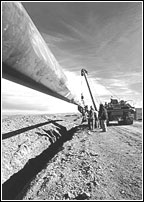
Pakistan and China have held talks on the construction of the strategic pipeline from Gwadar to China's borders. As China receives 60 per cent of its energy supplies from the Middle East, it is deeply concerned about the American presence in the Middle East which could disrupt energy supplies in a crisis. Now the Gwadar port allows China to diversify and secure its oil import routes while gaining access to the Persian Gulf.
China has also expressed willingness to construct an oil refinery in Gwadar. It would be Pakistan’s biggest refinery, which would refine 60,000 barrels of oil per day. A major oil refinery at Gwadar would further facilitate China’s oil imports. It has also shown interest in Balochistan’s metallic resources. It is already developing the largest reserves of gold and copper in the Saindak.
Despite the province's wealth of natural resources, Balochistan is the poorest and most restive province; the area is in the grip of poverty with 45 per cent of the population living below the poverty line. Local population lacks basic necessities like health, water, food and education. Village electrification is merely 25 per cent. .
The state of security is also not conducive to lure big investment. The supply of gas from Sui and other gas fields has been completely suspended a number of times due to attacks by local Baloch tribe. They have also targeted water pipelines, power transmission lines and gas installations. The violence not only results in loss of human life and property and discourages foreign investment.
When Nawaz Sharif government decided in 1992 to build a seaport at Gwadar Baloch nationalists supported the idea but subsequent developments like the creation of a land market, a planned military base and the expected massive inflow of non-Balochis in a province created fear in Balochis that they may become a minority in their own land.
The unrest started in 2003 and has intensified with time. The rape of a female doctor on January 2, 2005, in the hospital in Sui and later on August, 27, 2006, Nawab Akbar Khan Bugti was killed in a military operation..
Balochistan is sparsely populated; according to the 1998 census, the ethnic make-up of the province includes 54.7 per cent Baloch tribes and 29 per cent Pashtun tribes. With the development in Gwadar, population of Gwadar and its surrounding areas will rise from 70,000 to almost two millions. The Balochs are convinced that the majority will be outsiders.
Balochistan has failed to benefit from its own natural resources. The first natural gas deposits were discovered in Sui in 1953. Gas was supplied to Multan and Rawalpindi, in Punjab, in 1964; but Quetta had to wait until 1986 for its share of the gas, which it received because the central government decided to station a military garrison in the provincial capital.
Although natural gas from Balochistan accounts for 36 per cent of Pakistan’s total gas production, the province consumes only 6.12 per cent of its output. The natural gas is being used in the country as feedstock for the production of fertiliser, petrochemicals and power plant. But not a single unit is installed in the province.
In addition, the central government charges a much lower price for Baloch gas than it does for gas produced in other provinces, particularly Sindh and Punjab. Moreover, Balochistan receives no more than 12.4 per cent of the royalties due to it for supplying gas.
The Saindak copper and precious minerals project was supposed to provide training and employment to local youth. The project halted for ten years because of the unwillingness of the federal authorities to provide Rs1.5 billion for it to proceed. It was revived however, with assistance from the Chinese who receive 50 per cent of the profits. Of the remaining 50 per cent, only two per cent accrues to Balochistan, while Islamabad receives 48 per cent.
The Balochs had only a small role in the construction of Gwadar port, a project entirely under the control of the central government. Of the nearly 600 employed in the construction of the first phase of the project, only 100 persons-- essentially daily-wage workers-- were Baloch. No effort was made to train the local youths so that they can find work with the development project.
Gwadar has only one intermediate college while there is not a single technical school or college there or even in the surrounding area. Most of the locals rely on fishing for a livelihood and have lost the prime source after the port was constructed. The project will benefit the local people only when efforts are made to train local residents and the port is linked with the rest of Balochistan.
In addition, the land around the port was acquired below market price by the Pakistan Navy and Coast Guard and distributed to officers has since been subject to a great deal of financial speculation. Mostly non-Baloch have won major jobs and contracts from the armed forces and have benefited from land speculation.
According to the layout plan, both Pakistan-Iran (PI) Gas Pipeline as well as Turkmenistan-Afghanistan-Pakistan-India (TAPI) pipeline will pass through Balochistan. The attacks on pipelines inside Balochistan with increasing intensity are raising concerns. Although import of gas through pipelines from the Middle East and Central Asia is economically feasible, the state of security in region is not conducive to lure foreign investments.
This suggests that the military solution may well prove to be mission impossible unless grievances of local Balochs are addressed and they are brought on board. They also resent their land being parcelled out to outsiders and the impact of development projects in the province which does not benefit them..
Gwadar can serve as a corridor for potential investors/businessmen. It is only the political reconciliation that can ensure ideal security environment for sustaining ongoing development process and luring foreign investment that will help the province and eventually the country in the long run.