0
0

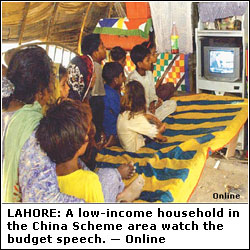 ISLAMABAD, June 9: Flavoured with relief and other populist measures ahead of elections, the government presented a Rs1.874 trillion consolidated federal budget for 2007-08 in the National Assembly on Saturday, envisaging a revenue target of Rs1.025 trillion, defence spending of Rs275 billion and a fiscal deficit of Rs398 billion.
Total subsidies of Rs113.9 billion are, however, just 5.6 per cent or Rs6.3 billion higher than the current year’s Rs107.6 billion. A major chunk of the subsidies — Rs98 billion — is meant for Wapda, KESC, textiles, petroleum companies and refineries.
About Rs23 billion has been kept for the import of fertilisers and to meet official losses in previous wheat and cotton imports and Rs7.5 billion for sugar import in a year of surplus sugarcane production. This leaves only Rs2.45 billion subsidy for commodities to be sold through utility stores including pulses, sugar, and ghee against Rs983 million during the current year.
Perceived to have been prepared keeping in mind the looming elections, the Minister of State for Finance, Omar Ayub Khan, who read out the speech amid opposition protest, described it as a budget of relief, budget of investment, budget of a fast-growing economy and a budget of the people. He said it would reduce the prices of kitchen items, ensure self-sufficiency and welfare of the people. In this context, he announced some populist steps offering benefits to the working class, including a 15 per cent increase in salaries of government employees.
Similarly, new pensioners would get 15 per cent increase in their pensions while a handful of older pensioners who retired before 1980 would get a raise of about 20 per cent.
“This budget addresses the crisis created by the Chief Justice’s suspension and, of course, it is the election year as well. The crucial question is whether it will be a case of too little too late,” said an insider.
The total budgetary outlay of Rs1.874 trillion for the next year is almost 25 per cent higher than the current year’s budgetary estimate of Rs1.5 trillion.
Budget deficit at Rs398 billion is estimated to be about 6.5 per cent higher than the current year’s budget estimate of Rs374 billion.
As ratio of GDP, the budget deficit would fall slightly to 4.0 per cent against 4.2 per cent during the current year. This would be met through external resources of Rs258 billion, about Rs131 billion bank borrowing and remaining through the national savings. Overall size of the economy (GDP) has been estimated at almost Rs10.007 trillion ($166 billion).
The share of current expenditure in total budgetary outlay is 66 per cent as compared to 72.4 per cent in revised estimates for 2006-07. The expenditure on general public services (inclusive of debt servicing, transfer payments and superannuation allowances) is estimated at Rs642 billion which is 60.9 per cent of the current expenditure.
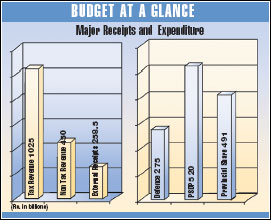
The target for CBR tax revenue at Rs1.025 trillion would be almost 22 per cent higher than this year’s original estimates of Rs841 billion. The defence spending has been estimated at Rs275 billion against Rs250 billion this year, up by about 10 per cent.
 One of the most critical features of the budget would be a staggering 54 per cent increase in current expenditure __ projected at Rs1.353 trillion, against Rs880 billion this year.
Of the Rs1.03 trillion total tax revenue, direct taxes are estimated at Rs408.25 billion while indirect taxes have been put at Rs622.3 billion.
The budget has projected to transfer a total of about Rs491 billion to the provinces as their share of net proceeds of the federal divisible pool and grants including subventions.
The public sector development programme (PSDP) has been estimated at Rs520 billion against Rs415 billion of the current year, showing an increase of about 25 per cent.
An amount of Rs275 billion has been allocated for defence expenditure against Rs250.2 billion of the current year, showing an increase of almost 10 per cent. The education sector, including higher education, would get a total of Rs24.5 billion, which is about 22 per cent higher than current year’s Rs20.1 billion.
Mr Ayub said the government wanted to provide benefit to about 87,500 federal employees and hence clerical staff in the grades of 5, 7 and 11 have been upgraded to grades 7, 9 and 14 respectively.
The resource availability has been estimated at Rs1.394 trillion against Rs1.1 trillion in 2006-07. Net revenue receipts have been estimated at Rs902 billion, indicating an increase of 28 percent over the budget estimates of 2006-07.
Likewise, the provincial share in federal revenue receipts is estimated at Rs466 billion which is 23.2 percent higher than the budget estimates of the outgoing year. The capital receipts (net) have been estimated at Rs59 billion against the budget estimates of Rs16 billion for 2006-07. The external receipts are estimated at Rs259 billion, up by eight per cent over the current year.
The minister said the government would build 5,000 housing units in Islamabad for low-paid government employees. Land would be provided by the Capital Development Authority at government rates and the employees would get loan for construction.
The budget also improved minimum wages of unskilled workers from Rs4,000 to Rs4,600, raised EOBI pensions from Rs1300 to Rs1500, all workers made entitled to disability compensation and increased death compensation under workers welfare fund to Rs300,000 against Rs200,000 at present.
Daal Chana, Moong and Mash, being sold at Rs38, Rs56 and Rs72 per kg would be sold through utility stores at Rs29, Rs47 and Rs57 per kg, respectively. Similarly, a per kilo relief of Rs10, Rs5 and Rs5 would also be provided on tea, sugar and rice respectively. The cooking oil would also be sold at Rs67 per kg against market price of Rs80. About 5,000 additional utility outlets would be opened within four months at union council level to increase the outreach.
The budget also offered 25 per cent subsidy on electricity charges on agricultural tube-wells to be equally shared by the federal and provincial governments.
The minister of state for finance also announced construction of Rs84.5 billion Neelum-Jhelum Hydropower project in Azad Kashmir for which Rs5 billion would be provided next year. Likewise, Rs500 million have also been earmarked for Bhasha-Diamer Dam and related upgradation of Karakoram Highway. About Rs29 billion have been allocated for the development of National Trade Corridor to enable the National Highway Authority to start different highway projects costing Rs147 billion.
In tax measures, investment in private equity funds has been tax exempt till 2014 and the capital gains tax on sale of asset share of private companies to private equity and venture capital has been reduced from 35 per cent to 10 per cent.
A new concept of real estate investment trust (REIT) has been introduced for investment in capital markets to enable small investors to reap profits from investment in real estate and the distribution of profit of RIET would be tax exempt up to 90 per cent. Sellers of property will be exempt from tax up to 2010.
The minister said that tax reforms will continue and a zero-rated tariff slab has been proposed to reduce cost of raw material. Similarly, the duty on import of machinery for horticulture, furniture, marble and granite, surgical and medical instruments has been withdrawn. The customs duty on energy-saving devices has been reduced by five per cent to 10 per cent.
Capital value tax on imported vehicles has been withdrawn. However, adjustment in customs duty at the rate of 5 per cent, 10 per cent and 15 per cent for different capacity cars has been introduced while a five per cent levy has been imposed on local vehicles. There will be no customs duty on 800cc cars. Generally the import of cars under various schemes has been discouraged to encourage local industry.
To control trade deficit owing to rising imports, one per cent levy has been imposed on all imports except petroleum products, edible oil, fertilizer, medicines and necessary food items besides already exempted items.
Textile sector has been given some incentives under DTRE scheme for research and development facility. Sales tax reduction has been offered for import of raw material for iron, steel, plastic and paper industries.