



 0
0

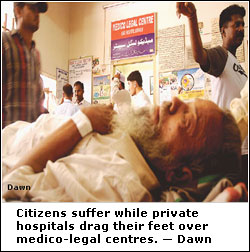 KARACHI, June 9: A government proposal about conferring medico-legal status — ie the legal cover to attend to trauma cases — on private sector hospitals has been pending for two years, Dawn has learnt.
On the one hand, there has been a delay in appointing medico-legal officers (MLOs) to private hospitals.
On the other, private hospitals are reluctant to attend to injuries that have subsequent legal implications, such as gunshot wounds or accidents, and refer such patients to public sector tertiary care units where MLOs are present.
Currently, no private hospital in the city has medico-legal facilities and while nine public sector hospitals have the required departments, only three of these are functional since the others lack the resources to entertain medico-legal cases. This is grossly inadequate in a city of 16 million people where at least 550 people die every year from road accidents alone.
“We will appoint medico-legal officers without delay once private sector hospitals are ready to provide the necessary space and apparatus,” said Dr Abdul Majid, the government of Sindh’s Special Health Secretary (Public Health). He told Dawn that private hospitals are willing to accept a medico-legal status, as long as the government builds a separate building containing the emergency operation theatre, apparatus and even appoint the doctors.
This, he said, would create a hospital within a hospital, which was not feasible. However, private hospitals point out that the government has taken no steps to improve emergency centres at established hospitals that already have medico-legal facilities.
In cases where legal proceedings are likely, such as accident or assault, the law of the country requires that an MLO examine the patient before treatment and issue a medico-legal certificate that records the nature, cause and gravity of the wounds. After this, the victim is attended to by the hospital’s regular staff of doctors and surgeons. Where a victim dies an unnatural death, the post-mortem examination to ascertain the cause of death is carried out by an MLO.
The city’s expansion and increased traffic congestion in recent years means that the closest medico-legal hospital is often relatively far. According to sources in public tertiary care hospitals, a large number of people injured in accidents, terrorist attacks or clashes die on the way to a public sector hospital where medico-legal facilities are available. Private hospitals, conversely, are spread across the city.
Medico-legal departments exist in the following nine hospitals: Civil Hospital in Saddar Town, Abbasi Shaheed Hospital in Nazimabad, Jinnah Post-graduate Medical Centre (JPMC) in the Clifton Cantonment Board, Qatar Hospital (Orangi), Government Hospital Korangi, Lyari General Hospital, Sindh Government Hospital Liaqatabad, Government Hospital New Karachi and Government Hospital Saudabad.
Of these, only Civil Hospital, JPMC and Abbasi Shaheed Hospital have functioning medico-legal departments. The rest lack the resources and equipment to carry out these duties.
This means, for example, that a patient injured in Malir or its adjoining areas has to be taken to the JPMC, which is at least an hour away, instead of the nearby Government Hospital Saudabad. Similarly, there is a medico-legal department in Government Hospital Korangi, but all such cases are referred to the JPMC.
Doctors point out that the implications of this increased distance, particularly in life-threatening injuries, are obvious.
According to Dr Seemi Jamali, deputy director JMPC, most medico-legal cases arrive at JPMC and almost all neurology-related cases – such as head injuries – are referred here since it is the only public sector hospital that has the required equipment. “We have a heavy load of emergency and trauma patients who need medico-legal certificates,” she said, proffering the view that other hospitals should share this burden and the government should develop policies in this regard.
Hospital sources told Dawn that the five inoperative centres lack the resources to treat emergency cases. The problem has been compounded, they said, by a new system introduced in 2002, under which the presence of a forensic expert and a judicial magistrate is mandatory during the post-mortem examination of custodial deaths. They said the autopsy is usually delayed since both officers are often not available simultaneously.
Even where medico-legal departments are operational, the situation remains grim. An investigation conducted by Dawn revealed that inadequate allocation of funds and the lack of proper facilities are impeding the performance of medico-legal doctors at the JPMC, Civil Hospital and Abbasi Shaheed Hospital.
Doctors complained that they lack the apparatus to properly examine the nature and extent of wounds, particularly where invasive measurements are required. The accuracy of such data is crucial in subsequent legal proceedings. They said that modern techniques and equipment, such as electrically-operated cutters for bone, have not been introduced and MLOs have to perform post-mortem examinations with crude and obsolete apparatus.





























