PML-Q under fire
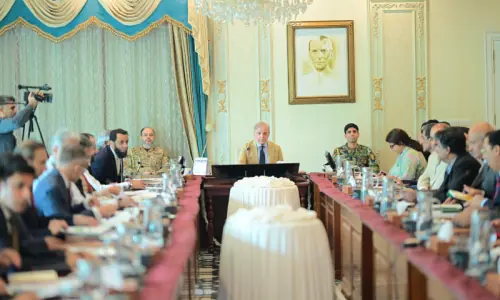
IN quick succession, President Pervez Musharraf and Prime Minister Shaukat Aziz have expressed their displeasure at the PML-Q parliamentarians’ indifference to the present political turmoil and regretted that most of them had not considered it their duty to support the government in its hour of crisis. Addressing a meeting of the ruling coalition’s parliamentary group on Wednesday, the president said that the PML-Q men always left him in the lurch in moments of crisis, even though there were 1,000 of them. Whether it was the A. Q. Khan case, the death of Akbar Bugti or the current judicial crisis, “I see the party nowhere”. The country, he said, would be in deep trouble if the present system came to an end. On Thursday, the prime minister spoke in the same vein and said his partymen had either lost heart, joined the opposition or were keeping quiet deliberately.
That the army chief should seek political support from parliamentarians may sound odd in a normal democracy, but in Pakistan, where the military has long entrenched itself in the political system by constitutionalising its role, this does not seem peculiar. Indeed, the lament does one good thing: it gets us an admission from the general-president that in crises what matters is support from the much-denigrated politicians and not from the military high command. Let the president admit: the exercise of power is a much more serious and complex business than the simplistic formulae our generals in politics have often come up with. Seizing power through a coup d’etat, making arbitrary changes in the Constitution, having all this validated by a compliant judiciary and getting hold of a group of yes-men for supporters may see a general through for a while, but sooner or later the façade gives way to reality — and the reality in this case is that the PML-Q is hardly a party that has the will or the power to swing the situation in its favour. The ruling coalition is a rag-tag group of turncoats and men with a dubious past. They have found their way into the corridors of power because they gravitated toward the strongman in their pursuit of power and pelf. They stood to gain because the general was in a position to deliver. Now that he himself is in trouble and trying hard to get out of it, the PML-Q seems hesitant about coming to his rescue. If some still support the general, it is with a clear knowledge that they are being watched, and lack of support at this stage could mean a denial of party tickets for the next election.
The crisis that began on March 9 does not seem to be abating. If there is any move that can take the heat out of the current ferment, it lies in the announcement of a firm date for the general election. Statements by some ministers suggest that an election could be as far away as January. This is absurd. The National Assembly’s term expires in November, but that is no reason why the polls cannot be held earlier. Given the intensity of the crisis, it is in the government’s own interest to advance the election. Continued uncertainty will harm the government in the sense that the bureaucracy and the law and order machinery could come under serious pressure and cause more problems for an administration that is so keen to restore normality in the country.
Dialogue on the Pemra front
THE prime minister’s initiative in suspending the implementation of the amended Pemra ordinance is a step in the right direction. Given the resentment the tightening of controls on the electronic media has given rise to, the government has done well by entering into a dialogue with media proprietors in a bid to resolve the differences that the newly introduced amendments in the Pemra ordinance have created. A confrontationist approach only leads to a deadlock and intensifies the crisis. The committee that has been set up will, hopefully, address the concerns of both sides. However, it hardly needs to be emphasised that had the composition of the committee included the representatives of journalists,
its deliberations would have taken into account their views as well. The emergence of private television channels in Pakistan is a new phenomenon. True the government can take credit for allowing and facilitating their growth but it seems that it has also been somewhat taken by surprise at the impact of television on society and public opinion.
As such, the teething troubles that the electronic media was facing, especially
in terms of the regulatory framework for their operation, have not been resolved yet. If anything these troubles have been intensified, thanks to the government’s knee-jerk reaction in the form of draconian curbs on the media such as allowing Pemra to ban channels or seize their equipment and impose heavy fines on them — all without giving them a chance to defend themselves before an independent forum. The media which has its own representative bodies should be encouraged to draw up its own code of conduct to be strictly followed. It is also important that Pemra, the regulatory body, should not operate under the ministry of information. In this position, Pemra is likely to exercise excessive controls because it is partisan and biased in favour of the government. To be effective and even-handed, any regulatory body should be independent and constituted by the parliament. Obviously, the government has its own complaints under the present circumstances. But that does not entitle it to use ham-handed methods to silence critics and crack down on the media.
Rise in kidnappings
THE downside of cellular technology is evident from the rise in cases of kidnapping in Karachi. The connection between the two lies in the kidnappers using cellphones to make calls to their victims’ families and demanding ransom. Not only is it difficult to trace a call from a cellphone, but with the unregulated sale of SIM cards it is hard to ascertain the identity of the cellphone owner. According to a story in this newspaper on Friday, the CPLC’s success rate in tackling kidnapping cases stood at 75 per cent in 2003 whereas today that figure has dropped to 70 per cent. The chief of the CPLC blames this on the fact that so many criminals get cellphone connections on fake identity papers; one estimate has it that 0.75 million SIM cards have been issued on fake papers. However, this is only one aspect of the problem. Despite tracking down a few members of a gang early this year, their organisation is still active. Another gang which kidnaps people and takes them to the tribal areas of the Frontier is also at large even though the provincial home department’s assistance has been sought in the matter. It clearly calls for a different strategy.
It is not just a few gangs known to the police that threaten people’s safety in Karachi. There are numerous incidents of people being held hostage in their cars and made to pay for their freedom. Such crime must be dealt with now before it reaches the alarming proportions it once did in 1990 when 79 cases were reported. The police, the CPLC and the Anti-Violent Crime Cell are working together in this regard but will need to step
up efforts, as well as coordinate with relevant departments, to find the men behind these heinous crimes and ensure that they are caught and punished.
In a state of delusion and denial
“WE have hit rock bottom,” were the prophetic words spoken by Gen Pervez Musharraf on the day of the coup on Oct 12, 1999. The self-declared chief executive had toppled a legitimately elected prime minister of Pakistan and his government.
The chief executive’s ship went on to sail into the presidency where it was duly “legitimised” through a referendum held in a “free, fair and transparent” manner. Can Gen Musharraf measure how far the “bottom” has deepened and widened since?
It is of no use delving into the accursed history of this poor country where army rule is more the norm than the exception, where nothing seems to be working and where matters are regressing. Does Prime Minister Shaukat Aziz, a former banker, know that the Pakistan’s downtrodden people are paying eight rupees for a piece of bread for which they paid two rupees before his economic policies were fully implemented?
Pakistan today has become one of the most violent countries in the world. Only an insider knows how much is spent on the security of the president and the prime minister and what elaborate and foolproof arrangements have to be put in place for them. Among the most disturbing developments is the proliferation of FM radio stations in the NWFP spitting venom against any and everything. Yet, the government is behaving like it did on May 12 in Karachi.
The ugly and tragic scenes of May 12 will continue to haunt us for a long time. Pakistanis have always looked up to the army for protection in cases of political victimisation and grave injustices. But when a serving army chief is, allegedly, identified with a political group involved in killing its opponents, who do the citizens turn to? Rather than go into mourning at the national level at the loss of innocent lives, the beating of drums heralds the arrival of the emperor. How callous can one be? Are we beasts or butchers or both? There were more than 40 dead bodies but the hired crowds danced in front of the parliament building in Islamabad.
Meanwhile, in true Goebblesian fashion, Information Minister Muhammad Ali Durrani, his deputy Tariq Azeem and Law Minister Wasi Zafar, who are always in denial, have been cheeky enough to deny the gory game or hold its perpetrators responsible. All this had been captured live on television and beamed across the world. However, the fear of God might soon see them taking the lead in abandoning the sinking ship.
Irrespective of the polemics of the Chief Justice’s rights and wrongs, the legal fraternity has stood up in a contest between the “the blacks and the khakis.” Their resolutions and revolution is a watershed in our chequered history. The genie has come out of the bottle and trying to put him back in will only mean breaking the bottle and sustaining wounds in the bargain. Our sleuths are only peacetime warriors and one should remember that the lawyers have the following of the masses who cannot disappear by blacking out TV channels.
In the prevailing chaos, the worst affected institution is the army. Why must the army, as an institution, be dragged into the dirty world of politics — because the chief of the army wears two hats? It simply does not make sense to criticise him as a civilian but not as an army general. The flawed and failed policies and priorities of the president are putting everything at risk. Incompetence coupled with inefficiency combined with arrogance and myopia is a toxic mix. The country’s social fabric has been torn apart. All systems are heading towards a grinding halt. The gulf between the haves and the have-nots has further widened.
General Musharraf wants an extension of five years in his tenure from a dead, rubber-stamp parliament, but for approval of his performance he runs to the corps commanders who have too much at stake to speak their minds while the ISPR chief says everything’s okay. Dr Ayesha Siddiqa’s ‘Military Inc: Inside Pakistan’s Military Economy’ is a must-read for all officers. Be brave and courageous. Show maturity and magnanimity. Don’t enforce your failing and failures. A fine strategist must have an exit strategy.
The group of parasites who are misguiding the general for their own survival will anyway outlive him. A time comes in the life of each soldier and general where he must shed his uniform honourably and in Musharraf’s case it is already past that time. The immediate reinstatement of the Chief Justice and free and fair elections under an independent election commission can give us faint hope of survival.
General Musharraf should refrain from making the blunder of having himself reelected by the present moribund assemblies. Now is the time for him to avoid reading several intelligence reports and to just read the newspapers to feel the pulse of the nation.One should remind him of what is prominently displayed at the frontier force regimental training centre in Abbottabad: “Sweat saves blood, Blood saves life, Brain saves both.”
The writer is a retired air vice-marshal and a member of a PPPP think-tank.
There is no military solution
THE team that wrote President Bush's Prague speech on democracy this week have clearly never visited Afghanistan. Otherwise they would not have had the president quoting a Soviet dissident who compared "a tyrannical state to a soldier who constantly points a gun at his enemy". The guns that most Afghans see pointed at them are held by Americans, and they are all too often fired. At least 135 unarmed civilians have been reported killed over the past two months by western troops, mainly US special forces.
The deaths by ground fire and US air strikes have become so frequent that last month the upper house of Afghanistan's parliament did something it has never done before. It called on the Nato-led forces to cease taking offensive action against the Taliban and asked the Afghan government to talk to the insurgents, provided the Taliban accept the country's new constitution. It also asked for a timetable for the withdrawal of foreign troops.
The upper house is not normally a radical body. More than half its members were appointed by Bush's friend, President Hamid Karzai. Its speaker is a moderate former mujahideen leader who was driven from power by the Taliban a decade ago. That men with this background should now be expressing doubts over Nato's tactics and even over its presence in Afghanistan sends a powerful signal.
Five years after western forces arrived here, the upper house's concern reflects an impatience with them that is widespread in Kabul. Initially the International Security Assistance Force (Isaf) was considered too passive.
The demand was for it to deploy out of Kabul to the non-Pashtun north and west, and arrest or disarm the warlords. Although these were anti-Taliban figures, they ran their areas like fiefdoms, neglecting development and stealing revenues.
After a two-year delay Isaf did move out, and now runs so-called provincial reconstruction teams in most provinces. It still leaves the warlords alone, since confronting them is considered the Afghan government's job. Some have been sidelined by Karzai, but given good jobs in Kabul.
Others were elected to parliament, after attempts to ban militia leaders from being candidates were dropped. None has been put on trial — a cult of impunity that also benefits a new generation of corrupt officials.
In the Pashtun south, the Taliban's homeland, the west did little. Instead of pumping in aid while the defeated Taliban were still demoralised, the Taliban were given three years to recover.
Now that Isaf has finally gone into the south, the complaint is that it is too aggressive. Isaf troops demolish houses, empty out villages, displace tens of thousands of people, and use indiscriminate firepower that kills innocent civilians. Isaf's task is complicated by the presence of over 10,000 US troops who are not under Nato command but operate in the same zones, killing more Afghans than Isaf, and giving all foreign forces a bad name since no one can understand the difference.
Making a priority of "force protection" - which means that soldiers on patrol or in convoy treat every Afghan as a potential enemy and fire on anything suspicious - has helped the Taliban to gain recruits. Before 9/11 the connection between the Taliban and Al Qaeda was only at the leadership level, and tenuous at best.
Now it is pervasive and at the grassroots. Young Afghans are strapping on suicide belts, a technique imported from Iraq - it was never used against the Soviet occupiers two decades ago, and shocks older Afghans as a perversion of their warrior nation's traditions. But it helps to make Isaf and US special forces even more jittery, feeding into the instinct to over-react.
Last autumn, British commanders tried to break out of excessive reliance on military force. They made a potentially precedent-setting deal with tribal leaders in the town of Musa Qala by agreeing to withdraw provided the Taliban did not move in. The deal was sabotaged by the Americans and, as on many earlier occasions, Tony Blair failed to stand up to the White House. He let the Musa Qala experiment fizzle out.
—The Guardian, London
| © DAWN Group of Newspapers, 2007 |