0
0

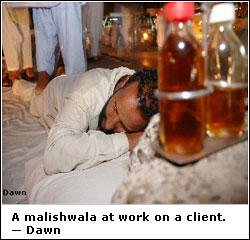 KARACHI: Cantt Station is usually always abuzz with activity. But after 7pm, this hustle and bustle becomes even more pronounced as charpoys start to appear before the hotels and motels and malishwalas, or masseurs, start gathering on the footpath to ply their trade.
Each of them has divided among themselves a particular portion of the pavement, which is marked by their particular white sheets and a pillow. Their customers include weary passengers, drivers and labourers, some of whom are regulars while others are simply curious to see just what magic these characters can work on their tired and tense bodies.
It seems that over the years malish (massage) has gained quite a bit of popularity among Karachians, as many people, mostly from the rural areas of Punjab, can be seen on the streets of the city -- bottles of oil in hand -- calling out to customers with the distinctive clink of their bottles.
Massage is a technique by which the blood circulation to a particular area of the body can be increased. The history of massage goes back more than 4,500 years: the Chinese used to treat various ailments through massage; in ancient India Ayurvedic treatment included massage with aromatic oils; while even Julius Caesar was known to have a daily body massage to ease his stress.
In Pakistan, too, massage is an age-old profession, passed on from one generation to the other. These malishwalas, called masseurs in expensive spas and saloons, are well aware of the ins and outs of the human body and can relax nerves and muscles with a flick of their hand. At times they can ease the body to such an extent that their clients fall asleep then and there.
The experts or gurus of the field charge between Rs200 to Rs500. They are usually spotted near the Quaid’s mausoleum and in front of some famous tea houses. They spend an average of more than an hour on a single client. Seen after 10pm, these people usually draw more affluent clients, who drive up in their own cars.
However, the malishwalas found at Cantt Station are novices and have only recently adopted this profession. They have learnt only a few tricks of the trade and have chosen this field as they could not adjust elsewhere. They charge no more than Rs50 to Rs70.
The majority of these malishwalas hail from Multan and its surrounding areas. With their families back in their hometowns, these men try to make as much money as possible so that they can send a major portion of it back to those at home.
As this scribe approaches them with a photographer, some turn out to be shy and do not wish to speak to a woman, while others are completely rude in their behaviour.
Rafiq, however, who doesn’t have a client at the moment, reluctantly agrees to answer a few questions.
He says that like many of those in this line of work, he has learnt the art of massage from his ustad some 10 years ago (which turns out to be a common story). Though his entire family works on the fields, he has come to the city to supplement his family’s income.
“I have five kids and I want them to study,” he says, a smile breaking out on his face at the mention of his children. He says he used to work as a labourer, but that job was too unpredictable. In the massage business, he says, he can manage a “decent living.” The decent living, he explains, is something between two to three thousand rupees. He says that he desires nothing big from life; just enough money so that he can provide his family with bread and butter.
Not hailing from Karachi, these masseurs know little about other localities of the city except for the ones where they work. Therefore, they prefer to stay with people of the same area, feeling protected in one another’s company.
When this writer asks the malishwalas if the rumour about them being involved in “other activities” is true, they reply in the negative. They claim that they would not have been so openly sitting here if they were involved in any activity besides massage. They say that the allegations levelled against them of depriving their clients of wallets and money while giving them body massage are false.
Syedur Rehman, a taxi driver, who is busy having a rather rough massage, reaffirms that he has never come across such masseurs. He says that he has been coming to this place for almost a year. He explains that the reason he comes here is because: “I get so tired at times and my muscles are so stressed that I feel I won’t be able to sleep if I don’t have a massage.”
However, he points out that none of his friends go for body massage. The taxi driver also complains about the kind of oil that is used by the malishwalas, saying that far from being aromatic, it is merely cheap mustard oil.
His masseur, Shabbir, laughs at the jibe and answers in the same coin by saying: “What do you expect me to do with the Rs30 that you pay me?”
Shabbir says his work is nothing short of labour.
“It is sheer hard work. I get so tired working from seven in the evening till seven in the morning that I feel I, too, can have a massage for a change,” he chuckles.
But not all malishwalas are lucky enough to have their own slab of pavement. Mohammad Shareef, probably the only bachelor malishwala of Cantt Station, has to use whatever vacant space is available.
Some people believe that more than the impact of the massage, the psychological impact of going somewhere to relax is the key factor behind massage’s popularity. They reason that when one approaches a masseur he is mentally prepared to relax. And in these tense times, perhaps it is only natural that the malishwalas are enjoying somewhat brisk business.