



 0
0

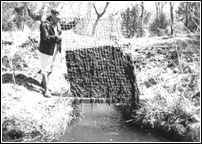 FAISALABAD, one of the largest industrial hubs, currently has more than 250 industries. These industrial units discharge untreated effluent containing high levels of soluble salts, heavy metals, aromatic dyes, inorganic salts, and organic materials directly into municipal sewers and open surface drains, ultimately draining into the Ravi River.
At the Institute of Soil and Environmental Sciences, University of Agriculture, Faisalabad, analysis of effluent collected from the drains of dyeing, printing, vegetable oil and textiles industries were found unfit for irrigation because of hazardous salinity and sodicity. However, among metal ions only copper and chromium were found above industrial disposal limit prescribed by the government.
It was noted that effluent of two major drains—the Madhuana, and the Paharang drains -- of Faisalabad was unfit for irrigation owing to higher levels of salinity and sodicity. Quality of the Paharang drain water was found the worst as large number of industrial units were located around it. Of the existing water supply system in Faisalabad of approximately 62 million gallons, 56 million gallons are obtained from tube-wells installed near the Chenab River and rest is pumped locally to the growing demand of the population.
According to estimates, only 10 to 20 per cent of water supplied for municipal and domestic use is depleted and the rest 80 to 90 per cent reappears as wastewater. It is obvious that with the increase in population demand for fresh water has increased which has resulted in increased quantity of effluent.
Though traditionally ground water was not a major source of supply in Faisalabad, the inadequate supply for the rapidly increasing population and accompanying industrial and urban development has made it an alternative source for urban dwellers, either directly or indirectly. Individual users (homes or industries) extract ground water through shallow suction pumps within their premises.
Agriculture has been suffering often and on from severe shortage of irrigation water in recent past. Due to unreliable and erratic rainfalls there is continuous decline in the availability of surface water for agriculture. Surface water availability at canal heads was 103.5 MAF during 2000 which decreased to 82.2 MAF during 2005. According to an estimate, the future water requirement would increase up to 277 MAF in 2025.
To augment irrigation supplies, farmers near cities have to depend upon municipal raw effluent for raising crops, fodder and vegetables. This raw effluent contains heavy metals in addition to soluble salts, plant nutrients, pathogens and suspended particulate matter. There is little or no facility with industries and municipalities for treatment of wastewater. What appears as sewage effluent, only 10 per cent of it is treated to primary level while 90 per cent is discharged without any treatment.
Wastewater from domestic and industrial areas is disposed into the same sewer system. According to a survey about 62,000 hectares around Faisalabad, 93,000 hectares around Lahore and 50,000 hectares in Hyderabad suburbs were irrigated with raw effluent for growing crops particularly vegetables. This area has increased tremendously during the last decade because of the reasons mentioned-above.
A survey study conducted by scientists at the Institute of Soil and Environmental Sciences, University of Agriculture, Faisalabad, revealed that this alternative source is affected due to discharge of raw effluent from dyeing, printing, electroplating, textile and metallurgical industries directly into unlined drains. The improper management of raw effluents, large unlined conveyance system used for irrigation, resulted in a very leaky distribution system that has led to contamination of soil and ground water.
Though biological contamination was not determined, metals like nickel, manganese and lead were found above permissible limits established for drinking water. Ground water quality along drains improved with the distance from the drain, according to the survey.
Farmers around big cities are dependent on sewage effluent for irrigating their crops for many years. As domestic and municipal effluent is rich in sodium, chlorides, sulphates and carbonates and bicarbonates, irrigation with such water over a longer period may lead to development of salinity and sodicity. Research studies have shown that continuous use of sodium-rich sewage effluent has resulted in salinity and sodicity of the otherwise productive and fertile soils. Among metals generally zinc, copper and manganese concentration in soils were found above the safe limits set for growing for food and fodder crops. The salinity, sodicity and toxic metals values in soil profile were higher in the surface soil than sub-surface soil.
Concentration of trace metals in sewage sludges effluent has been and is one of the major factors limiting their disposal onto agricultural lands. It is recommended that sewage and industrial effluent irrigation should be discouraged and at the same time industries and municipalities are advised to treat their effluent before discharging it into surface irrigation system to minimise its environmental hazards.
Most of the agriculturally productive soils in this country are presently in use; food production cannot simply be relocated if existing farmland is degraded. Our best agricultural soils need to have their productivity and crop quality to be protected not for 10, 20 or even 100 years, but in perpetuity. To this end, a cautious approach to the application of toxic metals to agricultural soils through sewage effluent or sewage sludge application would be prudent.





























