



 0
0

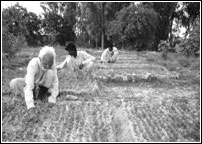 IN developing countries agriculture continues to be the main source of employment and livelihood for between 50-90 per cent of the population.. And small farmers constitute the majority, up to 70–95 per cent of the farming population.
Small farmers have traditionally survived on subsistence production. Many in the last two decades have experimented with export crops with occasional initial success but many with disastrous failures. Industrialisation and export orientation of agriculture have not benefited them. In the globalised market, small players have been marginalised. Yet economically they should not be ignored. Policies which have led to their marginalisation have meant the continuation of the vicious cycle of poverty for segments of society, highly uneven development and hence the inability of many developing countries to attain satisfactory levels of overall development.
Considering the relative number and area of farms in our country, about 4.79 million farms (94.47 per cent) have an area of less than 12.5 acres which may be categorised as small farms, while only 5.53 per cent of the total 5.07 millions farms have an area of more than or equal to 12.5 acres. These small farms are occupying a pivotal position both in terms of number and area, making it essential to improving their operational performance for a sustained and broad-based economic development. Many of the owners of small farms may be too poor to participate in the process of agricultural development. An increased participation of small farmers is not only essential for any substantial breakthrough in agricultural development, but is also desirable to reduce unemployment in rural areas.
Theory of agricultural dualism assumes the small-scale peasant sector to be endowed with plentiful family labour with low or zero opportunity cost, while facing a severe constraint on credit. The large-scale sector, on the other hand, relies on more expensive hired labour but has better access to capital, so the traditional sector is relatively labour-intensive and the modern sector relatively capital-intensive. Clearly, this explanation is not unreasonable.
In fact, ample evidence suggests that labour market imperfections are asymmetrical with respect to size. Thus, it has been found (i) that labour use intensity declines with farm size, (ii) that compared to the level implied by profit maximisation at market prices, the marginal productivity of labour of small land holdings is lower and that of big land holdings is higher, and hence (iii) small farms are highly productive (in terms of output per acre), but appear largely unprofitable when the cost of family labour is imputed (based on average market wage), ostensibly because of labour market imperfections.
Peasant agriculture is also subject to a credit constraint as financial institutions routinely require collateral in the form of land or other fixed assets before offering loans. They may also operate minimum floors on loan size and fixed fees which essentially prevent smallholders from obtaining the modest loans they need. Farmers with access to credit are able to purchase modern inputs, can finance land improvements and can apply more capital per unit of land. The larger the plot owned, the less binding is the constraint on credit. This is a testable statement. Where the supervision constraint works on operated land, the credit constraint concerns owned land, since land rented cannot be collateralised.
Inequality in land ownership is one of the reasons why overall agricultural yields remain below than that of other countries with similar resource endowments. Large farms have an advantage due to lower average fixed cost per unit of output as the fixed costs are spread over a larger output. The small farm firms are in a disadvantageous position, as they have to bear certain unavoidable costs with a smaller quantity of output.
A pervasive pattern in the developing countries is the low agricultural production and yield per acre. Particularly, small farmers do not have access to hired labour and credit. They lack scientific knowledge and training, have no or low education and low social status. All these factors seem to have been creating hindrance in the adoption of modern farm practices and the achievement of optimum level of input use. The lower rate of adoption of modern farm practices ultimately results in low production that leads to slow rate of economic growth. Any strategy formulated for improvement of agriculture in isolation of small farms is very unlikely to be successful in the long run.
Theory of inverse relationship between farm size and productivity which assumes that productivity falls with increase in the farm size, is one of the most important stylised fact of rural development and its policy implications are wide-reaching, especially for land reform. Hence, the inverse relationship constitutes a core argument for redistributive land reform as it implies that land reforms which equalise the size distribution of agricultural holdings will improve efficiency and equity simultaneously, thereby sparking rural growth.
For example, the early land reforms in Japan, South Korea and Taiwan were important factors behind the economic transformation of those countries, creating the agricultural surplus, ready consumer markets and political stability needed to sustain rapid industrialisation.
A similar argument concerns rural-urban migration, which is partly caused by push factors such as poverty, landlessness and unemployment in rural areas. Hence, the inverse relationship along with unequal distribution of land also underlies urban congestion and poverty.
Successful small farms must be managed intensively. They must earn more returns per acre, per rupee invested and per unit of production. The higher net returns on intensively managed farms come from the efficiency with which various practices, methods and enterprises are integrated. As different decisions have to be taken for profit maximisation like input mix and enterprise combination, so, it is necessary that knowledge about costs and returns be provided to the farmers.






























