0
0

KARACHI, May 31: A programme titled ‘Peace for all’ was organised by the Arts Council on its premises on Thursday. People belonging to various spheres of life attended it in an attempt to bring back the city’s status of a bastion of peace and the heart of the country.
Prominent poets, writers, music composers, singers, artists and sportsmen, including humor writer Mushtaq Ahmed Yusufi, fiction writers Dr Anwer Sajjad, Shakeel Adilzada and Shahida Ahmad, squash’s living legend Jehangir Khan, poets Himayat Ali Shair and Prof Sahar Ansari, sitarist Nafees Ahmad, painters Guljee and Shahid Rassam, musicians Niaz Ahmad and Arshad Mehmood took part in the event.
In their speeches on the occasion, the prominent personalities agreed that some ‘hidden hands’ were responsible for destroying the peace of the city whenever it moved towards a better future.
“Whenever Karachi attains peace and starts going, something ugly is engineered to destroy its tranquility and it gets back to square one,” said a speaker.
Another speaker said all people, including artists and other professionals, should make concerted efforts to counter the saboteurs’ attempts.
Dr Anwer Sajjad said a lasting peace could not be attained in any society till the battle between the oppressors and the oppressed continued, but everyone should dream of a better future and strive for peace.
He stressed on activism by people from all segments of society and said that there should be a coordinated struggle to achieve peace and prosperity in the city.
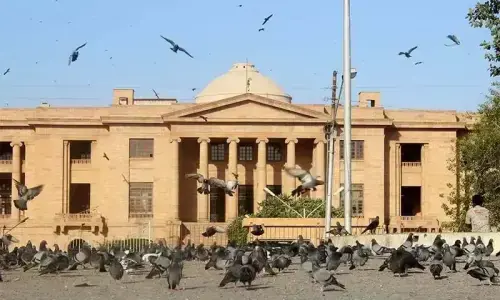
The celebrities earlier lit candles and released pigeons as a symbol of peace. Schoolchildren attended the function in good numbers. They sang songs on the theme of peace. Besides, Shahnaz Begum’s decades-old national songs continued playing in the background, enthralling the participants.
Arts Council secretary Aneeq Ahmad said the programme was an effort to remind people that Karachi was a city of `ghazals’ and not of ‘elegies’. He said the programme was a success but he prayed that peace should stay longer this time so that there would be no need for such programmes.