



 0
0

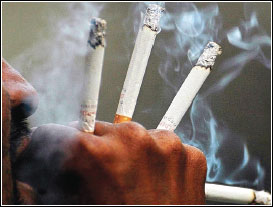 RAWALPINDI, May 30: The World No-Tobacco Day is being observed on Thursday as an effort to ‘fight the tobacco epidemic’. The World Health Organization (WHO), on the occasion, has released recommendations citing extensive evidence of harm caused by second-hand tobacco smoke and urging that all indoor environments be completely free of tobacco.
Smoking in public places and on public transport continues throughout Pakistan, as the anti-smoking law which came into force four years ago, has proved ineffective and failed to create a visible impact on the users of tobacco.
Smoking in public transport, parks, government offices, airports, railway stations, courts and hospitals continues unabated. This menace will continue until and unless the government takes strict measures to enforce the legislation which came into force in July 2003.
Tobacco burners are part and parcel of the society, and they could not be eliminated completely, however, an effective public awareness campaign could help to reduce the number of tobacco users. Together with the campaign to alert the public about the medical problems caused by smoking, the government should at the same time designate areas for smoking.
The government should ensure enforcement of the anti- smoking law by taking measures in collaboration with the NGOs. But, shockingly, smoking is common in government offices, hospitals, airports, railway stations and other public places. It is more prevalent in illiterate, married persons and those with poor general health.
However, the situation in Pakistan tells a different story. Despite signing and ratifying the WHO Framework Convention on Tobacco Control, government agencies have failed to enforce the convention in its true spirit.
In Pakistan, there is a need to implement prevention strategies, to discourage people to start smoking. It is also important to study factors under which people start smoking. However, the WHO says that tobacco is the second major cause of death.
Online adds: TheNetwork for Consumer Protection has strongly protested against the violation of anti-smoking laws within the premises of the Parliament House.
In a statement it said that a smoke-free environment is the only effective strategy to reduce exposure to tobacco smoke indoors. Smoking at public places denies the peoples’ right to a healthy living and clean air, it said.
APP adds: The global burden of deaths attributable to tobacco use each year is estimated to double if the current smoking patterns continue. It will cause some 10 million deaths each year and half the people that smoke today - that is about 650 million people - will eventually be killed by tobacco.
Smokeless tobacco causes oral cancer and might be a risk factor for cardiovascular disease, bidis increase the risk for oral, lung, and oesophageal cancers while waterpipe smoking increases the risk for oral and lip cancer and obstructive lung disease.
“The day promotes 100 per cent smoke-free environments as the only effective way to protect people everywhere from exposure to second-hand tobacco smoke,” said Dr Sharif Astory, a health professional at the Federal Government Services Hospital (Polyclinic).
Dr Asim Naeem, working with an NGO, said the most cost- effective strategies are population-wide public policies, like bans on direct and indirect tobacco advertising, tobacco tax and price increases, smoke-free environments in all public and workplaces, and clear health messages on tobacco packaging.



























