0
0

 KARACHI: Today the buzzword in these parts is development. Flyovers, expansive parks, office blocks and luxury complexes have come to signify development. But somewhere along the way we, collectively, or at least those in positions of power have almost completely neglected the cultural and architectural heritage of this city.
Development is an existential reality, but do the glorious buildings of our past need to be sacrificed to make way for another shopping mall, parking lot or luxury high rise?
The changed face of Saddar is exhibit ‘A’ in the case for the preservation of Karachi’s architectural heritage. Surely there must exist a way for both development to take its course while this city’s architectural and cultural landmarks are preserved.
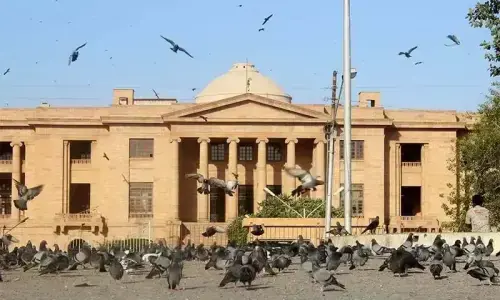
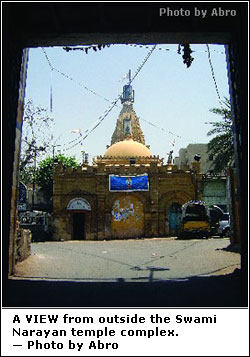
Perhaps one of the living symbols of Karachi’s storied past is the Swami Narayan temple, located off M.A. Jinnah Road – one of Karachi’s busiest thoroughfares -- right opposite the equally majestic KMC building, another enduring icon of Raj-era architecture.
The temple is Karachi’s oldest (125 years and counting) as well as its biggest (area-wise). While Hindu temples can also be found in other city areas such as Soldier Bazaar, Bhimpura, Clifton, Native Jetty etc, Swami Narayan Mandir can easily be considered the nerve centre for Karachi’s Hindu community.
The temple is a hidden jewel in a turbulent sea of activity. Just outside the complex, Karachi’s notoriously unruly traffic zips (or does it crawl?) to and fro, while the hustle and bustle generated by countless shops along M.A. Jinnah Road adds to the pandemonium. But once inside the gates of the temple complex, it is another world altogether.
Named after Swami Narayan (born Ghanshyam Pande), a Hindu holy figure of the early 19th century, the temple is run by the Swami Narayan Temple Estate Trust. The Mahant of the temple sits in Ahmedabad, Gujarat, India, whereas the chief priest, or Maharaj, of the temple in Karachi is Maoji Maharaj.
The temple’s main feature is the imposing sandstone spire, under which are housed the main murtis or statues of Hindu deities.
The temple is mostly dedicated to the worship of Shri Krishna but interestingly, next to the main worship area, there is a room housing the Guru Granth Sahib, holy book of the Sikhs.
Within the confines of the temple complex there is a residential community, which is said to contain 400 houses. According to residents, it is a multi-ethnic, multi-lingual community with residents from Sindhi, Maheshwari, Kutchi, Gujarati, Madrasi and Maratha backgrounds. Interestingly, there are also a couple of Muslim families, residents of the colony since before partition. But their homes open onto the street and not towards the temple, whereas relations are congenial, say residents.
The Swami Narayan temple complex also contains a dispensary, dharamsala, or rest house where Hindu devotees, mostly coming from the interior of Sindh, stay and a gaosala, which houses cows and bulls, revered in Hinduism.
One hopes that the temple, a living example of the diversity of belief that can be found in Karachi, is protected and preserved, especially considering recent news of encroachment upon the land of the Laxmi Narayan temple at the Native Jetty.