0
0

 The Central Development Working Party of the Planning Commission has recommended to the executive committee of the National Executive Council the Resettlement Action Plan for Mirani Dam worth of Rs1.84 billion for the cost of land, buildings, trees etc As the height of Mirani dam would be increased by 20 feet, it would increase the cost of the resettlement package.
Earlier, the Balochistan government had warned Wapda of serious political and social problems if resettlement plan was not implementing in a transparent manner.
From the very inception, the construction of large dams in Pakistan has given rise to major problems in land acquisition, rehabilitation, and compensation. Traditionally, the attitude of authorities towards affected persons has been one of neglect. Affected persons are seldom involved in decision-making, which affects their immediate and future lives. Nor is any information shared with those made to sacrifice their interests. In the case of Mirani dam, out of the total of 17,982 acres of land, the affected people of 7,669 acres have already been paid compensation, whereas the rest have yet to be compensated.
All the projects, from the Left Bank Outfall Drainage Project to Chashma Right Bank irrigation project are a good example of non-transparent modes. The planning and implementation of Chashma has been marked by a severe lack of transparency. Project authorities refused to share relevant documents and information, despite repeated requests made by local concerned communities and the NGOs. Construction, which involves destruction of farms and crops, began without informing the affected communities. Affected people did not participate in the process of land acquisition or the valuation of their property.
There is also evidence of corruption and inordinate delay in the payment of compensation, which is much below the market rate at the time of displacement. In nearly all the cases, land was acquired at market price around the time the project was cleared. Compensation was given to them at the time of land acquisition, which may be after few years. In the mean time, prices of the land shot up.
The rehabilitation policy suffers from lack of transparency and inequitable compensation. The Land Acquisition Act of 1894 has till recently been used to provide only cash compensation to the affected whose lands have been acquired for public projects.
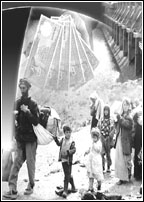
On account of displacement, production system is dismantled, close knit kinship groups get scattered, long established relationships are disrupted, traditional sources of employment are lost, market links broken, and custom related to child care, food security, intra-community credit transfers, etc, get dissolved. The system of social hierarchy and leadership lose their credibility, and ancestral symbols and shrines, graves and monuments and an entire sense of history and cultural identity are irretrievably lost. The obvious result of such sudden changes is impoverishment, both economic and social. The psychological trauma is profound because people find themselves landless, jobless, without food and access to community resources.
The compensation which is usually in cash is not an ideal resettlement package. Usually, the compensation is much below the market value and not sufficient to buy comparable land. In the case of Chashma Right Bank Canal, a large number of affected people have not been compensated at all, and those who have received compensation say that the amount is much less than market value. According to villagers, the market rate was more than Rs100,000 per acre, but the compensation rates announced so far are less than one quarter of that. In addition, corruption in the land compensation process is widespread, and affected villagers claim that far more land than is needed was acquired for the project.
The resettlement programmes have predominantly focused on the process of physical relocation rather than restoring the livelihoods of displaced people. The absence or the lack of economic and social development dimensions of resettlement programmes, such as livelihood opportunities forces affected people to abandon resettlement sites and migrate. As it happened in the case of Tarbela dam, allotted agricultural land was of poor quality and basic services such as electricity, health facilities and schools were not provided. Only those affected people with legal title were compensated for the loss of their lands and livelihoods, which increased the miseries of indigenous people.
The development project policy has been marked by the absence of popular participation of local community at the time of its drafting. Citizens have been totally excluded from the discussion about the location and nature of development projects, their size, their socio-economic impact, the distribution of their costs and benefits, and of course, the magnitude of displacement and the procedures of rehabilitation.
In the case of the Left Bank project, no single piece of information was shared with the affected communities. No public consultations were arranged. Resultantly, the project has a big technical flaw causing serious social, livelihood and environmental problems in coastal areas of Badin.
Such a denial of people’s right to participation in the decision making process betrays the spirit of government policies towards sustainable developments. It appears that the government acting under the influence of the World Bank and other IFI’s ignores the interests of its own citizens. So far, no national policy on rehabilitation has been formulated.
Benefits usually accrue to the more powerful and affluent having access to information, which is used for profitable speculation. The state lacks the institutions, the legal framework and the sensitivity, which would assure the project-affected people a better standard of living.
Similarly, the Kalabagh and other forthcoming dams rehabilitation and compensation plans will not be any better. The government’s fiscal constraints and the outstanding payments to Tarbela and unresolved claims of Gazai-Brotha affectees (e.g. fishermen etc) leaves little reason for the approximately 100,000 to 200,00 KBD affectees to hope for anything better. In the case of Ghazi Barotha, the total cost of land compensation is close to Rs5 billion whereas there were only 20,000 affected persons to be compensated.
In the case of Kalabagh besides land compensation, the cost of close to 47 model and extended villages, which have been planned for affectees would entail a heavy expenditure. If all these costs are taken into account, the total project cost would be more than what Wapda claims.
A clearly stated policy or Act ensuring the prevention or at least the minimisation of displacement due to planned development projects, should have been announced, before initiating the any rehabilitation policy. This is a serious procedural flaw. A policy which seriously looks for development alternatives, which minimises the displacement of people, is the critical need of the hour.