The decisive phase is here
THERE is little doubt by now that the struggle spearheaded by the legal community but supported by all the mainstream opposition political parties against General Musharraf’s dictatorial rule, which was triggered by the high-handed manner in which the reference against the Chief Justice of Pakistan was handled by the government, has now entered the decisive phase.
The turning point may have been the overwhelming welcome that the Chief Justice received in Punjab for his address to the Lahore High Court Bar Association.
The recent tragic developments in Karachi resulting in the loss of precious lives and material destruction have further exposed the insensitive and brutal nature of the present political system in the country, thereby giving a further impetus to the democratic movement.
Looking back at the developments since March 9 when General Musharraf received the Chief Justice in army uniform in his camp office to demand his resignation, one is struck by the series of blunders committed by the establishment subsequent to the Chief Justice’s refusal to oblige, each compounding the adverse repercussions of the earlier ones.
These moves, which were intended to overcome the crisis that was building up, have only served to aggravate the government’s difficulties.
The alleged presence of several generals of the Pakistan army in the camp office in Rawalpindi on the fateful day of March 9, if true, was obviously meant to intimidate the Chief Justice and to pressure him to resign.
When the tactic did not work, the Chief Justice and his family were subjected to discourteous and humiliating treatment over the next few days generating a storm of protest by the legal community and the public which has increased in intensity with the passage of time. Thus, the moves to subdue the Chief Justice boomeranged undermining the credibility and bona fides of the government’s case.
The reference against the Chief Justice has two aspects. One is the purely legal and constitutional aspect on which the Supreme Court, hopefully, will soon pronounce itself. The other is the political aspect because General Musharraf’s ham-handed moves to declare the Chief Justice ‘non-functional’ and later to send him on forced leave, amounting to his summary removal, were widely seen by the legal community, political parties, observers, commentators, etc as a calculated onslaught on the independence of the judiciary in order to stop its activism and thwart any constitutional challenges to the general’s continued rule.
This political aspect of the reference relating to the principle of the independence of judiciary, which is a sine qua non of any democratic system, explains the surge of support for the Chief Justice by civil society and political parties. This is an issue which concerns the people of Pakistan who have every right to raise their voice in support of recognised democratic norms in their own interest and in the interest of the country’s stability, security and progress.
In the aftermath of the president’s reference against the Chief Justice, the International Bar Association, in a report issued after the visit of its delegation to Pakistan, stated: “We share the perception of the vast majority of the legal profession that the actions of the president and the authorities constitute a direct assault on the rule of law and the independence of judiciary.”
The body also recommended that the president should rescind the order of March 9 purporting to restrain the CJP from carrying out his functions and that of March 15 placing the CJP under compulsory leave.
The Chief Justice, thus, has become a symbol of the independence of the judiciary because of the courage that he showed in rejecting the imperious command of the president.
His bold and courageous stand may change the future course of Pakistan’s judiciary which, in the past, had not distinguished itself by falling in line with the executive on important constitutional issues. Not only that, it has also triggered a powerful movement for the removal of military rule and the restoration of democracy in the country.
It appears that the government was unnerved by the growing support for the Chief Justice as shown by the welcome he received in Hyderabad, Peshawar and Lahore. Therefore, a decision was apparently taken to sabotage the Chief Justice’s visit to Karachi to address the lawyers’ convention on the premises of the Sindh High Court.
The strategy adopted by the provincial authorities to achieve this objective, in which Karachi was virtually handed over to hooligans and ruffians to do as they pleased, showed the establishment’s callousness and insensitive approach in clinging to power come what may.
In the process, over 40 precious lives were lost during the two-day carnage, damage to property was caused on a wide scale and the premises of Aaj TV were fired upon for several hours without any help from the law-enforcement authorities.
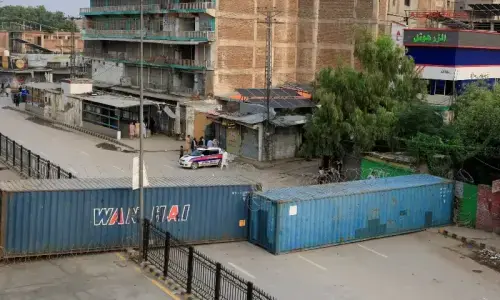
The city virtually came to a standstill, the High Court where the Chief Justice was to address the lawyers was blockaded, road blocks were created to prevent the Chief Justice from proceeding from the airport to the Sindh High Court to address the lawyers’ convention — all in open violation of the orders by the Chief Justice of the Sindh High Court.
While Karachi was bleeding and burning, the provincial and local authorities, instead of attending to their responsibilities of the enforcement of law and order, were busy showing their political strength.
The same can be said about the federal government which was busy holding its own rally in support of General Musharraf in Islamabad. There could not be greater evidence of the dereliction of duty by the governments at the federal, provincial and local levels.
Following the mayhem in Karachi, accusations and counter-accusations are being exchanged between the government on the one side, and the opposition parties and the lawyers’ community, on the other. President Musharraf has blamed the Chief Justice for not heeding the administration’s advice of not going to Karachi.
The lawyers of the Chief Justice and the opposition parties on the other hand have accused the government of deliberately causing chaos and disorder in Karachi to sabotage the Chief Justice’s visit.
The insistence of the MQM to hold its rally on the day of the Chief Justice’s previously announced visit to Karachi defies logic, especially when the provincial government, of which the MQM is a part, was appealing to the Chief Justice to postpone his visit because of the dangerous law and order situation.
If the provincial government was really concerned about the law and order situation, the MQM should have postponed its rally and the authorities should have adopted foolproof measures for ensuring peace and security in the city during the Chief Justice’s visit.
After all, if the Punjab government was able to handle the Chief Justice’s visit to Lahore from Islamabad by road, why couldn’t the Sindh government do the same for his road journey from the Karachi airport to the Sindh High Court?
The only conclusion one can draw in the light of what happened in Karachi is that the MQM and its patrons in the government were bent upon frustrating the visit. Maybe, the real objective was to show that in view of the MQM’s hold on Karachi, no anti-government rally could be held in the city, whether by the lawyers or by the opposition parties.
But from the adverse national and international reaction, it appears that the MQM’s strategy has again boomeranged. The series of nationwide strikes and protests against the handling of the situation in Karachi show that the party has lost considerable political reputation within the country.
As for the international reaction, the New York-based Human Rights Watch, in a statement issued on May 12 said, “The prevention of a peaceful reception for the Chief Justice by Musharraf’s supporters demonstrates the military government’s intolerance for civil society actions and has triggered widespread violence and death. The sequence of events leading up to this violence, including statements from the provincial authorities and the arrest of hundreds of opposition activists, indicates that the government, acting through its coalition partners, has deliberately sought to foment violence in Karachi.”
It appears that the movement for the restoration of democracy and the rule of law has entered a decisive phase. The legitimacy of General Musharraf’s rule, who assumed power through a coup against an elected government, has always been questioned, despite the Supreme Court validating it. The developments since March 9 have delivered perhaps a fatal blow to Gen Musharraf’s right to rule the country.
In the face of this situation, the general has two options. The first to continue with his present policies and try to ride out the current political storm. This course might appear easy to the general but it is likely to lead him to a political blind alley and ignominy.
An honourable and really courageous option before the president is to change course and initiate a process of national reconciliation by appointing a neutral caretaker government, restoring the Constitution as it was on October 12, 1999, but with those changes on which there is a national consensus, and preparing the ground for national elections under an independent election commission and with the participation of all the political parties and their leaders, whether inside the country or abroad.
He should also announce his intention to step down from power after the elections are over. He may create a niche for himself in history if he can summon enough courage to adopt this course of action. If not, he will go down in Pakistan’s history like other military dictators who failed to rise above themselves in the supreme national interest.
The writer is a former ambassador.
javid_husain@yahoo.com
Democracy and realpolitik
WHEN Pakistan was created it was assumed that it would be a democracy. Some people criticise Mr Jinnah for becoming the governor-general and place the blame on him for what happened subsequently, the assumption being that the only form of democracy is the so-called “Westminster” model as it happens to exist today.
Anyone knowing anything about the evolution of parliamentary government would know something as to how power moved over the centuries from the monarch, the aristocracy (i.e. the House of Lords) to the House of Commons.
When we look at democratic governments in the West, power can be shared between the president and the prime minister. Where monarchy still exists some residual power still remains with the monarch although it may only be exercised in a crisis.
The problem in Pakistan has an entirely different genesis. East Pakistan had the majority of the population. Punjab was the most educated and controlled the army and much of the bureaucracy. There was an apprehension, not unfounded, that given elected democratic government, Bengal would most likely continue ruling Pakistan.
Naturally, the Punjab establishment did not relish this idea. Because of strong ethnic (provincial) feelings in all the constituent parts of Pakistan, they were not prepared to wait for the political evolution of parties in both the eastern and western parts of the country on any ideological basis. Since the central government happened to be located in the western part of the country, this added decisively to the power available to the local ‘establishment’.
Opportunity opened up with the assassination of Liaquat Ali Khan in October 1951 when Nazimuddin stepped down from being governor-general to become prime minister. Ghulam Mohammed was elevated to the office of governor-general. He was a very able bureaucrat and had risen to a high position in the government of India. He seized this opportunity to take the decisive step of dismissing Nazimuddin.
The commander-in-chief of the Pakistan army supported him in this move. Neither was he foolish enough to ignore the Chief Justice of the highest court where the matter would be finally adjudicated. When we take this into account, it is reasonably clear that before taking any action he had confirmed the support of the Pakistan army and Chief Justice Mohammad Munir.
The next important step was the dissolution of the Constituent Assembly and its replacement by a more pliable legislative organ. Between 1953 and 1958 there was a procession of prime ministers. Nevertheless, the “politicians” managed to cobble together a constitution in 1956 on the basis of parity for East and West Pakistan. To implement this, the government of West Pakistan was consolidated and located in Lahore.
When the clamour for elections became a bit vociferous some final action had to be taken because feelings in East Pakistan had risen to the point where a confrontation between East and West was becoming likely. A monolithic East Pakistan political party could team up with disgruntled elements in the West and rule the country. The “western” establishment regarded this as a probable development which could not be risked.
Martial law was declared in October 1958 and with a brief interregnum of three weeks the real ruler of Pakistan emerged. General Mohammed Ayub Khan. The 10 years of Ayub rule till 1968 had nothing to do with democracy. There was development in both parts of the country; nevertheless, there was a real sense of deprivation in East Pakistan.
Yahya Khan, in taking over, removed the concept of parity between East and West giving the East an advantage; dismantled One Unit and restored the former provinces; and in 1970 held a reasonably fair and free election. It resulted in the nightmare of the 1950s being translated into reality in the 1970s. A monolithic political party with a total majority had emerged in East Pakistan — the Awami League under the leadership of Shaikh Mujib-ur-Rahman.
There were two options for the west wing establishment — to part company with the East amicably or to treat it as a potential colony. The military government of Yahya Khan decided on a military colonial solution and launched action to suppress the Awami League on March 25, 1971. The objective was to teach the Bengalis a lesson. As a result, there was a large exodus of the Hindu minority into India.
The Indian government took the opportunity to proclaim this as loudly as possible. Aggressive military operations on a large scale between May and October are difficult because many parts of the country are inundated with water. These are only possible towards the end of November. The Indians promptly invaded around this time. The inevitable result was the surrender at Dhaka on December 12, 1971.
The role Zulfikar Ali Bhutto played in all this as a trusted advisor of Yahya Khan is open to question. Anyway, the result is before us. The army handed over power to him and he emerged as president and martial law administrator. He was the ablest politician that Pakistan has produced to date. He had won a decisive majority in West Pakistan in the 1970 election. It was largely the result of our first past the post system adopted from the British. He obtained 39 per cent of the votes but nearly 60 per cent of the seats because the opposition was fragmented.
Unfortunately, he had no interest in democracy. He was a believer in one man, one vote, one time. Thereafter, he planned to remain in power for ever. He had obtained almost complete control over the armed forces. Under his dispensation the civil administration was converted into a bunch of sycophantic errand boys. The judiciary, in any case, since Justice Munir sold out to Ghulam Mohammed, was regarded as subordinate to the executive. Ayub Khan had changed the procedure of appointing judges to the high court to ensure this. ZAB tightened this up further.
To make sure of army support, he appointed the most apparently sycophantic general as the chief of army staff. As a result of all these developments the elections of 1977 were over-rigged. When the PNA agitation spread to the Lahore region, the army refused to fire on the agitators. This resulted in the removal of four brigadiers. The writing was on the wall, but ZAB was so convinced of his own political strength that, let alone see the writing, he couldn’t even see the wall.
The end result has been a series of disasters. ZAB destroyed the economy in the name of social justice. Ziaul Haq did his best to destroy the relaxed nature of Pakistani society in the name of the hereafter. The Afghans would have been quite prepared to fight the Russians without making it into a religious jihad. This approach resulted in the creation of the Taliban.
Ziaul Haq was trying to manage a façade of democracy which might have evolved in the right direction had Mohammed Khan Junejo not been obsessed with creating the immediate supremacy of the prime minister over the president.
Neither Benazir Bhutto on Mian Nawaz Sharif could be called democrats by any stretch of the imagination. They all tried to model themselves on ZAB without his intelligence and political ability. In any case, they were inducted through elections managed by the ISI and the MI. That is why we got the sequence: military-Junejo-Benazir-Nawaz-Benazir-Nawaz- military. It followed a simple principle: once a government had been dismissed, it could not be immediately re-elected, because it would compromise military supremacy. The wheel came full circle by 1999.
One wonders what people mean by restoring democracy, when no executive since 1958 has believed in it whether military or civilian. There is clamour for change; but as columnist Ayaz Amir has already said it will only bring another general. This seems a sensible prognostication. When one takes everything into account the decision of the government to try and intimidate the Chief Justice and the lawyers when making a reference against him was crass and extremely foolish. The good side of the agitation is that it has emphasised the importance of an independent judiciary.
Nevertheless, it is difficult to understand the shenanigans of the legal profession by insisting that the withdrawal of references against the Chief Justice would automatically result in democracy. This is obviously misleading.
Pakistan currently is not a dictatorship nor is it a democracy; but because of the current freedom of the media one of the most important preconditions for the creation of a democratic environment has been brought about by the present government.
There are certain flaws in its implementation which can be easily corrected, but it has, nevertheless, happened. There are other institutions which have to be strengthened to provide a stable democratic environment. Let us, at least, think seriously about how this can be done in a manner which might work for the future.
Karachi carnage & government’s inaction
IT appears that successive governments in Pakistan have only paid lip service to the words of the Quaid that “the first duty of the government is to maintain law and order.” From Governor-General Ghulam Mohammed to General Pervez Musharraf, every authoritarian ruler has tried to carve out for himself a permanent niche in power, often adopting extra constitutional means to do so.
With most of their time and energy consumed by the struggle to remain in power, they have left the people to the mercies of a partisan police force and administration.
Putting the current crisis in perspective, it was the denial of the right to change a government through elections that has now led to a situation where even the Chief Justice of Pakistan is removed by a sitting president so that the next change of government is in his favour. The Karachi carnage of May 12 is the result.
It is surprising that rallies by political parties in Pakistan should result in bloody clashes when dozens of demonstrations are taken out in the capitals of democratic countries by different parties on the same day, each enjoying its fundamental right to assemble.
As far as Karachi is concerned, it should not have been impossible to hold rallies in the city on the same day by different political groups. The basic duty of maintaining law and order rests with the government in power although everyone including the opposition has to abide by the law. When the government senses a threat to its authority, it resorts to violent methods either through police or other law-enforcement agencies.
The Karachi violence has brought before us one stark reality. The federal government is selective when it comes to intervening in such grave matters. In this case, the government knew that a clash was likely between the ruling coalition and the opposition. After all, its countless agencies must have been reporting the sensitivity of the situation to the government. Unfortunately, it chose to do nothing.
For the Chief Justice’s visit to Karachi, it was the duty of the government to ensure that the security measures were tight and to direct the provincial authorities to take all necessary steps in this regard. Had the president or prime minister been making the same visit, proper arrangements would have been made. But in the case of the Chief Justice, the Sindh government itself blocked the roads and made sure that the security arrangements were inadequate.
The Chief Justice of Pakistan is head of one of the organs of the state. His visit should have been coordinated by the federal government and the Sindh government and each and every detail discussed. The federal government, however, abdicated its responsibility and left everything to the Sindh government.
If law and order had been solely the responsibility of the provincial governments, the federal government would not have interfered in Balochistan, bypassing the provincial government and assembly there. It is clear that where the interest of the federal government is served by interference in provincial affairs, it does so, but where its interest is served by inaction and abdication of responsibility, it shifts the latter to the provincial government.
If the provincial government is unable to restore law and order, the responsibility of the federal government extends to taking over the executive authority of that province under Article 232 of the Constitution. Is this not strong enough a weapon in the hands of the federation to check errant provincial cabinets and to ensure that the provincial government addresses matters of law and order in a proper way?
Moreover, the federal government has made the Police Order 2002 part of the Sixth Schedule of the Constitution till 2009 which shows that it exercises control even over the police in the provinces.
The Sindh government has failed to discharge its responsibility under the Constitution to provide security and maintain law and order. Ordinarily, under a democratic and responsible government, it would have resigned or the federal government would have taken action against it. But, in this case, the federal government continues to defend the Sindh government which is least perturbed by the loss of lives in Karachi on May 12.
It seems that from the very beginning, the only purpose of the centre has been to malign the Chief Justice and make him controversial.
This suits its strategy and the motive behind its refrain that this is a constitutional and legal issue and not a political one. Since when have the Constitution and law been divorced from politics? The politicians approve changes to the Constitution when it is abrogated; it is, in fact, the politicians who should uphold its integrity.
When all precepts of democracy were brazenly violated by the government on March 9 by making the Chief Justice non-functional and later sending him on forced leave, it was the responsibility of the politicians to come to the rescue of the Chief Justice who stood for the rule of law and constitutional supremacy. Both rule of law and the supremacy of the Constitution are basic provisions in the manifestos of all political parties.
When an organ of state is held in awe by the use of force, it has every right to refer its case to the court of the people who are the ultimate source of all power. Do we forget that when the head of government (another organ of the state), the prime minister, is dismissed through force, he goes to the people for a final verdict because all organs of state derive their authority from the will of the people? Faced with the use of force, everyone refers to the people.
The government itself forced the Chief Justice to knock at the door of the bar and the people. Bar council rules clearly enunciate that every lawyer has to uphold the Constitution and the independence and dignity of the judiciary.
At no time in our history has the judiciary resorted to the power of the people though it represents their precious rights and values. It has always been browbeaten and forced into silence by successive governments. At no occasion has the Chief Justice appealed to the people to join him on his way to addressing the various bar associations. People have responded spontaneously because their interests and rights have been put at stake through this unconstitutional step against him. It is a step that has been seen as mala fide by the people from the very beginning.
Instead of heeding the voices of millions of people, the government is trying its utmost to make the Chief Justice appear controversial. In order to derive political mileage, it wants him to behave like its ministers. So far, he has dismissed such efforts by making it clear in the beginning of all his speeches that he does not intend to make political speeches. He has stuck to the high level of dignity and honour expected of him. It is now the government which should show scruples if it has any.
The writer is a barrister-at-law
barrister_zamir@hotmail.com
| © DAWN Group of Newspapers, 2007 |