



 0
0

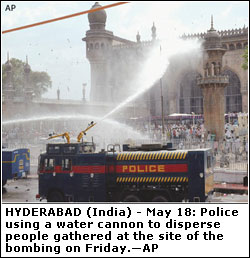 NEW DELHI, May 18: Major Indian cities were put on a high alert on Friday after a bomb ripped through a packed mosque during Friday prayers in the southern city of Hyderabad, killing nine worshippers. Three people were shot dead later when police fired on a mob which was venting its anger on the streets and, apparently planning to assault a Hindu temple, reports said.
Police said that more than 50 people were injured in the blast at Makkah Masjid, the main mosque in Hyderabad. The city, which is one of India's IT hubs, has also long been a communal flashpoint.
Bomb experts defused three more devices in the vicinity of the 16th century mosque, south India's largest. The mosque in the neighbourhood of the equally majestic Charminar monument are Hyderabad's tourist attractions.
Police said the device used in the attack was a sophisticated contraption. TV channels described the blast as an act of terror, a term they usually reserve for violence caused by Muslim extremists.
But secular Hindu activists and moderate Muslim leaders urged the state government to order a fair probe into the attack that left dozens injured. They asked for an independent inquiry and said it should not only look for Muslim suspects but should also consider the possible involvement of Hindu revivalist groups.
"Terror attacks have no religion and victims of all communities fall prey to these premeditated and violent attacks," said Mumbai-based activist Teesta Setalvad.
"India being a secular democratic republic committed to its constitutional mandate must ensure that all its agencies of state and law-enforcement look at all acts of terror dispassionately and acknowledge that these can be planned and carried out by outfits of all colours and hue."
There have been several attacks on Muslim congregations since last year, all of them in Congress-ruled states. In fact, the "Samjhota Express" attack on Muslim passengers from India and Pakistan took place in Panipat last February in the Congress-ruled state of Haryana.
The government has mostly blamed the attacks on Muslim extremists but independent observers have suspected the hand of the Hindu right in several of these attacks.
"We must not forget the lessons, unravelled, and yet to be unravelled following the Nanded (2006 and 2007) and Malegaon (2006) blasts in Maharashtra," said Ms Setalvad in a statement. She was referring to the mystery attacks on Muslim congregations in the Congress-ruled state of Maharashtra. Andhra Pradesh, of which Hyderabad is the capital, is also ruled by the Congress party. There are some fears that Hindu extremists right may be seeking to destabilise Congress governments in these states.
Reports quoted Andhra Pradesh Home Minister K. Jana Reddy as hinting at the involvement of foreign terror groups, saying: "This is a very unfortunate incident. This is the handiwork of outsiders who want to shatter communal peace and harmony prevailing in the city."
Director General of Police M.A. Basit, said: "This is a sophisticated mechanism and we believe that this capacity is not available in Hyderabad."
The crude bomb, hidden in a tiffin box under a stone bench in the historic Makkah Masjid in Hyderabad's Old City area, exploded at 1.30pm -- probably set off from a cell phone just as thousands of worshippers prepared to conclude their prayers.
The central government issued a nation-wide alert and beefed up security in sensitive parts of southern India.
The death toll in the mosque blast would have been much higher, but three more bombs were defused in the mosque premises within an hour of the explosion, officials said.
But reaction was swift across Hyderabad city, and particularly in the Old City, as crowds vented their anger.
Police fired to disperse crowds in the evening, killing three people. Hyderabad MP Asad Owaisi said as many as eight people had been killed in the police firing.
At least 15 people, including five policemen, were injured as crowds gathered in parts of the sensitive largely Muslim Old City and threw stones. Police and paramilitary force were deployed in several parts of the Old City and beyond as protestors took to streets, attacking buses and shops.
Shops and business establishments shut down in several parts of Hyderabad and its twin city Secunderabad and police intensified patrolling to prevent violence.
The blast took place near the 'wazu khana' where Muslims perform ablution before offering prayers. Five people were killed on the spot while one died in hospital.
Police later found a cell phone that they suspect may have been used to trigger the blast. Panic-stricken worshippers gave their account of the incident.
"I heard a loud thud as we were about to complete the prayers. The Imam asked people not to panic as people thought a tyre had burst," said Rafeeq Ahmed, who was offering prayers inside the main building of the mosque.
As tension gripped the city, all of Andhra Pradesh was put on high alert and the city sealed.
"This is an intentional sabotage of the peace and tranquility of the state. We had some intelligence reports but this could be an act of anti-social elements," said Andhra Pradesh chief minister, Y.S.Rajasekhara Reddy at a hastily-convened press conference in New Delhi before rushing back to Hyderabad.
Friday's attack was the third major bombing of a mosque in the year. In September last year, 31 people were killed in a bomb attack on a mosque in Malegaon in Maharashtra. In that attack, bombs mounted on bicycles exploded as devotees emerged from prayers.





























