



 0
0

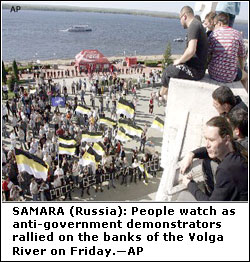 VOLZHSKY UTYOS, May 18: Russia and the European Union clashed on Friday over democratic freedoms in Russia at a contentious summit on the banks of the Volga River. German Chancellor Angela Merkel expressed concern after anti-Kremlin campaigners planning a protest near the summit venue were prevented from travelling there by Russian authorities.
“I hope that they will be able to express their opinion,” Merkel told a joint news conference at the end of the two-day summit.
Putin testily defended “preventive measures” taken by Russian police ahead of the rally, comparing these to common practice in European countries.
The Russian leader, in turn, criticised the treatment of ethnic Russians in EU members Estonia and Latvia as “unworthy of Europe” and accused Estonian authorities of causing the death of a Russian national during riots last month.
“They didn't just disperse demonstrators. They killed one demonstrator. He was injured and he wasn't helped so he died. We demand that the criminals be brought to account,” Putin said.
Hundreds of ethnic Russians rioted after Estonian authorities relocated a controversial Soviet war memorial, sparking furious reactions from Russian officials.
European Commission President Jose Manuel Barroso said it was “a sovereign decision” by Tallinn and emphasised a common stand by EU powers, saying the row was “a European problem.” The row with Estonia is one of many disputes between Russia and countries in formerly Soviet-dominated central Europe that joined the European Union in 2004.
Still, participants said “constructive” discussions had taken place at the summit in Volzhsky Utyos (Volga Cliff), a picturesque resort complex some 1,000 kilometres south of Moscow.
Putin and EU leaders discussed setting up an early-warning mechanism for increasingly vital Russian energy supplies to Europe following a request from Merkel after recent gas and oil cut-offs from Russia.
Putin told Barroso and Merkel over dinner on Thursday that supply agreements he signed earlier this month with the energy-rich Central Asian states of Kazakhstan and Turkmenistan would benefit Europe.
Talks also touched on Russia's bid to join the World Trade Organisation (WTO), which is being dogged by ongoing trade tariff disputes with Brussels, and the future status of the Serbian province of Kosovo.
But the overall impression was one of deep discord between the two sides.
“We found many problems during the summit. We have not always managed to convince each other but I think it's always better to speak to each other than to speak about each other,” Merkel said.
Negotiations over a vital partnership agreement between the EU and Russia, including in the sensitive energy sphere, are currently being blocked by EU member Poland because of a trade dispute with Moscow.
The current agreement runs out this year and can be extended, but EU officials said that failure to start negotiations would be an embarrassment for both sides.
Barroso on Friday reiterated the EU's position that there was “no basis” for Russia to maintain a ban on meat imports from Poland, the source of the dispute. Russia imposed the ban last year, citing food safety concerns.
Putin responded that the EU should first solve its “internal problems,” and Kremlin officials said that Russia had already made sufficient concessions to Poland and was waiting for a response.
“Russia can't tango on its own,” said Dmitry Peskov, a Kremlin spokesman.
The EU's External Relations Commissioner Benita Ferrero-Waldner ascribed some of the frostiness in relations to upcoming parliamentary and presidential elections in Russia.
“Russia is in a pre-election period so maybe nationalistic feelings are coming up. But at the same time there are questions that have to be solved in a constructive spirit,” she told reporters.—AFP



























