The politics of rallies
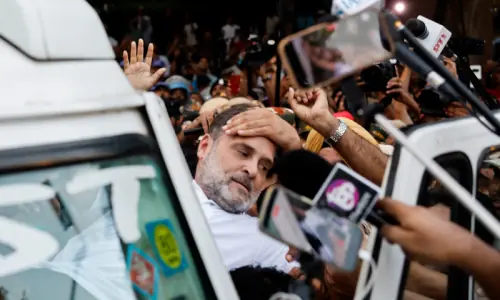
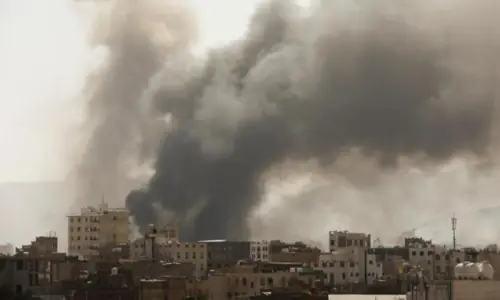
THE events that took place in Karachi and Islamabad on Saturday last, another black day in the short history of Pakistan, were sequences in a single manoeuvre. The operation has already caused the people heavy loss of life and property and it is unlikely to bring its master-minds the reward they had sought.
The objective of the offensive in the short run was to terrorise all those who were rediscovering, through participation in the lawyers’ campaign for independence of the judiciary, the thrill of political struggle. The possibility of the agitation developing into a mass movement strong enough to unhinge the regime, and this at a time when the election of the president was four to six months away and a general election was due after only six to eight months, apparently unnerved the custodians of power.
Even if General Pervez Musharraf had not protested (as he is reported to have done) at having been left by the partakers of his bounty to fend for himself, the flabbiness of the party sired by him was, in his view, simply unconscionable. Something had to be done to prevent any further erosion of the regime’s fast dwindling credit with the people. A demonstration of strength superior to what the opposition parties had managed was absolutely necessary.
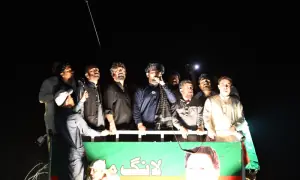
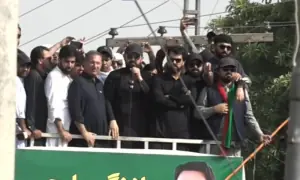
The commanders in the filed responded in the manner they knew best — mayhem in Karachi and a jamboree in Islamabad, both, unfortunately for the prospective beneficiaries, manifestly counter-productive.
The establishment not only wished to frustrate the Chief Justice’s plan to address a congregation of judges and lawyers in Karachi, it decided to frighten the lawyers into putting an end to their agitation. The hamhanded way in which the Chief Justice was virtually externed from Karachi only reinforced the lawyers’ will to fight on. While no words are strong enough to condemn the wholly contrived bloodbath in Karachi, the ruling faction’s game was in fact given away by its rally in Islamabad. Instead of laying the foundation of the king’s favourite parties’ victory in the forthcoming general election, it might have achieved the opposite.
Barely thirty years ago the Bhutto government was accused of planning rallies to erase the impression of mass support for the Pakistan National Alliance created by its processions and gatherings. It was alleged that the PPP leaders were collecting arms and hiring toughs to disrupt PNA rallies through use of ‘people’s power’. Although no significant activity by the PPP counter-rally force was reported, much was made of these allegations by General Ziaul Haq and also by the judiciary.
It was said that preparations for counter-rallies amounted to a design for civil war and this was used to justify the imposition of martial law. Politics may have come a full circle over a mere three decades as what was denounced by General Zia has been carried out with fanfare by his successors. It was left to a supremely reticent Zafrullah Jamali to point out the obvious.
The purpose of the Islamabad rally was to demonstrate the popularity of the sarkari party and convince the people that the opposition stood no chance in the coming elections. Even if the Islamabad rally had not been a case of involuntary appearances and the crowd had gathered spontaneously, such gatherings have not always reflected the organisers’ vote-power. Indeed, till 1970 it was generally believed that those who kept large gatherings spellbound for whole nights did not receive votes.
The only occasions when the size of the audience at public meetings or the strength of processions offered a correct measure of the sponsoring party’s electoral strength were the 1945-46 and 1970 elections, when popular movements were leading the political parties. Nobody in the sarkari party can claim to have generated that kind of movement.
No elaborate arguments are needed to show that the audience at the Islamabad meeting, at least a greater part of it, comprised forced labour. The media carried detailed reports and images of the methods used to commandeer vehicles and recruit flag-carriers and slogan-raisers with promises of wages, meals and travel by air-conditioned buses. At least the organisers knew how they had managed the show. Their investment in the enterprise was in self-interest, demonstration of people’s support to General Musharraf being of secondary importance.
To some extent they did gain their objective – not so much in terms of proof of their skill in assembling a crowd as by convincing General Musharraf of his dependence on the sarkari party, especially the chief ministers. Another possible gain was the use of Islamabad rally as proof of the ruling coalition’s popularity if foul play were alleged after the polls.
That the chief ministers’ and other party leaders’ gain was General Musharraf’s loss is pretty obvious. The general has scarcely ever cared about the non-violability of the principle that a head of the state has to be non-partisan, that he cannot identify with any political party. A candidate for the highest office in the land may be proposed by a political party (or a coalition of political parties) but once elected his affiliation to his promoters ends and he is supposed to represent the entire population.
By campaigning for the sarkari party for many months, at a huge cost to the public exchequer and to the unbearable inconvenience of the hapless residents of cities on the campaign trail, he has established his partisanship many times over. His appearance at the Islamabad rally may thus not appear unusual. But such things do matter. Sooner or later they facilitate the citizenry’s realisation of being cheated in the name of democracy.
More importantly, by placing himself under some obligation to the managers of the sarkari party the general has apparently given them a licence to use the state apparatus for self-aggrandisement. How the new opportunity to advance personal interests will be used by the sarkari party notables, especially by the utterly avaricious chief ministers, is beyond ordinary citizens’ imagination.
If General Musharraf and his close advisers have any illusions about the capacity of the PML-Q to deliver in a fair contest or even to survive a setback, they will do well to recall the dispersal of the Convention Muslim League in the post-1969 period. The PML-Q cannot boast of a larger membership than the Convention League had (at least on paper). The latter also had a greater hold over the National Assembly and much larger money-chests (thanks to the Field Marshal’s policy of putting rich industrialists and traders in key party posts) than the PML-Q.
In those days the king’s party also had the support of the National Press Trust and the state monopoly over the electronic media. Today the PML-Q and its allies can have media support only by either buying mercenaries in the profession or by sending armed gangs to rain bullets on media-persons or by employing the police cell called PEMRA to do some hatchetwork. What happened to the mightly Convention League? Within a year of the Field Marshal’s forced ouster the party disappeared as if it had never existed. With a very few exceptions its stalwarts rushed to join newly emerging parties with much greater speed than they had shown while joining Ayub’s cavalcade.
It may be useful to recall that in politics, as in other fields of human activity, most of the radiant knights are without their own sources of light. Like bulbs they emit light only when connected to a dynamo. Whether a political star has the power of a 100-watt bulb or a 500-watt beamer is immaterial. When the dynamo stops functioning they are equally useless throwaways. Everybody knew about the dynamo that supplied power to the Convention League grid and there is no mystery about the PML-Q dynamo either. The bulbs do not matter.
1969 is also relevant to the present for another reason. There must be many who can recall the celebration of the Decade of Development. Everything claimed by the publicity managers of the Ayub regime was not untrue. The whole world was showering praise on the regime for ensuring stability and for great innovations in the theory of democracy. The economists were chirping about a high growth rate. The army had been modernised, and so on.
But the more the official speakers blared about having saved Pakistan and its reconstruction, and the rivers of milk and honey flowing everywhere in the land, the angrier did the people become. For, official fairytales could not relieve the starving and jobless multitudes of their misery. All talk of glorious development was like rubbing salt into the people’s wounds.
A majority of the people in Pakistan today is unlikely to be diverted by tales of the regime’s achievements because they have no escape from dark hovels, do not have steady jobs, and have little protection against the excesses of the law enforces or their surrogates in the various militant groups. Above all, they have been deprived of the right to own their homeland, its land and its waters, its hills and its beaches. They do not like to be mocked at. Today the masses are more agitated about their impoverishment and disempowerment than ever before.
Let nobody ignore or rule out the revolt of the poor and the meek. Even if they cannot, for want of leadership and organisation, make revolutions, they can compete with the minions of the state in creating chaos and anarchy that could destroy whatever valuable is still left in our luckless society.
Why jirga bodies won’t work
THE government is to constitute jirga committees consisting of sardars and like-minded notables of the area, district coordination officers, nazims, and DIGs to settle disputes among feuding tribes in interior Sindh. In doing so, it will be providing relief and legal cover to culprits hailing from the more influential tribes and involved in cases lof murder, loot, plunder and ‘honour’ killings.
Jirgas and “faislas” go against the concept of providing relief to victims and the aggrieved. In many areas of interior Sindh, outlaws are accommodated by sardars and waderas under the garb of doing justice to victims and their families. Despite the fact that jirgas were banned by the Sindh High Court, they continue to be sanctioned by ministers, MPAs, nazims and ministers.
The price to be paid for purchasing this cover involves a few lakh rupees, about Rs150,000 to Rs300,000 for murder and Rs25,000 to Rs50,000 for wounding a person. In some cases, minor girls are given as penalty for murder or injuries sustained. Most of the time the murders are counted on both sides and are made even. If the number of persons killed is equal on both sides the offences stand neutralised.
But no culprit is punished for violating the peace of the area or for making life miserable for the poor, many of whom do not belong to the feuding castes and just happen to live in the area where they are dominant. Several men, women and children have been murdered in cold blood, simply because they were either inadvertently passing through no-go areas or working in nearby fields.
The interest of those who perpetuate the jirga system in prolonging clashes has become deep-rooted. Their strategy has always been to create terror among the poor. Most of them have been directly involved in backing and supporting the people of their own castes and their allied tribes to sustain clashes with rival tribes. The advantages of lawlessness in their areas are multiple for them, although it is only the sardars, waderas and bhotars who are the beneficiaries. The tribesmen and the people of the entire district pay a heavy price.
Traditionally, the sardar, wadera or bhotar can only enjoy his status when the people of his tribe show unquestionable allegiance to him. The honour extended to him by those of his caste and others of weaker ones arises from fear of his political power and influence with the police and in government. Additionally, he is able to support and command a platoon of thieves, armed gangs and other hooligans.
During feuds, the people are totally dependent on him in police matters. Most of the time, they look to him for arranging the supply of arms and ammunition. They also look to him for protection from offenders in his tribe.
Because of tribal clashes, many areas become no-go zones, not only for the general public but for the police as well as for several other government departments. Most of the areas affected on account of these clashes start from the ‘pakka’ and extend deep into the ‘kachcha’ (situated on both sides of the River Indus) area. A big chunk of the benefits that accrue to the waderas comes from the kachcha area, and they gain control over thousands of acres of forest land and hundreds of fish ponds.
They have the power to encroach on and illegally cultivate as many acres of forest department land as they like without paying a penny to the authorities. They earn millions of rupees from the fish ponds. They are involved in cutting down thousands of trees and making millions of rupees from this activity. Nobody, not even the forest department, questions them. They are exempted from all types of taxes and revenue and enjoy free electricity for their machines and tubewells if it is available in these areas.
From the constitution of jirga committees under consideration by the Sindh government, it is clear that these would include waderas and other notables. The nazims, in most cases, are either their sons, brothers or nominees. The DCOs behave and work as secretaries to the nazims. The DCO stays posted in the district for as long as the nazim or sardar is pleased with him. The case of the DIG is not much different.
The police in the concerned district are helpless and unable to deal with those involved in tribal clashes. Hundreds of cases are registered for murder and plunder under the garb of tribal enmity in every district. Thousands of criminals are nominated in these cases. Absconders keep roaming under the very nose of the police, but nobody can touch them as a number of officials have obtained their postings with the blessings of the wadera.
Unfortunately, many district police officers are the nominees of waderas who are politically powerful figures in the present government. The DPO, therefore, is either incompetent or totally helpless to take the right decision.
The position of the town police officers and station house officers is even worse. The result is that the police do not dare touch the criminals. Many such areas have become sanctuaries for those involved in killing people in broad daylight and stealing vehicles.
The police sometimes venture into these criminal nurseries to conduct operations that are fake, primarily because the criminals living here are heavily armed and, secondly, because of the political influence of the wadera. The DPO knows that displeasing the wadera will only bring him hardship and cause him to be transferred. The same applies to the TPOs and SHOs.
Almost all registered cases are pending investigation in the police stations. Many have been disposed of under “cancelled or “false”. Investigations in such cases are incomplete. Even if some cases are sent to the court, the situation there is not encouraging enough because of weak prosecution.
Under these circumstances one is totally unable to comprehend the logic of empowering the waderas and not devising rational strategies based on ground realities to improve the law and order situation and establish the writ of the state.
The law can only be enforced if police postings are based on merit and needs. Political pressure in these postings as well as in decision-making must be discouraged by giving a free legal hand to the officers. The latter should also be held accountable for failure to carry out their duties and for the misuse of authority.Constituting jirga committees is no solution. Only the creation of fear of authority and the writ of law are the solution. Incidents of crime must be registered, properly investigated and sent to the courts. The criminals involved should be arrested and jailed, and not unleashed for more loot and plunder.
Many jirgas have been held in the past revolving round inter-tribal clashes. Penalties have been imposed and pledges taken on the Holy Quran. But each time, decisions have been violated and faislas dishonoured. Weapons are taken up by the respective parties against each other without any hesitation or fear of facing the authorities.
Efforts are also required to equip the district police and properly train it. Joint operations by police and other law-enforcement agencies should be conducted for sweeping the area and recovering weapons. Disarming people is not sufficient; it must also be ensured that the transportation of arms and ammunition to the affected areas is stopped.
Non-functional schools in the province that have been closed for years should be opened and new ones constructed. The same goes for health outlets. Roads should be repaired and new ones built to ensure easy access for the law-enforcement authorities in far-flung areas and for villagers to markets and other towns and cities. Only then will there be greater awareness.
This is the only way to bring peace and prosperity to these areas, and requires sincere efforts and proper planning for its implementation. The authorities should heed this instead of making the landlords even more powerful resulting in the exploitation of the ignorant masses, politically, socially and economically.
The writer is a Sindh MPA. alwani@cyber.net.pk
Where oil makes the difference
IN a remote corner of Africa, millions of civilians have been slaughtered in a conflict fuelled by an almost genocidal ferocity that has no end in sight. Victims have been targeted because of their ethnicity and entire ethnic groups destroyed –– but the outside world has turned its back, doing little to save people from the wrath of the various government and rebel militias.
You could be forgiven for thinking that this is a depiction of the Sudanese province of Darfur, racked by four years of bitter fighting. But it describes the Democratic Republic of Congo, which has received a fraction of the media attention devoted to Darfur.
The UN estimates that three to four million Congolese have been killed, compared with the estimated 200,000 civilian deaths in Darfur. A peace deal agreed in December 2002 has never been adhered to, and atrocities have been particularly well documented in the province of Kivu –– carried out by paramilitary organisations with strong governmental links.
In the last month alone, thousands of civilians have been killed in heavy fighting between rebel and government forces vying for control of an area north of Goma, and the UN reckons that another 50,000 have been made refugees.
How curious, then, that so much more attention has been focused on Darfur than Congo. There are no pressure groups of any note that draw attention to the Congolese situation. In the media there is barely a word. The politicians are silent. Yet if ever there were a case for the outside world to intervene on humanitarian grounds alone –– "liberal interventionism" –– then surely this is it.
The key difference between the two situations lies in the racial and ethnic composition of the perceived victims and perpetrators. In Congo, black Africans are killing other black Africans in a way that is difficult for outsiders to identify with. The turmoil there can in that sense be regarded as a narrowly African affair.
In Darfur the fighting is portrayed as a war between black Africans, rightly or wrongly regarded as the victims, and "Arabs", widely regarded as the perpetrators of the killings. In practice these neat racial categories are highly indistinct, but it is through such a prism that the conflict is generally viewed.
It is not hard to imagine why some in the west have found this perception so alluring, for there are numerous people who want to portray "the Arabs" in these terms. In the United States and elsewhere those who have spearheaded the case for foreign intervention in Darfur are largely the people who regard the Arabs as the root cause of the Israel-Palestine dispute. From this viewpoint, the events in Darfur form just one part of a much wider picture of Arab malice and cruelty. Nor is it any coincidence that the moral frenzy about intervention in Sudan has coincided with the growing military debacle in Iraq –– for as allied casualties in Iraq have mounted, so has indignation about the situation in Darfur. It is always easier for a losing side to demonise an enemy than to blame itself for a glaring military defeat, and the Darfur situation therefore offers some people a certain sense of catharsis.
Humanitarian concern among policymakers in Washington is ultimately self-interested. The United States is willing to impose new sanctions on the Sudan government if the latter refuses to accept a United Nations peacekeeping force, but it is no coincidence that Sudan, unlike Congo, has oil –– lots of it –– and strong links with China, a country the US regards as a strategic rival in the struggle for Africa's natural resources; only last week Amnesty International reported that Beijing has illicitly supplied Khartoum with large quantities of arms.
Nor has the bloodshed in Congo ever struck the same powerful chord as recent events in Somalia, where a new round of bitter fighting has recently erupted. At the end of last year the US backed an Ethiopian invasion of Somalia to topple an Islamic regime that the White House perceived as a possible sponsor of anti-American "terrorists".
The contrasting perceptions of events in Congo and Sudan are ultimately both cause and effect of particular prejudices. Those who argue for liberal intervention, to impose "rights, freedom and democracy", ultimately speak only of their own interests.
To view their role in such altruistic terms always leaves them open to well-founded accusations of double standards that damage the international standing of the intervening power and play into the hands of its enemies.
By seeing foreign conflicts through the prism of their own prejudices, interventionists also convince themselves that others see the world in the same terms. This allows them to obscure uncomfortable truths, such as the nationalist resentment that their interference can provoke. This was the case with the Washington hawks who once assured us that the Iraqi people would be "dancing on the rooftops" to welcome the US invasion force that would be bringing everyone "freedom".
Highly seductive though the rhetoric of liberal interventionism may be, it is always towards hubris and disaster that it leads its willing partners. ––Dawn/Guardian Service
Overdrawn at the bank
LAST week the World Bank published a major book on a crucial aspect of development. The problem was its title. The scandal surrounding its president, Paul Wolfowitz, and the pay package he secured for his bank-employee partner means The Many Faces of Corruption (one chapter piquantly headed "Corruption in Public Procurement: A Perennial Challenge") has become less a resource for development economists and more a goldmine for satirists.
Poverty; development; infrastructure: the areas the World Bank deals in are hardly the stuff of laughs. Its president, however, has got caught in a controversy that sounds like a bad joke. A man who was bundled into the job by the Bush administration, which could no longer find a use for him, blustered about educating borrower nations in the ways of good governance - and was found wanting in this area himself. Thanks to Mr Wolfowitz, the salary of his partner, Shaha Riza, is higher than Condoleezza Rice's earnings. At just under $194,000, it would make a respectable prize on a gameshow. As the American satirist Stephen Colbert says: "He knows corruption is the enemy; and Mr Wolfowitz fights fire with fire."
No wonder that there is now a mutiny among staff and some (primarily European) donor nations. The turmoil has already driven out the bank chief's PR man, Kevin Kellems. He resigned saying that "given the current environment...it is very difficult to be effective in helping to advance the mission of the institution". The same logic obviously applies to his boss. Mr Wolfowitz has fought off calls for his resignation, each time with weaker ammunition. First he declared that an investigation by the bank's executives would exonerate him. Instead it found him guilty of "questionable judgment and a preoccupation with self-interest". The bank chief said he thought he had been asked to arrange Ms Riza's pay, a claim the report says "simply turns logic on its head". His last defence is one of acting in good faith. Yet he reportedly threatened bank staff with retaliation if they revealed the pay rises and promotions won for his partner.
The bank's executive board, which met Mr Wolfowitz Tuesday night, is due to make a statement later this week. It could reprimand the bank president, or issue a vote of no confidence. But Mr Wolfowitz has been found guilty of the sort of conflict of interest that would normally lead to the dismissal of any other of the bank's 10,000 staff, and neither measure would calm the storm. So it should either sack him or arrange the terms for his departure.
His role as an architect of the Iraq war meant that Mr Wolfowitz was never going to get an easy ride at the bank. If he does go, his critics will doubtless be in celebratory mood. They will have won a prized neocon scalp. But bringing down one of President Bush's inner circle for violating an institutional code of conduct is a bit like nabbing a mafia boss for tax evasion. They should take this opportunity to push for reform of the system that put such a divisive figure at the helm of what is, after the UN, the world's most important development organisation.
The job of World Bank president is traditionally the gift of the US, just as the head of the International Monetary Fund is a European appointment. This is the legacy of an antiquated system. So far Europe has resisted any change of this cosy arrangement for retiring politicians. The IMF's managing director, for instance, is Rodrigo Rato, a Spanish rightwinger whose main qualification for the job seemed to be that he needed one.
––The Guardian, London
| © DAWN Group of Newspapers, 2007 |