



 0
0

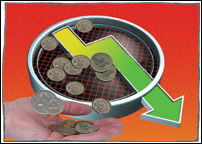 Does the federal budgetary exercise conducted every year with great fanfare mean anything for the country’s poor?
With almost 45 per cent of total expenditure going towards defence and debt servicing, another over 44 per cent towards development expenditure, grants, and subsidies, there is just nine per cent that goes towards general administration that includes law and order, social, economic, and community services. Almost 89 per cent expenditure is allocated for creating an enabling and a conducive production climate with less than nine per cent aimed directly at the uplift of the poor.
Direct beneficiaries of the production climate that the budget focuses on are the upper income groups whose lot is more a function of budgetary outlays as compared to that of the poor who are expected to wait for the “benefits to trickle down” to them at an unknown point in time in the future. The government insists that their strategy is pro-poor growth and has benefited the poor which assertion requires closer examination to assess the effectiveness of the pro-poor growth slogan.
The policy makers are all out to prove that with their less than nine per cent federal expenditure on social, economic, and community services and some “trickle down effect,” the poverty picture has improved. According to official estimates, percentage of population below the poverty line has declined from 34.46 in 2001 to 23.9 per cent in 2004-05, that is, a decrease of 10.56 percentage points. Rural poverty decreased by 11.16 percentage points and urban poverty by 7.79 percentage points, according to official claims. While the above may look encouraging on the surface, it is important to know the poverty line that cuts off the poor from the non-poor. The latest inflation adjusted poverty line is Rs878.64 per adult equivalent per month (Pakistan Economic Survey[PES] 2005-06). For an average household size of 6.55, it may translate approximately to Rs5755 per month. Who would believe that an income of Rs6000 per month for a family of 6.55 would lift them out of income poverty or private consumption poverty?
It does not matter whether the officially defined poverty level is 34.46 or 23.9 per cent for as long as the percentage of population between the official poverty line and the poverty line above which the people would actually be lifted out of consumption or income poverty is unknown. That is the percentage of population with monthly household incomes roughly between Rs5755 and Rs15000 needs to be known, failing which, our poverty estimates will be grossly under estimated. Even at Rs15000 per month, a household of 6.55 will barely get by. There is actually a sea of poverty with whose severity cannot be reduced no matter how much the volume is scaled down in imagination for rosy paper presentations.
Before yet another attempt is made to force fit the reality to what might be desired on policy paper, it is important to take a look at the Household Integrated Economic Survey (HIES) 2004-05 used to support poverty estimates. Its sample of 14706 households is considered “representative” in a country with almost 23.5 million households (population of 153.96 million and average household size of 6.55). That is, HIES was based on 0.06per cent households in the country when there were about 8.0 million poor households with poverty level above 34 per cent population. That is, a study of only 0.18 per cent poor households can hardly be used to generalise for the whole country. If poverty for country’s 0.18 per cent poor households has reduced by almost 11 per cent, it cannot be deduced that poverty has also reduced for all the remaining 99.82 per cent poor households also.
For, what is true for a part may not be true for the whole. To conclude improvement in the poverty picture on the basis of only a small fraction of country’s households is to commit fallacy of composition that will not help the reality on the ground even if it makes one look good for a short period of time. People are quick to detect the actual situation as the World Bank too is now beginning to see.
Small percentage of total expenditure is not likely to make a real dent into poverty that not only remains visible to the naked eye but is also not ruled out by an analysis of figures presented officially.
According to the household survey figures presented in the PES 2005-06, the richest 20 per cent spent almost thrice as much on food in 2005 as was spent by the poorest 20 per cent. Even then the food expenditure of the richest 20 per cent increased by 19 per cent from 2001 to 2005 whereas that of the poorest 20 per cent gained 11.6 per cent in food consumption expenditure during the same period. In fuel and lighting, the richest 20 per cent gained 20.9 per cent during 2001-2005 whereas the poorest 20 per cent gained only 5.7 per cent during the same period.
The expenditure on personal care articles/service, clothing, and education decreased for the poorest 20 per cent during 2001-05 whereas expenditures on the same heads increased significantly for the richest 20 per cent during the same period. The only head under which the expenditure of the richest 20 per cent decreased during the period 2001-05 was medical care whereas expenditure on medical care increased by 14.6 per cent for the poorest 20 per cent during the same period. This may indicate the state of health that may have improved for the richest 20 per cent due to their better living conditions and quality of life as compared to that of the poorest 20 per cent.
The above shows a rich-poor gap not likely to close in the near future. There is an attempt to touch the tip of the multi-dimensional poverty pyramid by increasing consumption expenditures on basic necessities such as food, clothing, education, and personal care items. While the situation of 99.82 per cent poor households is not even known, the situation of 0.18 per cent poor households gauged does not show improvement on all fronts that it should without which the possibility of sinking back below the officially defined poverty line remains high.
Important question is whether poverty reduction is a mere function of social, economic, and community expenditures? If yes, a lot more needs to be spent to bring all the poor households above the poverty net. Financial resource mobilization would then remain an even more huge task. While tax evasion needs to be plugged that remains a daunting challenging, horizontal equity in taxation structure is long overdue. Agriculture contributes 22.5 per cent to GDP but its share in taxation is ridiculously low at 1.2 (PES 2005-06). Wholesale and retail trade’s share in GDP at 18.6 per cent is higher than that of manufacturing at 17.9 per cent (PES 2005-06).
While manufacturing’s share in taxes is 62.2 per cent, that of wholesale and retail trade is only 2.8 per cent (PES 2005-06). Transport, storage, and communication also contribute disproportionately less in taxes as compared to their share in GDP. These inequities in taxation need to be removed on a war footing failing which the financial resources needed to address social, economic, and community issues of the poor will remain unavailable.
Poverty is not an issue that can be addressed through borrowed money. Also, poverty is not an issue that can be addressed on a sustainable basis by only pouring money into the segment without building capacity of the poor to generate own incomes. This virtuous cycle requires government intervention also through an earnest attempt to reduce asset poverty of the poor. Without land to the small farmer and extension services aimed at building small peasants’ resources and capabilities, asset poverty will remain. It will keep feeding back into their income and consumption poverty that cannot always be addressed by constantly replenishing their incomes from national resources — internally generated or externally funded.
Prophet Muhammad (PBUH) had himself made an axe from an income-poor man’s hidden asset and encouraged him to use the axe to generate income instead of asking for financial help. The poor man’s income had thus increased manifold and the Prophet (PBUH) had said that that was the best form of life. Lesson for us is that asset distribution and availability remains at the centre of a sustainable poverty reduction effort.
And, land assets might be aplenty and under-unutilised in rural agricultural sector whose equitable distribution require a definite resolve to kick start a poverty reduction programme to address poverty issues meaningfully. Otherwise, attempts to make a poverty situation look good only on paper will remain a hard sell internally as well as externally.






























