0
0

ISLAMABAD, May 10: Pakistan on Thursday allowed import of cotton through land route initially from India and later from Uzbekistan to meet a shortage of around three million bales the local textile industry faces this year.
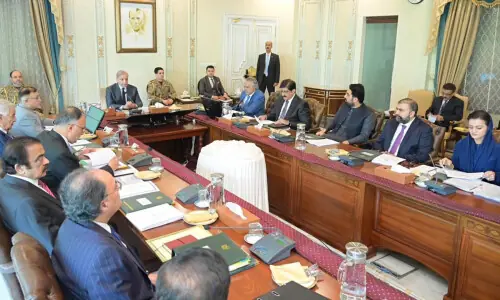
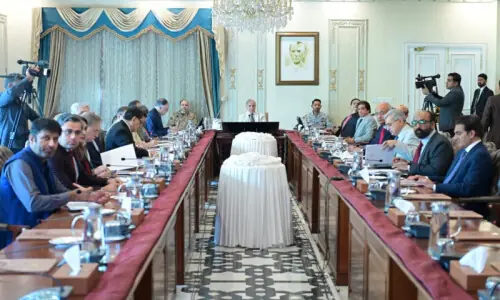
The economic coordination committee (ECC) of the cabinet led by Prime Minister Shaukat Aziz also allowed setting up of a 450MW thermal plant in central Punjab, lifted a restriction on foreign insurance companies from raising local equity, eased import of machinery and equipment for services industries and decided not to allow export of pulses at any cost.
The meeting also allowed Port Qasim Authority (PQA) to sign an implementation agreement with Associated Group of Iqbal Z. Ahmed to set up a $142 million floating Liquefied Natural Gas (LNG) terminal on build, own and transfer (BOT) basis and import and export of Liquefied Petroleum Gas (LPG) from the same terminal.
The agreement has already been signed.
Briefing newsmen after the meeting, economic advisor of the finance ministry Dr Ashfaque Hassan Khan said the ECC decided that in the first phase long staple cotton be imported through rail and road via Wagah border from India to save Rs200 per maund cost on transportation to help Pakistani products compete markets abroad.
The committee instructed the ministry of food and agriculture to immediately provide quarantine facilities at Wagah to protect domestic crop.
Similar quarantine facilities would also be set up at Torkhum and Chaman borders to enable long staple cotton imports from Uzbekistan through land route.
Mr Khan said that cotton imports used to reach Karachi through Iranian Bandar Abbas port for onward upcountry destinations.
Pakistan required about 16 million bales of cotton this year and domestic crop was estimated at around 13 million bales.
The ministries of textiles and food were asked to examine pros and cons of allowing short-staple cotton imports in the light of its impact on local farmers.
POWER PLANTS: The meeting approved a proposal to allow setting up of a 450MW combined cycle thermal plant at Chichun Ki Malyan in central Punjab at a tariff of 8.842 cents per unit.
The tariff was offered by US-based Alstom and Marubeni in a competitive bidding. The project would also involve investment from the government of Qatar.
General Electric (GE) which will supply plant and equipment would provide performance guarantee for the plant.
Mr Khan said the Wapda had originally invited bids for 600MW (3X200 MW) diesel engine combined cycle in September last year and got offers for 11.11 cents per unit tariff, but the 450MW offer was given preference because its tariff was on the lower side.
In a related decision, the meeting also allowed the producers of non-pipeline quality (Low BTU) natural gas to exercise first right to set up power plants at the gas field before allowing this gas for use by any other investor.
There are tens of gas fields where low quality gas is produced but could not be transported through pipelines and hence remain unutilized.
INSURANCE: The meeting decided to do away with a restriction on foreign insurance firms to bring at least half of $4 million equity from abroad. Now, the foreign insurance companies would be free to provide local or foreign equity.
SERVICES INDUSTRY: The ECC also empowered the central board of revenue to allow one-time import of machinery and equipment including crockery, fittings at five per cent duty at its own for hotels, departmental stores etc instead of seeking such approvals for individual companies from the ECC.
However, the resale of such material in the market would be considered as criminal offence.
PULSES: The meeting also decided that “no export of surplus will be allowed at any cost” despite good crops.
Mr Khan said the meeting was informed that a few people had started purchasing pulses from farmer at a price higher than procurement price fixed by the government in the anticipation to exporting it.
He said that while such a move was good for farmers, the government would not allow its export to ensure domestic prices within the reach of the common man.
PRIVATE EQUITY AND REAL ESTATE: The meeting directed the securities and exchange commission of Pakistan (SECP) to resolve all issues pertaining to facilitation of real estate investment trust (Reits) and investments in private equities so that it could be announced in the next year’s budget.
RESEARCH FACILITY: The meeting also allowed use of research and development subsidy for export of dyed and printed fabric, white home textiles and dyed/printed home textiles to seven countries of central America including Panama, Nicaragua, Costa Rica, Belize, Guatemala, Honduras and El Salvador.
The meeting also considered a proposal for exemption of sales tax on electricity generated by Pakistan Ordnance Factories and asked the central board of revenue to examine it in detail and place it before the next ECC meeting.
Mr Khan said that a summary on provision of single point mooring facility for a private sector refinery at Khalifa Point was withdrawn by the petroleum ministry for unknown reasons.