



 0
0

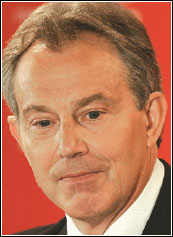 LONDON: Tony Blair’s decade in power will be remembered for his media-savvy transformation of British politics, but above all for the Iraq war. Blair, a guitarist who famously fronted a student rock band called Ugly Rumours at Oxford University, has become one of the world’s most controversial leaders for backing the US-led invasion of Iraq in 2003.
Britain’s involvement is still a divisive issue four years on, and his governing Labour Party has slumped in the polls. The 54-year-old Blair now admits giving up as prime minister could help reverse his party’s and his successor’s fortunes.
“But I also believe ... that the essential New Labour position, which is to get over some of the old divisions of left and right in politics ... will hold,” he said before the May 2 anniversary of his 1997 landslide election win.
Anthony Charles Lynton Blair was born on May 6, 1953 in Edinburgh, the Scottish capital. He spent most of his childhood in the northern English city of Durham, and went on to study law at Oxford University, becoming a barrister.
He went into Labour politics in his 20s, and in 1983, when the Conservatives under Margaret Thatcher were pushing British politics decisively to the right, he was elected to parliament for the northern English town of Sedgefield.
He rose rapidly through the Labour ranks as the party sought to bounce back from a series of disastrous election defeats and bitter internecine conflict.
In 1994 Labour leader John Smith died unexpectedly, and Blair, then aged only 41, was elected to succeed him, having struck a deal with now finance minister Gordon Brown, that the latter would not run. Brown is now virtually certain to take over as prime minister.
In 1997, Labour swept to power — making Blair at 43 Britain’s youngest prime minister in 185 years — in what was seen as a fresh start after 18 years of rule by the Conservatives under Thatcher and then John Major.
The charismatic Blair seemed refreshingly in touch. He hung out with Britpop bands and captured the public mood after the death of Diana, Princess of Wales, calling her “the people’s princess.” But a succession of overseas conflicts, particularly Iraq, plus what some have seen as Labour’s cynical manipulation of the news agenda and scandals involving his party and ministers, have changed all that.
Where once the youthful, photogenic Blair was seen as an asset to woo the politically apathetic, women and younger voters, certain Labour members increasingly saw the greying premier as an electoral liability.
In winning the 2005 general election, the father-of-four became the first Labour leader to win three straight terms in office.
His brand of social and economic policies is a far cry from the party’s leftwing socialist roots.
Many members denounced his uncoupling of Labour’s strong links with trade unions to promote a free-market, more characteristic of the rightwing Tories.
But “New Labour” — the rebranded party he promoted from 1994 — was an electable proposition where through much of the 1980s “old” Labour was slowly self-destructing through ideological in-fighting.
On domestic policy, he introduced some of the most wide-ranging changes in the British constitutional make-up for centuries when Scotland and Wales voted to have their own devolved administrations.
Although the groundwork was laid by Major, Blair signed the Good Friday peace agreement in Northern Ireland, largely ending decades of violence between Catholics and Protestants.
Other key moments include the introduction of the Human Rights Act, partial reform of the unelected upper chamber, the House of Lords, and greater legal recognition for same-sex couples.
Britain’s central bank, the Bank of England, was given the power to set interest rates and the minimum wage was introduced.
Sustained economic prosperity, low unemployment and increased growth have become familiar mantras from both Blair and Brown.
On a personal level, Blair became the first serving British prime minister to became a father since 1849, when his wife, Cherie, a prominent human rights lawyer, gave birth to their third son, Leo, on May 20, 2000.
Another, less positive, first, came in December last year when he became the first serving British prime minister to be questioned by police in a criminal inquiry, over claims Labour offered seats in the Lords to wealthy party donors.
However much Blair wants to be remembered for reforms in areas like education, public health, pensions and law and order, Iraq is likely to overshadow all that.
By allying himself closely with the United States in the face of strong opposition, his authority at home and as a world statesman has been severely dented as violence in the Gulf state spirals.—AFP





























