



 0
0

What are you looking at?
MAKES you think sometimes but not often enough. Karachi has lost much of its civility over the years, and why not. There is no shortage of irritants in the concrete jungle where life is becoming ever more harried but without the comforts that industry and honest toil are meant to deliver to the hard-working.
Ours is a twisted system that offers greater reward to desk-bound paper-pushers and word merchants in air-conditioned cubicles than men digging ditches under the baking sun. Not that the office workers’ is a particularly enviable lot. They are overworked and underpaid, the public transport system treats them like cattle, a 50-minute commute takes three hours thanks to the traffic and what used to be a ten-minute drive can take sixty. Worse, reaching journey’s end is no guarantee of repose.
Braving the traffic horror you finally get home, only to stew in your juices as KESC goes AWOL yet again. A bath would be nice but, sorry, the water stopped trickling an hour ago and the pump won’t work. It’s dehumanising.
It wasn’t always like this. Candles and their stubs used to last years, retrieved from a special hidey-hole — if you could remember where you stashed them — and dusted off in an emergency. Like the koel there was something vaguely monsoon-esque about power failures, coming as they did soon after the first pitter-patter of rain. Now they are the norm and we are like laboratory rats being subjected to twice the maximum dosage, just to see if we can take it and live to tell the tale.
Tempers fray easily under these conditions. Arguments over restaurant bills turn fatal and minor car scrapes degenerate into fistfights. People scowl habitually and an absent-minded smile will most likely be met with a stroppy ‘kya dekh rahe ho?’ (what are you looking at?) Not your ugly mug, you retort, shelving the stray happy thought and diving headlong into the stinking cesspool of urban mental decay.
Then there is the air and noise pollution that is, quite literally, driving us crazy. Studies by people who know their chemicals confirm that Karachi is not fit for human consumption. The air we breathe is a heady mix of carbon dioxide, oxides of nitrogen, sulphur dioxide, hydrocarbons and suspended particulate matter, all well in excess of acceptable levels.
Irritability and sudden rage are classic symptoms of exposure to these pollutants, as are allergies, headaches, nausea, respiratory disease, lung cancer, heart problems and brain damage.
Usually it is city ways that transform life in the hinterland. In Karachi these days the opposite is true. We are experiencing an erosion of urbaneness and the invasion of a mindset that is insufferably macho and feudal in its provincialism.
Security henchmen for the show of it. Stopping in the middle of the street instead of pulling over to the side just because you can in your Lexus, and the people stuck behind you be damned. Not indicating while turning because only girlie-boys do that. People sporting the fierce tribal look instead of the cultured and refined. Even bankers in nylon ties look good by comparison.
Dehshat and izzat have come to be conflated in this incongruously modern yet medieval lifestyle we purport from the rafters. The irony is lost on all but a few.
Those in Karachi who rail against feudalism to further their cash-lined agendas are part and parcel of this mass display of vulgarity. Sadly, most people are not only impressed by this nouveau trash but aspire to it. We once lived in a city, now we worship at the altar of barbarity.
There was a time when what a person did for a living was more important than how much money he made. Old middle-aged fools like myself can’t help but reminisce about the way it was, in our dotage wonder what happened to the Karachi that was our pride and joy.
Enough said, for now.
imalik@dawn.com
COMMENT: Shahid Afridi will be a hero yet
IN Pakistan’s cricket circles, opinions on Shahid Afridi are – to put it mildly – polarized like the Middle East. In one corner are those who cannot bear to utter his name, and will plug their ears if they hear it spoken. Scorched by the embers of failed expectations, they protect themselves from further disappointment by dismissing his potential altogether. “Forget Afridi,” seems to be the motto.
In the opposite corner are the diehards. Rooted in an unshakeable belief that Afridi is a stick of dynamite, they hold firm that he should be permanently locked into Pakistan’s Test and ODI sides and the key thrown away. It is a gaping, visible divide that has become increasingly bitter and rancorous. Over the course of his enigmatic career, Shahid Afridi has provided ample ammunition to both camps.
On the one hand, he’s one of the most feared players in international cricket today. Not long ago, when cricket’s leading monthly The Wisden Cricketer polled 26 prominent bowlers from around the world to see which batsman they feared the most, Afridi was voted the third-scariest (after Adam Gilchrist and Brian Lara). The most telling comments came from Australia’s Brett Lee, who said that Afridi “just makes up his own rules as he goes along. He can take a ball from leg stump and hit it over cover-point. It doesn’t matter where I bowl to him. In the end, you just have to admire him.”
A glance at world records in ODIs reveals Shahid Afridi’s name popping up everywhere. He’s made the fastest (37 balls) and the 4th fastest (45 balls) centuries ever, and has made the 2nd fastest half-century (18 balls) on two separate occasions. In the list of quickest half-centuries, in fact, Afridi’s name appears five times among the top 13 names (no other name is repeated). Afridi also currently happens to be number two in the list for most sixes plundered over the course of a career (225, right behind Sri Lanka’s Sanath Jayasuria who has 238).
And there’s more. Afridi has twice pillaged 28 runs in an over, a figure exceeded only by Jayasuria, who once took 30 from an over. Afridi also has the highest career strike rate (runs per 100 balls) of any player ever. At a murderous 108.58, he outscores any competition.
The flip side, of course, is the countless times Afridi has self-destructed by playing an incomprehensible shot in a tight situation. We’ve all been through it and we all know the feeling. Seemingly oblivious to the circumstances, he will commit himself to a stroke that schoolboys will be ashamed of. Pakistan supporters are left feeling they’ve been kicked in the stomach and pushed off a cliff.
Why Afridi does it is anybody’s guess, but what has become crystal clear by now is that he has no plans to change his behavior. The ones who need to change are the rest of us. Afridi’s decade-long international career has left a series of exasperated captains, coaches, fellow players, and fans in his wake. He has said countless time he won’t listen to any of them. It’s about time we paid attention.
Why? Because he’s a special talent and, dreaded by other teams, wins matches for Pakistan. The problem is that he has become a victim of his own success. We, the voyeuristic public who cannot get enough of his eye-catching batting exploits, have been complicit in that victimization.
One crucial area where all of us can do better is in the nature of our expectations from Afridi. It is perhaps no coincidence that his greatest innings came when least was expected of him. On 4th October 1996, he came in to bat with Pakistan 60-1 against Sri Lanka at Nairobi Gymkhana. It was his first ODI innings (he had made his debut two days earlier but did not get to bat). In his absorbing Urdu memoir Shahid Afridi ki aap beeti (co-authored by Qaiser Saghir), Afridi points to the lack of public expectations as the key to what happened that day.
It is nearly impossible to break that record of a century from 37 balls, yet this is what Afridi is expected to do each time he now walks in. Let us recover some perspective and be reminded that Afridi came into the Pakistan team basically as a leg-spinner. He had a reputation that he could slog a bit, but his original cricket identity was from wrist spin.
Although ferocious batting has come to overshadow his resumé, Afridi can stand as an international cricketer on the basis of leg spin alone. His repertoire includes three of the four aces of wrist spin bowling – leg-break, googly, and top-spinner. He doesn’t have a great flipper, but no one apart from Shane Warne does. Afridi also possesses a devious fast-ball hurled with the seam up that can york batsmen in ways that would make Wasim and Waqar proud. With an incendiary mix of cunning and daring, Afridi stays forever on the prowl, always ready to strike and crush. When all else fails, there’s still the Afridi in him – never completely vanquished, he’s always ready to rise up again.
Afridi has 198 ODI wickets at 35.82. His career economy rate of 4.60 runs per over is similar to Umar Gul’s (4.59) and Danish Kaneria’s (4.56), and better than the economy rates of Rana Naved-ul-Hasan and Mohammad Sami. The bowling average may be modest, but he is clearly a match-winning bowler, as six of his 17 man-of-the-match awards have come from bowling success.
Figures also throw light on where Afridi will be most useful as a batsman. Three of his 4 hundreds and 22 of his 27 fifties have been scored as an opener. He crosses 50 every 5.6 innings as an opener, but only every 14 innings when batting from any other position. His batting style is ideally suited to exploit the early overs and field restrictions. Yet amazingly, even though Pakistan has one of the worst opening pair problems in the world, Afridi is left to languish in the lower order. Sure, there’s a risk that if he opens we’ll be 10-1, but the way things are that’s likely to happen anyway.
Shahid Afridi is a phenomenal cricketer who has been misunderstood and misused. It is time we tried something new, letting him bat where he is most likely to succeed, and at the same time unburdening him from our expectations. He is good enough to play for his bowling alone (with sharp fielding an added bonus), and who knows even the batting might come good. Afridi will become a hero when we least expect him to.
Behind the scenes
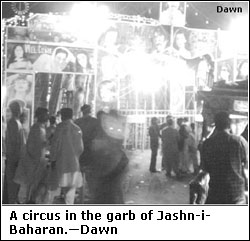 THE district administration and police seem to be least interested in coming to grips with the menace of vulgarity which is flourishing right under their nose. The Jinnah Town, which arranged a week-long programmes in connection with the Jashan-i-Baharan festival at a historic Dhobi Ghat ground, concluded the other day leaving much to be desired.
The boundary wall inscription of the venue clearly mentioned that an industrial exhibition and Jashn-i-Baharan festival would continue from April 25 to May 3. But, nothing of the sort was there which could portray a glimpse of the industrial exhibition.
It is Dhobi Ghat ground’s proud boast that it had welcomed Quaid-i-Azam Muhammad Ali Jinnah, Zulfiqar Ali Bhutto, Benazir Bhutto, Nawaz Sharif and other prominent leaders of the country. However, inauguration of lewd programmes, including death wells, death balls and magic shows, took a lot of flak from citizens. The exhibitors damaged badly the historical ground and filth of animals produced foul smell.
Police kept a mum over the situation because most of rankers were among the onlookers of death wells. Scores of young policemen thronged to the spot to watch offensive actions of girls hired by owners of death wells.
The administration had announced that families would be provided a congenial atmosphere, but on the ground situation was such that they avoided visiting the exhibition. If some family happened to visit the venue to enjoy the circus on the pressing demand of their children, they had to face objectionable remarks and gestures of mischief-makers.
The exhibitors did not pay any heed to the timeframe set by police high-ups and they continued to exhibit their shows in defiance of the authority. “We are going through a hell owing to late night functions of so-called Jashn-i-Baharan,” Ahmed Ali, a resident of Dhobi Ghat Mohallah said. People of adjoining areas spent sleepless nights and loadshedding was another curse which fueled the problem.
Qaiser, another resident, said that the young generation would certainly fall into the clutches of social evils if a town administration provided an opportunity to execute indecent shows at the exhibition. Fearing protest by opposition parties, he said the ruling party remained tight-lipped to the situation as the town nazim belonged to the PML-N.
Umer, a boy, said that on one side the government had approved the Women Protection Bill to save women from evils of society while on the other it was allowing to exhibit vulgar shows.
Sources said the town administration had planned to do something different from other towns and that prompted it to hold Jashan-i-Baharan programme in such a way.
When contacted, town nazim Shehzad Malik admitted that they received complaints regarding vulgarity. He said it was the prime duty of police to act against wrongdoers who exhibited vulgar programmes or continued them after the scheduled time.
Justifying his decision to permit the installation of death wells with dances of eunuchs and women, he claimed it was the true culture of Punjab. He said such traditional dances would not ruin the morality of the young generation. He said administrations of other towns also allowed such programmes.
Regarding the damage done to the historic ground, he said a project costing Rs1 million had been announced for its upgradation and work would be taken in hand soon.
| © DAWN Group of Newspapers, 2007 |



























