Conservation is the key
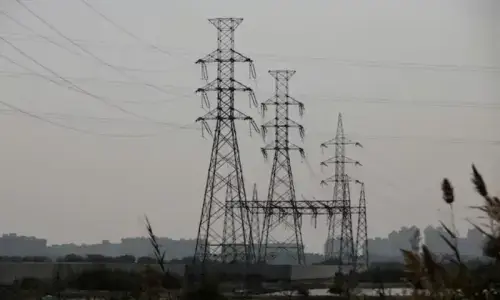
THE government’s failure to plan for the future lies at the root of the energy crisis currently engulfing the country. However, no amount of finger-pointing at this late stage can extricate the country from the mess that the government has created with its singular lack of vision. With no respite in sight until new power plants come online, the focus must be on conservation if we have to make ends meet. As a nation, we are great wasters of energy and there is immense potential for improvement. Here, actions both big and small are equally significant. Even if conservation measures are not able to eliminate loadshedding in its entirety, they can certainly help reduce its frequency and duration. For that to happen, what needs to come to the fore is a collective sense of social responsibility that has so far been conspicuous by its absence.
Social responsibility can be divided into three main categories — governmental, corporate and individual. For its part, government at all levels must set an example that others can appreciate and readily follow even if it entails personal sacrifice. Air-conditioners and lights in government offices need not be turned on well in advance of the officers’ arrival. Streetlights that remain on during the daytime too are a common sight — a practice that can and must be discontinued forthwith. The relevant authorities should also explore the possibility of halving the number of streetlights in major cities by turning off or removing the bulb from every alternate pole. Parks that remain lit up all night long are unnecessary even in the best of times, let alone in a severe power crisis. No amount of evening or daytime energy-saving regulations can avert loadshedding at 3am, but this small measure can have a positive impact. Moreover, no storekeeper who endures power cuts all day long in stifling heat and loses perishable items in the process, will ungrudgingly shut up shop early when the government itself is wasting electricity for all to see. Illuminated billboards are an unaffordable luxury in the present circumstances and this is where large firms can cooperate with the government. They can, moreover, choose not to light up their office buildings at night when no one is at work.
Individual consumers can also make a major contribution. The government estimates that nearly 1,700MW can be saved across the country if everyone turned off just one 100W bulb. Remote-controlled appliances that remain in perpetual standby mode — televisions, DVD players, stereos, etc — are all silent guzzlers of electricity and they need to be switched off at the mains. Studies in the UK and Australia show that appliances on standby account for eight and 10 per cent respectively of total power consumption in those countries. Computers and printers that are not in use should be shut down — failing that, at least the monitors must be switched off. Rechargeable cordless phones can be put away for a few months and replaced with traditional instruments. Clothes ought to be pressed in one go when the iron is hot, instead of wasting power over several sessions that involve reheating the coil all over again. Putting larger loads in washing machines will save both electricity and water. What is essential though is the will to make a difference, and that is where we must not be wanting this time.
Avoiding a clash
WITH the entire nation in a procession mood, the people of Karachi are bracing for what could be a Saturday full of tension, if not violence. Two rallies are to be held — one honouring Mr Iftikhar Mohammad Chaudhry, the other by the Muttahida Qaumi Movement. The details of the MQM rally have not been announced yet, but the programme for the reception to be accorded to the ‘non-functional’ Chief Justice on his arrival at the Karachi airport is ambitious and makes it clear that two of the city’s arteries — Sharea Faisal and M.A. Jinnah Road — will be anything but normal for the hundreds of thousands of vehicles which use these thoroughfares in the hours when the pro-CJ rally will be on the move. Both sides have claimed that their rallies will prove on whose side “the people of Sindh” are and that the processions will be peaceful. However, the people of Karachi can only hope and pray.
The rivals claim that they are holding rallies to uphold judicial independence, but one can clearly see that the two are working at cross purposes. The character of pro-CJ rallies throughout the country has been anti-government, while the MQM is part of the ruling coalitions in the federal and provincial governments. On Tuesday, Mr Altaf Hussain said his party stood for an independent judiciary but he termed the pro-CJ rallies as “jugglery” and “political gimmicks”. Two rival rallies on the same day is cause for concern, and the rally organisers owe it to the people of Karachi to ensure that there is no violence in a city which is violence-prone. More important, the two sides should realise that the aim of every form of protest is the good of the people. From this point of view, Saturday’s rallies would be counter-productive if they lead to violence. As for Karachi virtually coming to a halt, and millions of people suffering torture in May’s heat because of traffic jams, the conscience of those organising the rallies need not prick. The people of Karachi have long got used to hardships inflicted on them by those who claim to fight for their cause, no matter how worthy it may be.
Another gang-rape case
THE alleged gang-rape of a married Hindu woman in Umarkot by upper caste Hindu landlords is not the last time one will hear of such a dastardly act. If there is any silver lining to the event, it is that the woman’s father-in-law has filed an FIR, naming the three men who allegedly barged into the house and raped the woman at gunpoint. The family is now being pressured into withdrawing their charges or facing dire consequences. One hopes that the police will stand up to all pressure and do their duty of investigating the crime and arresting those involved in it. As reported in a news story on Wednesday, an elderly villager said that two girls were recently raped in the same manner by influential people but the police refused to entertain an FIR against the rapists. This matter should also be investigated for the police’s job is to provide assistance to all aggrieved people, not to protect the influential. The provincial government should take note of what is going on and step in to ensure that the legal process in each case is completed, without being dissuaded by pressure or influence. If any pressure is to be exerted, it should be to arrest and prosecute those allegedly guilty of a heinous crime.
It is because of police laxity that many rapists have gone scot-free. While it may be encouraging that more women are stepping forward to report rape, it is equally important to secure the convictions for the rapists. The police must play their role of ensuring that the culprits are apprehended while the government must provide all necessary help and prodding for the arrest and prosecution of all manner of criminals, especially rapists. Only then will men think twice before committing rape, for they will know that they cannot get away with their crime of one kind or the other.
Right way ahead for France
THE French electorate this week forwent an opportunity to pick a woman as the head of the state for the first time, opting instead, by a small but decisive margin, for a sharp turn to the right. It’s a decision quite a few of those who voted for Nicolas Sarkozy on Sunday may come to regret before long.
For all his keenness to depict himself as an outsider, Sarkozy was very much a part of the establishment 18 months ago when economically depressed suburbs in cities across France exploded after two youths of Arab origin were electrocuted while being chased by the police. Two days earlier, Sarkozy, in his capacity as interior minister, had described petty offenders as “scum”; a few months before that, he had vowed to clean out the Parisian suburb of La Corneuve with an industrial-strength power hose.
If soundbites of this variety, spiced up with a racist flavour, infuriated large numbers of people, they also served as a dog whistle that attracted the far right. The National Front’s Jean-Marie Le Pen received a smaller proportion of the vote in last month’s first round of the presidential election than he did five years ago because a section of his support base defected to Sarkozy, correctly viewing him as a more effective vehicle for the extremist agenda.
Not surprisingly, the next president’s perceptions of the present are coloured by his views of the past. Twelve years ago, Jacques Chirac admitted collective French responsibility for collaboration with the country’s Nazi occupiers. Sarkozy rejects all guilt on this account. Another favourite subject of his is the supposed falsification of history by those who find cause for shame in France’s colonial past. However, it isn’t very clear which colonial experience he fancies as a particular cause for pride: Algeria? Vietnam? Rwanda and Burundi?
He has been more ambiguous on the subject of the latter-day colonisation of Iraq, describing the occupation of that country as a “historical mistake”, yet, during a visit to the US, chiding his own government for its “arrogance” on the matter, to the considerable annoyance of Chirac and Prime Minister Dominique de Villepin. The latter, while serving as foreign minister, responded eloquently to the Bush administration’s belligerent rhetoric at the UN. France played a vital role in ensuring that the US and Britain embarked on their aggression without the world body’s imprimatur.
This was unquestionably the Chirac government’s finest hour on the international stage, and its policy enjoyed an approval rating of 90 per cent among the French public. This helps to explain Sarkozy’s reluctance to diverge too sharply from the near consensus. But had he been ensconced in the Elysee Palace in 2002-03, it is likely that he would have followed in the footsteps of Spain’s Jose Maria Aznar and Italy’s Silvio Berlusconi by massaging George W. Bush’s bloated ego with unstinting moral support and a limited military deployment.
Unlike some of its neighbours, postwar France has maintained a certain aloofness from the US. This tradition, established by the president-elect’s putative hero Charles de Gaulle, is likely to be discontinued by “Sarko the American”, which in turn could precipitate a diminution in Europe’s stature in world affairs -- not least in the Middle East, where Sarkozy’s attitude towards Israel closely reflects that of the US.
It is on the domestic front, however, that Sarkozy’s progress will closely be analysed, and his campaign benefited from the fact that he brings to the project a clear vision, unpleasant as it may be.
In his victory speech, he vowed to “rehabilitate work, authority, morality, respect, merit”. Whether it was used deliberately or subconsciously, “rehabilitate” is an interesting choice of word, because it carries the implication of bringing back into vogue something that existed in the past. You will seldom find its proponents acknowledging that the neoliberal “reform” process falls squarely in that category, for it is based on the assumption that rapid “growth” and “wealth creation” are contingent on further empowering the owners and controllers of capital while wresting from workers many of the rights that were gained after long and arduous struggles.
This is, in other words, a regressive process, its primary aim being to take relations of production back to where they stood a 100 or so years ago. Small bribes often succeed in restricting resistance to the backsliding. Trade unions tend to sell out, or become so bloated and bureaucratised that they lose the respect and allegiance of their members. But those that continue to serve their historic purpose of agitating and bargaining for better conditions face the wrath of the entrepreneurial classes: they are dismissed as relics of the distant past and as hurdles to “progress”. From the capitalist point of view, the ideal solution to the nuisance posed by organised labour is legislation that strips it of its powers.
That, in part, is the sort of thing Sarkozy has in mind. His supporters hope, and his opponents fear, that his influence on the economic landscape of France will be as profound as the effect Margaret Thatcher produced in Britain. He has the unions in his sights, not least because they proved a year ago that they can still summon up the street power to resist retrograde proposals.
The bone of contention last spring was the de Villepin government’s contrat première embauche, which would have made it easier for employers to sack young workers. It was ostensibly intended to combat widespread youth unemployment, but millions of French workers and students didn’t see why job creation should entail job insecurity, and they poured into the streets in numbers not witnessed since May 1968, compelling Chirac to order a retreat.
Sarkozy has frequently underlined the need to “liquidate the legacy of May 1968”, offering the impression that the events of that tumultuous phase in French history were little more than a mass mobilisation in defence of the right to strike. In fact, the radicals of ’68 were determined to overturn the power structure, and very nearly succeeded in bringing down de Gaulle. They were let down, above all, by a Communist Party fearful of seriously challenging the status quo.
Among the more prominent leaders of the abortive revolution of ‘68 was Daniel Cohn-Bendit, who now represents Germany’s Greens in the European Parliament. He recently advised Sarkozy’s presidential rival Ségolène Royal, the Socialist Party candidate, to back away from left-wing policies. “If she tries to play it on the traditionally socialist card, she will lose,” he predicted, “because France has veered right.”
So much, then, for the legacy of May ‘68. It was, in fact, liquidated long ago. Sarkozy isn’t inheriting a socialist state any more than Royal would have sought to create one, had she won last Sunday’s election. France does, however, retain elements of the welfare state. As Tony Judt commented in The New York Times a couple of weeks ago: “The dysfunctional French social model, we are frequently assured, has failed. In that case there is much to be said for failure. French infants have a better chance of survival than American ones. The French live longer than Americans and they live healthier (at far lower cost). They are better educated and have first-rate public transportation. The gap between rich and poor is narrower than in the US or Britain, and there are fewer poor people.”
Much of this may no longer hold true once Sarkozy has had his way, but there can be little question that his campaign benefited enormously from the incoherence of the competing vision. Royal was unable to offer voters much more than a vague, unexciting continuity. It wasn’t entirely her fault: the fractious Socialist Party was never solidly behind her, and some socialist voters decided that a dose of Sarkozisme was likelier to reinvigorate the left than a bout of Royalisme. However, the risk is that five or 10 years of Sarkozy could drastically alter the shape of French politics, paving the way for a situation analogous to that of Britain, where the Thatcherite legacy found the ideal host in New Labour.
European social democracy has been in decline for decades: most of the parties associated with that label have convinced themselves that there is no alternative to neoliberal economics and, furthermore, that deviations from the capitalist path are indefensible on the electoral battlefield. No one exemplifies this trend better than Sarkozy’s friend and admirer Tony Blair. The centre has shifted, making it simpler for conservatism to slide towards extremist variants of the creed. Sarkozy, with his appeals to nationalist pride, is one of the consequences. If the drift continues, it is not inconceivable that the far right in Europe will before long acquire “respectability” of the sort it hasn’t enjoyed since the 1930s.
“I will be president of all the French people,” Sarkozy vowed in his victory speech. The diminutive, polarising politician’s tall claim will severely be tested once he begins implementing his agenda after next month’s parliamentary elections. One of his first targets is likely to be the 35-hour working week. And a harsh crackdown on “delinquency” could reduce France’s unemployment problem the American way: by increasing the prison population, with disproportionate representation for non-whites.
There is a small possibility, of course, that the reality of power will moderate Sarkozy’s crypto-fascist tendencies. However, given that their new president appears to have little time for notions such as liberté, egalité and fraternité, it’s more likely that the plurality of French citizens will sooner or later find themselves rallying to defend not the legacy of 1968 but the spirit of 1789.
mahir.worldview@gmail.com
| © DAWN Group of Newspapers, 2007 |