0
0

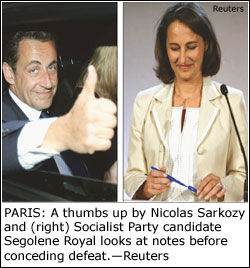 PARIS, May 6: Right-winger Nicolas Sarkozy scored an emphatic victory in the French presidential election on Sunday, trouncing Socialist rival Segolene Royal to win a clear mandate for his tough economic and social reforms.
Wild celebrations erupted among Sarkozy supporters in Paris as soon as polls closed and projections said the 52-year-old former interior minister had around 53 per cent of the vote against Royal’s 47 per cent.
There was a high turnout estimated at about 85 per cent by polling institutes which highlighted the widespread interest in the election of a new generation of French leaders after President Jacques Chirac’s 12 year rule.
Delirious members of the ruling Union for a Popular Movement (UMP) burst into chants of “Nicolas - President!” and hugged each other in joy at the party’s campaign headquarters.
Thousands also gathered on the historic Place de la Concorde in central Paris where Nicolas Sarkozy was to give a victory speech and veteran French rocker Johnny Hallyday was to headline a special concert.
At the Socialist Party headquarters in Paris, supporters gloomily digested a third consecutive presidential defeat.
Royal, who had hoped to become France’s first woman president, told disconsolate supporters she hoped “the next president of the republic will accomplish his mandate for the service of all French people”.
Thousands of police reinforcements were deployed in and around the capital to head off the risk of unrest by youths from high immigrants areas, many of whom regard Sarkozy as a hate-figure since riots of 2005.
On the last day of the campaign Royal — slipping badly in opinion polls — had issued a stark warning that a Sarkozy victory would trigger “violence and brutality” across the country.
Sarkozy will take over from Chirac on May 16, and has promised to act quickly to enact key items of his manifesto.
After legislative elections in June he plans a special session of the National Assembly to push through the first stage of his reforms.
These include the abolition of tax on overtime, swingeing cuts in inheritance tax, a law guaranteeing minimum service in transport strikes, and rules to oblige the unemployed to take up offered work.—AFP