



 0
0

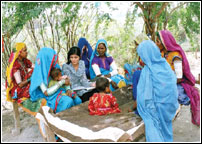 The microfinance sector is still in initial stages of development but it is considered to have great potentials. The recent statistics show that almost 25 per cent of the country’s population (nearly 38 million) lives in absolute poverty. And within this, microfinance is recognised to be a significant poverty alleviation tool. Encouraging is also the positive growth in this sector over the past six years.
The microfinance programmes (MFPs) are broadly categorised into five groups. These include: microfinance institutions (MFIs) or the NGOs which specialise in the field and are licensed by the SBP), rural support programmes (RSPs) as part of their operations), and other NGOs doing microfinance as part of their integrated operations, and commercial finance institutions (CFIs) or commercial banks involved in microfinance.
MFPs sector presently comprises of 20-25 NGOs, six MFBs, 4-5 CFIs and six RSPs. Recently, the SBP Bank of Pakistan has also issued guidelines for commercial banks to enter microfinance sector. Khushhali Bank claims to have a current annual coverage of 100,000 clients.
Loans and savings are the two key services that are currently being provided by the micro-finance sector. The average size of loan taken by poor households from NGOs is about Rs16,540 at an interest rate of 18-20 per cent per annum. The important indicator to look in this regard is growth in outreach. Performance indicators report (2005) shows that the number of active borrowers from 2003-2005 have increased by 85 per cent while outstanding loans increased by 115 per cent. Where as, growth in the number of savers and value of savings is reported to be 38 and 49 per cent respectively.
MFBs claim to have the largest share in loan lending microfinance market. Khushhali Bank is the leading player with almost 92 per cent of active borrowers. Next to MFBs come RSPs in terms of number of active borrowers. Again the leading player in RSP group is NRSP (National Rural Support Programme) accounting for 59 per cent of RSP overall share. MFIs come third in terms of microfinance market share. The leading MFI is Kashf foundation providing loans to 73 per cent of MFI market in terms of active borrowers.
These three leading players i.e.; Khushhali Bank, NRSP and Kashf Foundation together cover 70 per cent of the microfinance market in terms of active borrowers and these programmes are gaining popularity.
The microfinance sector continues to be a promising sector as it presents lots of opportunities. Firstly, it helps in stimulating growth of the economy. The sector contributes significantly to the creation of new jobs and new work opportunities. Secondly, microfinance has shown positive impact on women empowerment. Women make almost half the labour force. Now a large number of women are moving into self-employment. The most frequently cited reason for this is the search for independence and control over one’s destiny. Women are generally underemployed and are economically and socially disadvantaged in our male-dominated society.
Poor women are given access to microfinance when no other financial services are available to them and it enhances their status and well being in our society. Research has shown that women clients of microfinance institutions are more inclined than men to invest in their families’ health and education. Thus, they often require distinct loan, savings and insurance products.
Despite its recent popularity, our microfinance sector is faced with a number of challenges. A brief review of some of the key challenges follows;
Pakistan is an agro based country where 67.1 per cent (28.1 million) of the total labour is in the rural area. The country is also facing high level of inequality in income distribution. The share of highest 20 per cent of the households was 49.7 per cent in the national income in 1999 while bottom 20 per cent of the households receives 6.2 per cent of the national income. The present reach of MFIs and NGOs are around 10 per cent of the potential market of 6.5-7 million poor households.
The conclusions drawn from Pakistan Integrated Household Survey (PIHS) and the Pakistan Socio-Economic Survey (PSES) are that in year 2000 the poor had very little access to formal and semi-formal credit markets; the vast majority of loans were used for consumption rather than investment; large size loans were provided by formal and semi-formal credit providers; and lastly, the suppliers of credit were unable to supply when the users of credit needed it the most. This has severely reduced the role that credit might have played in maintaining consumption levels. The demand of microfinance products should not be measured by counting the numbers of the poor. Some earlier research conducted in this area has shown that many poor households do not demand loans. This could be because there are not enough profitable productive opportunities to generate repayments. In these cases, lack of loans is not the binding constraint that limits the expansion of household income. Schools, hospitals, roads, access to markets and institutions would typically be more important than mere loans in contributing to their income and welfare.
Another challenge that microfinance sector is facing is to remain financially viable in the absence of domestic subsidies or foreign support. Much of the microfinance sector is dependent on subsidies. And that if lending agencies collapse or if subsidies are terminated then the majority microfinance institutions may not survive. Further majority of these micro institutions fail to reach poorest of the poor as they normally avoid rural areas where majority of the poor communities live. Majority of the loans are agriculture related where private moneylenders or middlemen play the dominant roles.
Micro institutions usually lend small loans. They are forced to charge higher interest rates due to high monitoring cost. In fact, private moneylenders have advantage over banks because of their local connections and past dealing experiences. Formal micro financing programmes can only be successful if they keep the information cost of examining the creditworthiness of the client at the lowest.
Thus, there is a need to define new organisational designs to overcome the shortage of money supply in microfinance sector. The challenge lies not only in finding donors and providing them with sufficient funds but also in finding the right production function (technology and trained human capital) that makes it possible to produce quality financial services at reasonable costs for the microfinance.
Government investment in infrastructural development (roads, markets etc.) also made an important impact on the smooth and stable performance of these financial institutions. For example, wherever the government agencies are active in purchasing the agriculture commodities there will be fewer chances for the informal sector to penetrate.
Lastly, in the words of Prof. Mohammad Younus “It is not micro-credit alone which will end poverty. Credit is one door through which people can escape poverty. Many more doors and windows can be created to facilitate an easy exit. It involves conceptualizing about people differently; it involves designing a new institutional framework consistent with this new conceptualisation.”






























