



 0
0

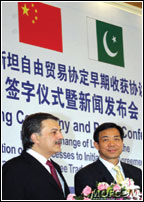 PRIME Minister Shaukat Aziz has a lot of expectations from the five-year trade pact with China and the free trade agreement (FTA) signed during the visit of President Hu Jintao to Pakistan. He expects the trade between the two countries to grow from the present $5 billion to $15 billion in five years.
But during the meeting last week between the two countries in Beijing on extending the FTA to the services as well, the Pakistan side said that total trade between the two countries stood at $3 billion, while the Chinese side claimed that it was $5.3 billion. Researchers on both sides have agreed to work out the figures and reconcile the large difference.
Is it a case of under-reporting or under- invoicing imports from China to evade duties as is common in Pakistan? The Central Board of Revenue recently uncovered a gross malpractice with regard to imports from China and found that payments of duties were far less than it should have been.
The Islamabad dry port, known as Margalla dry port, was used for the purpose by senior customs officials. It was a massive scandal which was exposed. Are their more such cases ? While efforts are being made to expand the scope of FTA between China and Pakistan, the Asian Development Bank has come up with a cautionary note to Pakistan. As the prime minister talks of expanding trade with China five-fold in five years, the ADB says the expiry of the China–specific safeguards imposed by the US and the European Union on Chinese textile exports may further weaken Pakistan’s balance of trade.
That means with the increase in Chinese textile exports to the US and European Union, Pakistan will have fewer opportunities to export goods to them unless special protective measures are taken.
At the same time Pakistan and the European Union are close to finalising the third generation agreement which provides Pakistan with more facilities. And yet the issue of fish exports to the EU remains pending as Pakistan has not made enough efforts to allay the fears of the EU about the hygienic condition prevailing on the Karachi fish harbour where the fishing plants are located.
Pakistan’s exports to China in the first six months of the financial year were for $500 million while the Chinese exported goods worth $2.226 billion. There were varieties in the Chinese exports which included machinery, electronics, chemicals, pharmaceuticals, and other manufactured goods, while Pakistan exported primarily cotton yarn and cotton cloth.
Will Pakistan be able to produce large varieties of goods and that too in plenty to increase its exports to China to balance trade when it reaches $15 billion?
Pakistan cannot afford to lose when it already has a large trade deficit and on that account a sizable balance-of-payments deficit. China wants to help Pakistan in every possible way. Particularly in the economic sector it wants to help Pakistan as much as it can.
China is now open to trade with all countries and is signing FTA with them. It is also signing FTA with Australia during the forthcoming visit of Chinese President Hu Jintao to Australia.
We have to compete with Chinese goods both in quality and in price to boost our exports. For that matter we will have to compete with the goods of other countries in each market. The foreign investors in China are able to export much of their products to the world using cheap and trained labour. We too could induce foreign investors in Pakistan to export some of their products if the cost of production is low and the cost of doing business is not high. As at present they are not, they prefer selling their products in the local market at higher prices. Pakistan compares prices of their goods with the prices of goods in India and feels disappointed.
Meanwhile, Sri Lanka is moving towards implementing the FTA with Pakistan which it signed two years ago. It was the first FTA which Pakistan had signed and had great hopes in it. But the Sri Lankan government, preoccupied with internal problems, has taken too long to implement it and it is now expected to implement it later this year.
Pakistan’s basic problem is the lack of large exportable surplus and variety in exports which are focused too much on textiles. Dr. Nadeem-ul-Haque, Chancellor of the Pakistan Institute of Development Economics, says that Pakistan’s exports have increased a great deal but is still a small part of its GNP. That is because of Pakistan’s large population and high consumption.
The solution lies in curtailing population growth and reducing its consumption. Prime Minister Shaukat Aziz says the population growth will be brought down by 1.3 per cent by 2020 and that is a long way from now, and precipitate action is not possible in the present context of religious extremism.
The government may think of the FTA as a magic wand for accelerating exports but in fact it is a double-edged weapon which if not handled deftly, can cut the hand that wheels it.
The focus has to be on producing a variety of large exportable surpluses, high quality goods at competitive prices and smart salesmanship. Otherwise the FTA we sign will have little to feed on.






























