0
0

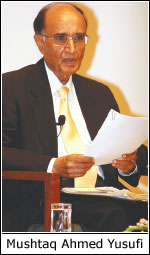 KARACHI, April 29: There is a very thin line between a good humorist and a humanist — and that’s the only line banker-turned-humorist Mushtaq Ahmed Yusufi toes. The subtlety of his satire laced with unlaboured, chaste Urdu idiom, in a country where the present but mirrors the political past, is a forte that distinguishes him from others in the field.
On Saturday evening, he had his audience, comprising mainly doctors and surgeons gathered at the Sindh Institute of Urology and Transplantation, in splits. Reciting excerpts from his humour and satire-based books and sharing personal anecdotes with a witty, allegorical twist, 84-year-old Yusufi confounded all those years with a teenager’s buoyancy. Bouts of laughter roared in the hall; even the astute giggled like silly girls.
Accomplished and modest in equal measure, and admittedly having served in the ‘wrong’ profession for 42 long years, Yusufi said praise by those tasked with introducing him at such recitals embarrassed him. “I do the job quite well for myself, saving others the lies they’d have to tell in the event,” he declared, setting the tone for the evening.
It is the ability to laugh at himself that earns Yusufi the right to laugh at those around him or pick on those who would not let you laugh. With just the right amount of political innuendo as his aid, the humorist also alluded to the current situation in the country. There was more to come in spontaneous humour, including the narration of a longish audience with the late dictator Ayub Khan and Altaf Gohar in 1967, before he picked up the printed excerpts to read. First the personal ones:
On his indifferent health: “This is the first time in recent months when a doctor present here has not asked me to undress. They carried out 26 medical tests for several health conditions on me a few weeks ago. I tested positive for all. Pregnancy was just about the only condition they didn’t test me for.” On aging: “At my age a man has usually known all kinds of pain, save labour. The generation I belong to was raised believing that it was your elders’ prayers that caused childbirth. In England, aged 60, I discovered they put on adult programmes on TV after 9pm. Pity, I didn’t know that a decade earlier. What I saw, however, reminded me of the only lessons I got in human anatomy and biology as a little boy from the curse words adults used back home.”
On the loss of his wife: “I complained to my eye doctor of double vision. He said I was lucky to see two wives instead of one. I told him I couldn’t tell the legal one from the illegal… I don’t even have one anymore.”
On that sobering note, Yusufi reached for the selected excerpts from his printed works that he had brought along to read aloud. An hour of enthralling laughter followed. Here are some of the themes he touched upon:
On Karachi and its lingo: ‘In UP there is hardly a house without a vine of motia flowers wrapped around it. In Karachi the only variety we know is cataract (motia). There is no equivalent in Urdu for lafrra and phadda (brawl). The situation never arises if it’s Urdu you speak.’
On Lahore: ‘It’s unnerving that you should name the place you go to ‘blacken your face’ as ‘Diamond Market’ (Heera Mandi).’
On Islamabad: ‘It’s like paradise; one that every reigning Adam must be thrown out of.’
On changing values: ‘Hafiz Jallundhri has wisely said: ye ajab marhala-i-umr hai ya Rab ke mujhe/ har buri baat buri nazar aati hai’ (At this strange juncture in life, every vice appears just that).
On hypocrisy: ‘The real intent behind sending young nawabs to a nautch girl’s was to protect them from witnessing what passed at home.’
On the ultimate in antidotes: ‘A poet has poignantly said: supurd-i-khaak hi gar karna tha mujh ko/ tau phir kahe ko nehlaaya gaya hoon? (For lowering me six feet under, I wonder/ why did they bother to bathe me?)
On gender bias in Urdu poetry: ‘It’s unfair to judge a literary genre out of its context. Consider a politically correct version of Momin’s famous couplet: Tum mere paas hoti ho goya/ jab koi doosri nahin hoti’ (you are in my thoughts only when others (girls) are not).
Yusufi characteristically finished on an allegorical excerpt. Selected from Japanese literature, it reflected the prevailing socio-political situation in the country. The moral of the anecdote featuring five lions posted to protect a temple was that while four of them guarded the temple from outside against intruders, the fifth one posted in the inner sanctum was necessary to stem the loot from within.
The fifth lion, Yusufi said, was “khalq-i-Khuda, jo mein bhi hoon aur tum bhi ho”, (the people, including you and I), who must reign supreme one day, as identified by Faiz in his poem Ham dekhain ge. He finished by reciting the last stanza of the poem.
Earlier, Drs Farhat Moazzam, Izaz Ahmed and Anwer Naqvi of the SIUT’s Centre for Biomedical Ethics & Culture delivered their short welcome speeches at the behest of the host, Dr Adibul Hasan Rizvi, who had had to leave on an emergency consultancy trip to Brazil.