



 0
0

Have a safe journey!
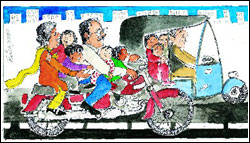 Everyday there are reports of fatal and non-fatal accidents on the roads. Quite a good number of roads in this city are wide and with the construction of flyovers, road users are tempted to go at a break-neck speed. Most of the young drivers (better say underage drivers) suffer from an overdose of confidence and have misplaced trust in their ability to negotiate all sorts of traffic. It is therefore wise for other road users not to depend on them for safe completion of their journeys.
For the public, the rule of thumb in the case of a road accident is that irrespective of the fact whose mistake caused the accident, the driver of the bigger vehicle automatically gets named as the guilty party and the other as the victim.
Anyone who disregards the road safety rules is bound to meet with an accident sooner than later. Given this universal truth, there is no gainsaying the fact that the drivers of some vehicles are more prone to accidents than others. The drivers of two-wheelers are more prone to accidents than those of the four-wheelers and need to be extra careful. The vulnerability of two-wheeler drivers increases manifold if they violate traffic rules as they are often seen doing.
Most motorcyclists carry more than one passenger. Sometimes the number is close to six and the riders include the old, the sick, the disabled and toddlers and sometimes all of them on a single motorcycle. This is not all. I have seen, as you also must have, most two-wheeler riders drive around without putting on the mandatory helmets, willfully and recklessly flouting the lane rules, using mobile phones while in motion and overtaking both from the right and the left.
About the kind of loads carried, the less said the better. Carrying of wooden doorframes, iron rods, huge glass panes, bundles of tube lights, loose boxes, pipes and other hazardous material are a common sight.
What’s even worse is that most of them ignore traffic signals. No wonder the instances of their accidents are common, the fates of entire families are sealed by the loss of lives or limbs of the riders in accidents.
Traffic police alone may not bring about overnight changes in a city like Karachi where the vehicle population is mushrooming, thanks to financing institutions. Though the police have powers to enforce the law and impose fines, the shortage of policemen has contributed to the aggravation of the problem. They are too few to be effective. Often the traffic crossings remain unmanned and traffic signals unattended while those on duty are seen making their earnings by giving a free hand to violators on roads.
In this situation, the frequency of accidents and extent of losses can be imagined. Though there can be many ‘musts’ and ‘shoulds’ at all cadres of the government to avoid such grave losses, it would be better if motorists adhere to the traffic rules.
A modicum of self-discipline would bring in good results. Safe driving entails that one makes allowances for fellow drivers and pedestrians. No chances should be taken here because life is precious.—HA
A recreational park
One of the oldest recreational spots in the city, Hill Park has indeed come a long way. As a kid, this writer would go there for the simple reason that the Park had one of the second largest amusement parks in the city with some of the longest slides that provided respite to children and adults alike in many a sultry summer evening. Thankfully, the Park still manages to do that. Its current state of affairs, however, is another story.
With two amusement parks to boot now and a bunch of ducks and geese that are permanent residents there, cleanliness should a major concern. Sadly, it isn’t for the artificial lake which has been created especially for the birds is filthy to say the least.
The murky waters feature grime, bags of chips and popcorn, discarded shoes (?), among other things. Then, there are the plants which seem to be slowly decreasing in number simply because there is no one to take care of them, while litter is strewn all over the place.
Hookers are found “working” in the Park which is fast becoming notorious because of the easy availability of girls when they are needed.
All this is unfortunate indeed especially because the Park has a great deal of potential as a recreation spot – for starters, it has a proper parking space, which is rare for most other recreational facilities available in the city.
It also has one of the oldest eateries of Karachi which serves anything from chaat to pani puri to “bumbai” (Bombay) style khichra. Most importantly, however, there is a spot on top of the hill from where you can literally view the entire city — from Chundrigar Road to the Clifton Beach to the Karachi Airport.
Karachians are often found complaining about the lack of recreational spots in the city and in a bid to please them the government is eagerly building new parks all over the place (by tearing down some monuments of historic significance, such as the Jahangir Kothari Parade).
If recreation is truly a sore point, why not revamp what we already have?
—Samina Wahid Perozani
Suffering in comparison
For someone who has been taking pride at the few flyovers and underpasses that were built in Karachi during the last two or three years, a visit to Islamabad was an eye-opener. The roads there have a better surface and are also better maintained. Motorists, bus drivers and even motorcyclists observe the traffic rules in Islamabad. No jumping the red lights at crossings, even if there is no other vehicle in sight. The policemen don’t spare even the VIPs for breaking the traffic rules, like they don’t on the Motorway between Lahore and Islamabad.
What is no less important there is no load shedding, not just in the capital but also in the adjoining villages, hence there are no shops selling UPS (Uninterrupted Power Supply), nor does one see huge generators fixed on the pavements – not an unusual sight in Pakistan’s port city.
There are no heaps of garbage, or at least I didn’t see any. Also there are no shopping bags hanging from the tree branches.
But the airport in Chaklala, which was rechristened Islamabad Airport, is a big disappointment. Disembarking from an aircraft and boarding a bus is too outdated. One wonders when the new airport will be built in the capital.
As the one who has travelled extensively in the last few years, I can say that the Jinnah International Airport may be smaller in comparison with most airports in the West, but it is just as well-maintained as are the airports in Europe and the US. Last week when I stepped out of the aircraft after sunset, I felt as if I had entered an oven. I missed Karachi’s sea breeze very badly. But a passing shower soon made Islamabad extremely pleasant. It was almost like Karachi in winter.
Islamabad has one more advantage – the hills are only a few miles away.
Finally, it’s good to see that the sleepy capital of the country no longer goes to bed early. There is traffic even close to midnight and some of the eateries remain open quite late.—Asif Noorani
Compiled by Syed Hassan Ali
Comment: Weather and daft officials ruin potentially thrilling finale
A WORLD Cup that promised more than it delivered produced a final that played to the same script. A thunderous innings by Adam Gilchrist enticed Sri Lanka to respond valiantly but an ill-timed downpour created fatal confusion among players and umpires as the World Cup final, the showpiece event in international cricket, ended in complete farce.
This tournament has been a disaster from start to finish, from Bob Woolmer's death to this anti-climactic triumph for Australia. The ICC has continued to maintain that the competition has been a success. It should ask the people who matter, the fans.
The stands have been empty, the format flawed, the tournament too long, and the cricket tedious. If that is the ICC's idea of success I would hate to see what failure looks like.
National and international cricket administrators have lost touch with what is important. Despite Australia's commanding position and Gilchrist's stunning innings, Sri Lanka were mounting an exciting challenge for the trophy. A potentially thrilling finale was ruined by the weather and daft officials, robbing Sri Lanka of any realistic possibility of success.
Even so, it would have taken a miraculous performance to overhaul Australia's total. While Sri Lanka did show that it is possible to put this Australian bowling attack under pressure, it is Australia's batting that is on another level to all other countries.
The top six batsmen are skilful, smart, and domineering. Their techniques are finely honed for all-out attack and it is inevitable that one of them will produce a special performance. It must be particularly reassuring to see Adam Gilchrist and Matthew Hayden stride out to open each innings, with the captain and world's best batsmen Ricky Ponting padded up to continue the assault.
In ideal batting conditions, Gilchrist produced a remarkable innings that stole the match from Sri Lanka. All bowlers were alike to him, and once he was settled he began to hit straight and true with astonishing control and power. Some of that control was produced by a squash ball stuffed into his left batting glove, apparently to ease the bottom hand's influence in his stroke-play.
Gilchrist's innings ranks with any of the great World Cup final performances, and was even more extraordinary since none of his fellow batsmen managed to play as freely as he did. Sri Lanka were shell-shocked and lost their bowling discipline. But Gilchrist has a remarkable ability to turn good length balls into short balls and that is when bowlers lose control.
Certainly in my lifetime, there has been no better wicket-keeper batsman than Gilchrist, and it is hard to imagine that anybody could have ever been better. Thanks largely to Gilchrist, the wicket-keeper in modern cricket also has to be a frontline batsman. Otherwise you can forget competing with Australia.
Glenn McGrath is another Australian cricketer who has set new standards. He closed his international career in Barbados with a record third consecutive World Cup triumph, the player of the tournament award, and the highest number of wickets in the competition and World Cup history. The world's batsmen will sleep a little more easily.
Ponting joined McGrath and Gilchrist in picking up three World Cup winners' medals. He leads his team from the front, both with the bat and in the field. He might not be the oldest but he has their respect. It is the professionalism of these three senior cricketers that explains the success of Australian cricket. Nobody remains in the national team on reputation alone. You have to perform consistently at a high level.
And that is where Australia are, on a higher level to all other international teams. They were by far the best team in this tournament and fully deserved to be the 2007 World Cup winners. On the evidence of the past few weeks, the rest of the world is a long way behind the power cricket of Australia.
| © DAWN Group of Newspapers, 2007 |



























