



 0
0

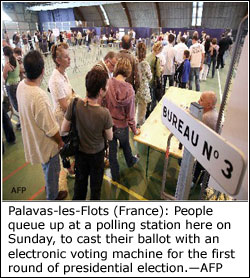 PARIS, April 22: Voters turned out en-masse in Sunday in France's cliff-hanger presidential election, with rightwinger Nicolas Sarkozy and socialist Segolene Royal predicted to go through to the run-off ballot.
Pollsters said turnout would be a record, reflecting the excitement the campaign has sparked and also memories of the 2002 vote when far-right leader Jean-Marie Le Pen shocked the world by qualifying for the second round against Jacques Chirac.
The estimated 30 per cent of voters still undecided going into polling day added to the tension surrounding one of the most unpredictable French elections in decades.
Opinion polls have for months made Sarkozy and Royal the favourites to reach the runoff vote on May 6 to decide who takes over from Chirac.
But centrist candidate Francois Bayrou and the anti-immigrant former paratrooper Le Pen maintained hopes of a second round spot.
In the face of voter concerns over high unemployment, globalisation, and seething discontent in high-immigration suburbs, Sarkozy has pushed a right-wing programme based on the themes of national identity and getting France back to work. Critics say his tough talk could divide rather than unite the nation.
Royal, who aims to become France's first woman president, has presented herself as a nurturing mother figure and has proposed a leftist economic programme that maintains France's generous welfare system intact.
Bayrou, who emerged as a surprise “third man” in the polls, wants to end the left-right political divide by forming a national unity government.
All three come from a new generation of politicians, and in a campaign that has been as much about personalities as policies, all claimed to represent a break from a discredited past.
Eight other candidates were also running, ranging from a Trotskyite postman to a hunting party hopeful whose vote-splitting potential gives them importance in the first round.
Around 44.5 million registered voters -- an increase of 3.4 million on 2002 -- were eligible to choose a successor to Chirac, 74, the Gaullist leader who steps down next month after leading the country for 12 years.
Three hours before polling closed, 74 per cent of voters had cast first-round ballots, a giant leap from the 2002 vote, officials said.
Turnout appeared on course to set a record, according to polling firms IPSOS and IFOP, who predicted it would reach 87 per cent at the close of polls.
There were widespread complaints about electronic voting machines which were used in a small number of polling booths, their first appearance in a French presidential election.
The Socialist Party, Communist Party and the Greens demanded that the machines be withdrawn for the second round, calling them a “catastrophe”.
But there was also widespread excitement over the high turnout.
In Clichy-sous-Bois, the flashpoint Paris suburb where riots began that spread across France in late 2005, Ziad and his younger brother Shahazad said they had not voted in 2002 but this time they had picked Bayrou.
“Segolene, I just don't see her as president, Sarkozy, he's scary, so that left Bayrou,” said Ziad, who declined to give his surname, as he left a polling station.
Only the two front-runners qualify for the second round. Initial estimates of the result were expected the moment voting ends at 8:00 pm (1800 GMT).
Opinion polls have consistently given a clear first round lead to Sarkozy, the 52-year-old leader of the ruling Union for a Popular Movement (UMP).
Royal, 53, a former environment minister, has been in second place followed by Bayrou, 55, and the 78 year-old Le Pen.
Rarely have candidates in a French election gone to such lengths to cast themselves as the face of change for a country plagued by doubts about its identity and its place in the world.
Few believe that French voters are about to stage a revolution at the ballot box, but the next president will be the person who best succeeds in addressing a yearning for change.—AFP




























