0
0

Toxic waste making Gujranwala sick
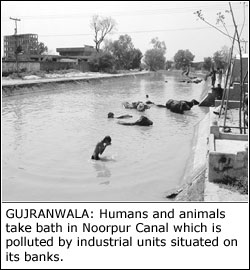 In the absence of appropriate drainage for toxic wastes, factories in and around Gujranwala dump their chemicals into canals or sewage pipes, causing serious health risks for citizens.
Factories in the suburbs of Gujranwala release their toxic wastes into canals, contaminating water and destroying crops, while those in the city release chemicals into sewage pipes, clogging the drainage system. Such blockages often result in pools of stagnant contaminated water in streets. If the water finds it way through the sewage system into the Mian Singh Minor canal - the Water and Sanitation Authority’s (WASA) only sewage dump - it floods the canal and ruins crops in the rural suburbs. Gujranwala is one of the cities of Pakistan where hepatitis is most widespread.
Almost 99 per cent of factories in the city — mostly tanneries, printing mills, sanitary fitting manufacturers, aluminium utensil manufacturers and soap factories — have no cleansing or recycling plants to re-use or detoxify their wastes.
Tanneries are situated inside the city and their waste includes such chemicals as the sulphuric acid, wetting agent, acid of salt, the hydrochloric acid, sodium carbonate and lime - all thrown directly into sewage pipes.
They have no other option, said Muhammad Jamil, a tannery owner. He blamed WASA for the problem, saying it had not provided an alternate.
Qazi Shahid Hamid, principal of the Institute of Leather Technology, told Dawn that his institute’s waste was recycled and the harmful sulphuric acid and sodium carbonate were converted into the environment-friendly and harmless sodium sulphate.
Muhammad Anees Butt, the owner of the Prime Soap Manufacturing Industry, also blamed WASA for the problem, saying it must provide a separate drainage system for toxic wastes. Many soap factories emit soda ash and alkalis that can cause skin diseases.
Talking to Dawn, the supervisor of Pakistan Textile Mill admitted releasing chemicals into the sewage system in the absence of any other disposal method.
Abdus Sammad, export manager of Faisal Sanitary Fittings, said his factory, like the rest of them, threw toxic acid of salt into the sewage lines from where it was thrown into canals. However, Yaseen Butt, president of the Sanitary Fittings Association, said it was the brass cottage industry and not sanitary fittings factories that contaminated canal water, by a process called “Niyaara”.
Ceramics factories threw their waste into adjacent “vacant areas”, said Malik Muhammad Amin, president of Pakistan Ceramics Manufacturers Association. He said if the authorities pointed out a ceramics factory dumping waste into the sewage system, his association would take stern action.
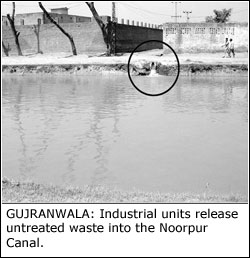 Abdus Sattar Khan, an Irrigation Department executive engineer, said factories dumping wastes into waterways were challaned, but his department could not act effectively against factories contaminating the Upper Chenab Canal, Noorpur Canal, Ludhaywala Minor and Mian Singh Minor until WASA stopped throwing its own sludge water into these canals.
Crops in about 20 villages including Maya, Bhudda Goraya and Manga were being seriously affected by contaminated canal water, Muhammad Mansha, an Irrigation Department sub-engineer told Dawn. He said the department had issued 15 challans to factories dumping chemicals into the Mian Singh Minor this year so far.
It was illegal even to release clean water into canals without the permission of the Irrigation Department, which he said charged Rs 14,000 per cusec of water released annually.
About 25 factories throw toxic waste into the Noorpur Canal, gauge checker Muhammad Akram told Dawn. People bathing in the canal were prone to several skin diseases, he said, and the chemicals contaminate the milk of cattle that drank water from the canal.
Sher Afgan, a sub-engineer of the Gujranwala sub-division of the Drainage Department, said the department owned five drains in the outskirts of Gujranwala that carries rainwater out of the city. He said it was illegal to throw factory waste into drains but since the factories had no other option, the department charged them Rs 11,000 per cusec of waste annually.
WASA engineering director Arshad Madan said the authority had neither funds to re-open its 15 dry drains and use them for factory waste, nor the equipment and manpower to remove chemical waste from sewage pipes every day. The district nazim had not responded to the department’s several requests for funds, he said, and WASA lost its major source of income - sale of sewage water to farmers as fertiliser - because of contamination from factory waste. WASA also had to throw sewage water in the Mian Singh Minor because of the lack of funds, he said.
He said Gujranwala was a poorly planned city since it was founded, but WASA was blamed for all the problems.
He said WASA was about to finalise a “master plan” for the city as part of a three-year scheme, and the plan included separate drains for factory waste.
| © DAWN Group of Newspapers, 2007 |