0
0

 THE estimated cost of Diamer-Bhasha dam, according to a Wapda official, has further swelled by $2.06 billion- from $6.5 billion to $8.56 billion- due to the price escalation factor and the revised seismic design of the project.
Earlier the ministry had been told that Wapda had worked out a $1 billion increase in the project .Similarly, the contract cost of Gomal Zam Dam, one of the nine ‘priority’ water sector projects approved in 2001 under the government's Water Vision 2025 programme, had been raised from Rs4.388 billion to Rs10 billion.
Pakistan is justifiably proud of its outstanding achievement in building the Indus Basin Replacement Works. In the intervening years, the quality of project implementation has declined substantially and the quality of project implementation is poor. Today, implementation of water sector projects is characterised by inefficiencies, completion delays and time and cost overruns. Factors that affect implementation include: defective planning and management, litigation over land acquisition, non-compliance with agreed resettlement and rehabilitation programmes, neglect of environmental issues, delays in procurement and preparation of accounts and carrying out audits, and the lack of preparation for transition from construction to operations.
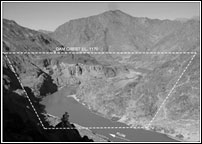
Diamer-Bhasha Dam: The reason for increase of the project cost is that it is located in the seismic zone of the Asian tectonic plates and Wapda is setting up a micro-seismic network to record seismic activity, specifically near the dam site. Though scheduled for completion by 2015, the authorities recently announced that the project would be completed in 2016.
The land acquisition for the project has already been completed, utilising an allocation of Rs67 billion made by the government sometime in September last year for the purpose, including the compensation for re-settlement of the displaced population. At present a number of geologists and civil engineers are busy at the dam's site for investigations and preparation of updated feasibility study and detailed engineering design by the Lahmeyer International GmbH of Germany, which was declared blacklisted last year by the World Bank.
The European Bank for Reconstruction and Development had blacklisted Lahmeyer, after found guilty of bribery on a World Bank project in Lesotho. Consequently, the Lahmeyer stands debarred, effective November 03, 2006, from award of any World Bank-financed contract, anywhere in the world, for a period of seven years..
Entrusting project design and its construction supervision to a company blacklisted by the World Bank is likely to have many far-reaching adverse implications. All the donor financing agencies, including ADB and others, generally follow the World Bank decision on corruption related matters.
The increase in the contract cost of the Diamer-Bhasha dam appears to be questionable for a number of reasons.. First, that feasibility consultants initially formulated a database containing 863 instrumentally recorded earthquakes of magnitude four or more in a radius of 200 kilometres of the project area from 1927 to 2001 then why did they not included the financial cost of micro- seismic network to record seismic activity? Secondly, if the price of construction material goes up, then how can $2.06 billion sufficient be for the forthcoming years?
Gomal Zam dam: The increase in the cost of the dam has apparently been done on the demand of the Frontier Works Organisation (FWO) as a precondition for resuming work on the dam, which was abandoned in 2004 by the Chinese firm M/s CWHEC after the kidnapping and subsequent murder of one of their engineers. Being built on the river Gomal in the South Waziristan Agency, the project should have been completed by June 2006, but the interruption in work has resulted in the cost going up from Rs4.388 billion to Rs10 billion.
Official say that the contract cost has increased because the prices of construction material have gone up since 2002. The September 2004 monthly report, which was the last month of working of the Chinese company, says that 98 per cent work has been completed on design and services, 16 per cent work on dam and spillway, 14.4 per cent work on the main canal and irrigation system, two per cent work on distributaries and 23.6 per cent work on transmission line. However, it is not clear whether the amount of money already spent by the Chinese is now included in the calculation of the total cost. Incidentally, Gomal Zam Dam was the first water sector project to have been conceived according to the European construction standards despite the discrepancy that exists between the prices of construction materials in European countries and Pakistan.
Here again the increase in the contract cost of the Gomal Zam dam appears to be questionable on a number of counts. First, the hike in the prices of construction materials during the last two or three years does not justify such a hefty cost revision.
Second, the Chinese firm had already completed a significant portion of the project before it abandoned it in 2004. Third, despite FWO's acknowledged excellence in project execution, it would amount to stretching things rather too far to equate it, even implicitly, with the internationally recognised expertise of China. If the Chinese company had found it feasible to undertake the project for Rs4.388 billion till 2006, then why should the same project be handed over to the FWO for Rs10 billion, particularly when a sizeable portion of it has already been completed? Unfortunately, cost overruns amounting to billions of rupees have become a regular part of project execution, commonly attributed to delayed execution of projects and lack of financial discipline.
With the firm idea that big projects are the best form of providing irrigation, the irrigation bureaucracy goes to great lengths to brush aside questions on the feasibility of such projects. The engineers consider such question a challenge to their competence and are often not ready for a dialogue, as they may have spent a major portion of their lives in designing and executing the project. Indeed, this bureaucracy has a vested interest in the execution of large dams due to the large funds that make rent seeking possible. As they monopolise the data concerning the project, it is extremely difficult for researchers and public interest groups to do a cost-benefit analysis of the project.
The government has been well aware for quite some time of the steep rise in the cost of irrigation and multi-purpose projects. Generally there are four important causes for cost escalation: (a) rise in prices, (b) inadequate investigation and provisions, (c) change in the scope, design, and additional requirements and (d) other causes like an increase in land rates, rehabilitation measures, paucity of funds and poor performance of equipment.
Taking note of the price indexes (wholesale price index; index for fuel, power, light and lubricants; price indexes of construction materials like cement, iron and steel; index of labour; index of unit value of imports- machinery other than electrical), the officials estimated an increase in the cost of construction due to escalation in prices. However, if we singled out then the increase in cost due to inadequate investigation and surveys as ‘one factor that has caused significant deviation from the original estimated cost of the projects. It is observed that neither sufficient time nor adequate personnel is available to prepare accurate reports, as they are always a rush for preparing the feasibility report for the decision-making authority.
Despite this chronic problem of cost overruns right from the Terbela Dam, no serious attempt was made to rectify this trend. As a result, the concerned officials began to be lax about the estimates and were concerned with somehow getting the benefit ratio. Specific problems, if any, for the projects, which are likely to be met during construction, are not discussed. Like in the case of Diamer Bhasha dam even knowing the fact the dam in a very seismic position, no action was taken in this regard earlier. It can thus be surmised that improper investigations are perhaps deliberate to ensure the clearing of project reports. The fear that a through investigation would render the project cost higher than the stipulated percentage, acted against a comprehensive and rigorous project plan. Once a project is cleared and enough investment made on it, it becomes easier to get the remaining money as now the concern of the funding agency is to see that the project is completed as soon as possible.
The issue of cost overrun is very important. Though the method of calculating the benefit-cost analysis ratio is itself inadequate, it could provide some basis for assessment. However, this method is totally ignored in practice. This seems to be a classic case of improper utilisation of public resources without accountability. Accountability is limited to the preparation and clearance of project documents. Once passed, in practice it seems to become irrelevant to the ultimate decisions that are taken in the field and the burden of credit by international lending institutions are left for our future generations.