



 0
0

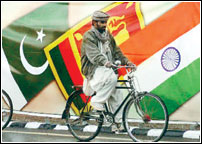 THE two-way trade between Pakistan and India continues to surge, showing a four-time growth in the last five years, despite manybarriers in movement of goods and people.
The bilateral trade swelled from $235.74 million in 01-02 to more than $1 billion last fiscal year. Trade analysts see further volume growth as Pakistan has expanded its positive list of import trade with India that now includes machinery/equipment, raw materials, chemicals and accessories of a number of manufactured items which are in great demand in local market.
Opening of banks in Pakistan and India, resumption of shipping services and an improvement in road and rails transport between the two countries is bound to give a further boost to their bilateral trade.
``Businessmen of India and Pakistan now trade almost 2,000 items in more than 25 categories'', Raees Ashraf Tar Mohammad, a leader of Pakistan Grocers Association said This has built mutual confidence and communication between businessmen of the two countries. We book orders on telephone or on fax and rest of the formalities follow. In the last ten years or so ``not a single dispute'' was reported.”
According to a trade analyst, the share of Pakistan's exports to India in overall exports increased from a mere 0.5 per cent in 01-02 to 1.8 per cent in 05-06. ``This is a six-time increase in Pakistan's exports to India during last five years, a leader of Karachi Chamber of Commerce and Industry said while pointing out that Pakistan's exports to India have increased from less than $50 million in 01-02 to about $300 million in 05-06.
Simultaneously, imports from India into Pakistan too surged from $186.52 million to $802 million, up from 1.8 per cent to 2.8 per cent Pakistan's global imports.
In all, these five years, the balance of bilateral trade remained in favour of India. In the year 2005-06, it rose up to more than $500 million.. This came a rude shock to the Ministry of Commerce in Islamabad.
In July 2006, when the federal commerce ministry issued a notification to implement concessional tariffs under South Asia Free Trade Agreement (SAFTA), India was omitted from the list of Saarc countries. The Indian Commerce Minister, Mr Kamal Nath raised this issue in the Inter Ministerial conference at Khatmandu, giving a veiled threat that India might review the tariff concessions being offered to Pakistan under SAFTA.
``We are not withdrawing these tariff concessions'', said the Indian High Commissioner in Pakistan while replying a query of a businessman at the Karachi Chamber of Commerce and Industry early March. But at the same time, he declared: ``India does have the option to take back all these tariff concessions if SAFTA was not implemented in letter and spirit''. ``We are not applying this option on Pakistan is another matter'', he added.
``Our trade relations with India are based on a positive list of about 1,078 items'', said the Federal Commerce Minister, Humayun Akhtar Khan. This has been well elaborated in Pakistan's Import Policy Order. India wants the most favoured nation (MFN) status which is in fact a WTO issue where India can agitate.
So far as implementation of SAFTA is concerned, the minister said that India can raise this issue bilaterally at the Committee of experts or at the Inter-Ministerial committee level. Pakistan is not happy with non- tariff barriers and overall Indian trade policy. Indian contention is that whatever the non-tariff barriers or other policy issues of their trade, `these are not Pakistan-specific and are meant for global imports''.
But Pakistan has taken a position saying that quite a few of NTBs hurt its imports-- mainly textiles into Indian market. In a detailed rejoinder, Pakistan has filed 26 objections on non-tariff barriers and has mentioned seven instances of para-tariffs that affect Pakistan's imports into India. For example, India has a set of restrictive rules on fabrics in which AZO dyes are used.
Pakistan has banned AZO dyes but has complained that the Indian authorities subject import consignments from Karachi to all such tests which take seven days to three months to complete and the cost is 10 per cent of the value of consignment. ``The complex set of regulations discourage exporters, affect cost competitiveness of exports to India and delay clearance at the customs'', Pakistan’s commerce ministry maintains.
Indian administrative departments and divisions and its various states have an elaborate list of separate rules, regulations, restrictions, conditions, tariff rates for movement of goods which causes uncertainties and delays and discourage exporters and hence serve as non-tariff barriers.
Exchange of these notes between the commerce ministries of India and Pakistan has apparently not affected the bilateral trade so far. Though there have been some concerns in the official quarters in Islamabad on the `yawning trade gap'' with India, trade does not share this view.
It is argued that the imbalance in trade with India may widen further. “India is a close neighbour supply source of textile machinery and equipment'', a local leader of textile industry said. A few local textile industrialists imported Indian machinery via third country-Dubai, Hong Kong or Singapore. They consider these machineries relatively less expensive and more efficient than what they were buying from Japan or European countries.
Another advantage of buying Indian textile equipment and machinery is that engineers involved in installation and trial running do not cost as much as Japanese or European consultants. ``Indian engineers are just a telephone call away and their demand for fees and boarding is not as high as of others'', he said.
Two countries have been helping each other over the last few years to overcoming their shortages of agricultural products. Pakistan supplied chickpeas, pulses, grains and sugar when these were short in supply in India. India supplied onions, potatoes, pulses and other food items. Market report suggests that Indian experts are ready to work out a joint plan to exploit fisheries and export value added fish products.
Engineering sector is one area where Pakistan stands to gain a lot from India. Indian engineering goods exports now exceed $10 billion mark. Pakistan meets its 25-30 per cent requirements of engineering products from imports. India can be a good source of engineering products with freight advantage and relatively easy and quick delivery and after-sales service
In automobile India has emerged as a major component supplier to some of the world's largest auto players like General Motors, Volvo, Toyotas and Hondas and is reported to be manufacturing 275 auto parts, many of which are relevant to Pakistan.
In 1991, the intra-Saarc trade as a proportion of trade with rest of the world was three per cent. It increased to only 4.7 per cent by the year 2004. Intra- regional trade in South Asia is only 0.8 per cent of their GDP.
This slow growth is being attributed to unending tensions between the political leadership of India and Pakistan.






























