0
0

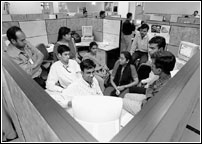 ONE of the major criticisms levelled against India’s buoyant information technology sector is that there is nothing high-tech about the work that it does. Many critics dismiss IT service providers as white-collared sweat-shops, doing routine and boring work for western clients.
Similarly, the ITES (IT enabled services) sector, which includes Business Process Outsourcing (BPO) outfits and call centres, is rubbished as low-tech tasks that developed economies are increasingly passing on to low-wage countries like India. However, the fact remains that the IT and ITES sectors earn huge revenues for the country, and are continuing to grow at a frenzied pace.
According to the National Association of Software and Services Companies (NASSCOM), the Indian IT industry is on course to reach its export target of $60 billion by 2010. For financial year 2006-07, which got over on March 31, the industry’s exports will top $31 billion, a 32.6 per cent jump over the previous year’s figures.
The industry has ballooned over the past 10 years, with revenues growing nearly 10-fold: from $4.8 billion in 1997-98, to $47.8 billion in the just-concluded fiscal. The industry’s contribution to India’s gross domestic product (GDP) has risen from 1.2 per cent to 5.4 per cent in the last 10 years. The industry also employs over 1.6 million skilled professionals.
According to Kiran Karnik, president, NASSCOM, consistent growth – in both the export and domestic segments – reaffirms the confidence in the industry by clients around the world. However, the industry is facing severe challenges, including the gradual withdrawal of tax-breaks and other incentives by the government, the strengthening of the Indian currency, and the sharp rise in salaries.
Karnik believes that small and medium players in the industry will be badly hit because of reduced government support and imposition of taxes. The government recently slapped a minimum alternate tax (MAT) on the industry, besides imposing fringe benefit tax (FBT) on employee stock options, especially hurting the industry.
According to Karnik, higher costs for leased space will also adversely affect small and medium enterprises, who do not have their own premises. He warns that all these factors will make India a less attractive IT destination, and international firms may opt for other places including China, South East Asia and Eastern Europe.
WORRIED over the fact that many international companies are bypassing India and heading for other destinations in South East Asia and the Far East for setting up manufacturing units, the Indian government last month came out with its much-awaited policy on semiconductors.
International giants including Intel wary of waiting for the government’s policy have opted for other locations. While last month the government unveiled its semiconductor policy, international majors like Intel and Texas Instruments decided not to set up fabrication (fab) units in India, and take advantage of the new incentives.
Intel recently announced plans to set up a $2.5 billion computer-chip factory in China, its first in Asia. This, despite India’s IT and Communications Minister Dayanidhi Maran claiming that he would restart negotiations with Intel about setting up its fab unit in the country.
Several chip makers from around the globe have been lured by the hefty incentives that China offers them – including a 100 per cent tax break for the first five years and a 50 per cent break for the next five years. Intel’s investments in China will add up to $4 billion.
Texas Instruments, which was one of the first American hi-tech firms to open shop in Bangalore in the 1980s, has also ruled out setting up a manufacturing unit in India, though it will continue to focus on research and product development. The company does not believe India is an ideal manufacturing location.
Most chip manufacturers favour other Asian nations, including Japan, Taiwan, South Korea, and now China. Even Vietnam is considered a better place for manufacturing chips and other hi-tech products.
But a few companies have announced plans for manufacturing units in India. They include Infineon Technology AG of Germany, which has signed up joint venture with Hindustan Semiconductor Manufacturing Corporation, promoted by US-based Indians, for a $4 billion project.
Dr Deven Verma, chairman, Hindustan Semiconductors points out that India will emerge as “a destination of choice” for hi-tech manufacturers. Demand for semiconductors is likely to touch $36 billion by 2015. SemIndia is investing $3 billion in a semiconductor fabrication unit in Hyderabad, in association with American major AMD.
Maran had announced the new semiconductor policy, offering capital subsidy for companies setting up chip manufacturing units in India. He is confident that India would attract over $6 billion in investments from international chipmakers over the next three years.
The government is offering a 20 per cent capital subsidy for units coming up in special economic zones (SEZs) for a 10-year period, and 25 per cent for those setting up units outside these zones. However, the federal government has virtually frozen its SEZ policy, following politically-instigated opposition to these facilities in West Bengal, Maharashtra and other states.
THOUGH India has not attracted many chipmakers, it has become a hub for chip designers and R&D units. About 200 semiconductor companies have opened offices in the country, especially in cities like Bangalore and Hyderabad.
The government of the southern Indian state of Karnataka – of which Bangalore is the capital – is eager to set up three SEZs focussed on semiconductors. A 10,000-acre ‘Knowledge City’ that is coming up near Bangalore will be dedicated to the semiconductor industry, especially chip designing and R&D.
Bangalore has today emerged as ‘chip capital’ of India, and about 70 firms have a base in the city. In fact, Bangalore now ranks next only to Silicon Valley in California, in terms of the number of VLSI (very large scale integration) engineers who are available there. About 15,000 engineers, who help in designing chips, operate in Bangalore; there are about 20,000 in Silicon Valley, and a mere 2,000 in Cambridge in the UK, the other major international chip design hub.
Industry analysts expect Bangalore to even overtake Silicon Valley in a few years in terms of the work that is done on chip designing. Many of the designers in California are from India, and there has been a reverse brain-drain of sort of late, with substantial numbers returning to India, and starting their own outfits in Bangalore.
But as in many other areas, India is strong in outsourced design services – which is designing chips for clients – and not so much in original designing.
Other Indian cities too are hoping to lure international chip firms. The West Bengal government, for instance, is laying out the red carpet for semiconductor firms. Dr Debesh Das, the state’s IT minister, says that the state will set up an IT park to attract VLSI and other chip design firms.
A 100-acre VLSI facility will be built at Kharagpur, which is well known for its Indian Institute of Technology (IIT). The government also wants the private sector to partner it in setting up an ‘India Design Centre,’ at the Electronics Complex in Salt Lake near Kolkata.
Noida, on the outskirts of Delhi, has also begun attracting international majors. Freescale Semiconductor Inc, a US-based chipmaker, recently opened a 300,000 sq ft design centre in the satellite city. The company, which last year set up a 100,000 sq ft design centre in Bangalore, has invested about $50 million in India.
Clearly, despite the enormous infrastructure-related problems in cities like Bangalore and Kolkata, international majors are still keen on setting up design and R&D facilities in India.